

























































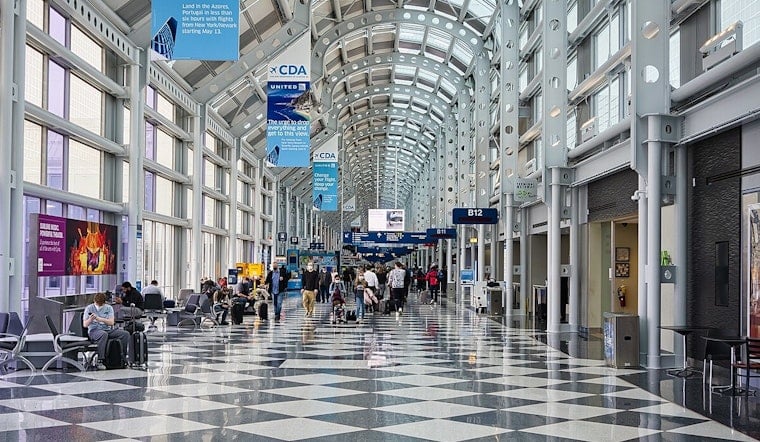
U.S. Navy Petty Officer Rachel Christy walked through Chicago's O'Hare International Airport this month to be with her daughter for her final cleft palate surgery, a homecoming made possible not by military orders but by a nonprofit that trades volunteer hours for donated airline miles. Christy has been stationed in Pensacola, Florida, since May 2025, putting hundreds of miles between her and the family she was finally able to embrace at the gate.
The nonprofit behind the reunion, Miles for Military, allows everyday people to donate unused airline miles to active-duty service members who would otherwise have to cover the cost of personal travel themselves, according to CBS Chicago. Christy, a U.S. Navy petty officer, described the moment of reuniting with her family as surreal, saying it's surreal because her family has been apart for so long. The station's report notes that Miles for Military has now flown 1,000 enlisted service members home and has set a goal of reaching 5,000 flights by the end of 2026.
How Volunteer Hours Become a Plane Ticket
Miles for Military was founded in 2022 by Maureen Byrne, a Marine mother who started the organization after paying nearly $900 for a single holiday flight home for her son, according to the Dorchester Reporter. To qualify for a flight like the one that brought Christy home, active-duty service members in ranks E-1 through E-4 must complete at least 25 volunteer hours with an approved 501(c)(3) nonprofit or community organization and apply at least a month before traveling, per Miles for Military's published guidelines.
The organization caps its ticket grants at $1,000 per application for economical, round-trip flights within the 50 U.S. states and territories, a limit designed to stretch donated miles across as many junior service members as possible. That model exists because of federal law: Public Law 108-375, Section 585 of the 2005 Defense Authorization Act established the framework allowing nonprofits to collect and redistribute donated frequent flyer miles to military families, per the federal statute. A similar national effort, the Fisher House Foundation's Hero Miles program, partners with airlines including United and Delta to distribute between 1.5 million and 2.5 million donated miles per week, though that program focuses primarily on combat-injured, ill, or hospitalized service members and their families.
Why Junior Enlisted Families Feel the Squeeze
Christy's situation reflects a broader financial reality for junior enlisted troops. Across all branches, roughly 500,000 active-duty junior enlisted personnel are generally required to cover their own travel costs when taking non-official personal leave, since Department of Defense funding does not pay for ordinary leave travel. In 2026, basic monthly pay for junior enlisted service members ranges from $2,407 for an E-1 to between $3,142 and $3,815 for an E-4, following a 3.8% military pay raise that took effect January 1.
That follows a cumulative 14.5% pay increase junior enlisted troops received in 2025 to address inflation and financial stress, after military family research found more than a quarter of junior enlisted families experiencing food insecurity, according to the American Armed Forces Mutual Aid Association. Against that backdrop, a single last-minute flight home can eat up a meaningful share of a junior sailor's paycheck, which is why programs converting volunteer service into travel assistance have found an audience among military families.
A Multi-Year Medical Journey Reaches Its Final Step
The surgery awaiting Christy's daughter caps a process that typically spans years. The Centers for Disease Control and Prevention reports that approximately 1 in every 1,600 babies born in the United States has a cleft palate alone, a birth defect that frequently requires multiple corrective surgeries stretching from infancy through childhood, according to the CDC. That staggered surgical timeline is part of why being present for a final procedure carries such weight for a parent stationed far from home.
Christy landed at O'Hare, where two newly renovated gates opened in Terminal 3 this month as part of the airport's ongoing multi-million dollar modernization effort, according to CBS Chicago's coverage of the airport. For Christy and her family, though, the terminal upgrades were incidental to the moment itself: a mother finally back on the ground in the city she calls home, in time for the surgery that closes out years of treatment for her daughter.





