

























































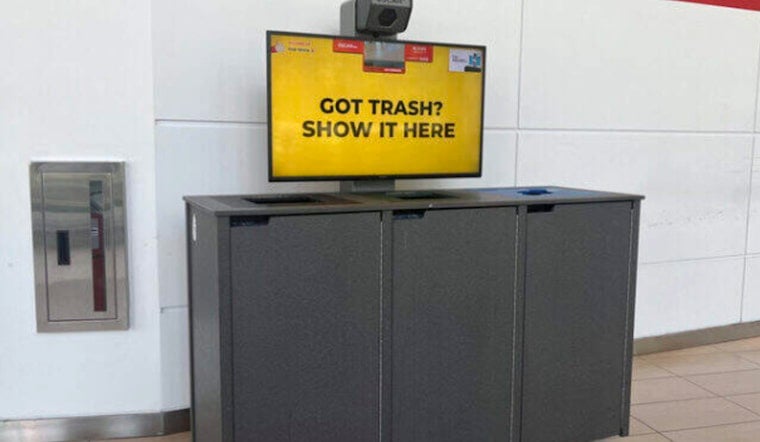
Two AI-powered trash cans that Coca-Cola bought for NC State University are sitting in a back room instead of guiding students at Talley Student Union, after the machines repeatedly gave confusing or wrong advice about where to toss their garbage. The university installed the pair of so-called Oscar sorters in the student union, which sees more than 15,000 visitors a day during the school year, but pulled them before students returned to campus this fall.
The removal came down to consistent sorting-recommendation errors, according to the News & Observer, which reported that the machines failed to distinguish compostable spoons from recyclable ones and struggled to identify different kinds of coffee cups. Jennifer Gilmore, director of marketing and communication for NC State's retail and hospitality division, said the school must first determine the exact information the AI needs to make correct bin recommendations. NC State staff are now working with the sorter's manufacturer to recalibrate the machines, though the university has no specific target date for bringing them back.
How the Oscar System Works
The bins are branded Oscar, part of a platform built by Vancouver-based startup Intuitive AI, which launched the technology in 2017 to eliminate human error and contamination at public disposal bins, according to Be Giant. The sorters use cameras to capture a user's hands as they hold up an item, then flash a recommendation on a screen for which bin it belongs in; if a person's face gets caught in frame, the system blurs it out. Each unit is trained on NC State's own trash stream and, once back online, is expected to send usage analytics and metrics back to the university, per the same account cited by the News & Observer.
Despite the AI processing and camera hardware, the sorters draw less power than a hair dryer, according to a company statement referenced in that reporting. They also aren't cheap: NC State pays $429 per can per month to keep them running, a cost covered under the university's broader arrangement with Coca-Cola.
Coca-Cola's Role in Funding the Pilot
Coca-Cola purchased the Oscar sorters for NC State and funded their hardware, setup costs, and a two-year AI subscription, paying $20,600 for the pilot program, per the News & Observer's reporting. The gift flows out of NC State's beverage pouring rights agreement with Coca-Cola, a relationship that dates back to 2008 and was renewed in August 2025 through a new 10-year deal extending through July 31, 2035, according to NC State University. That agreement includes investments in student fellowships, internships, and campus sustainability initiatives, and Coca-Cola funding at NC State has also included Earth Week activities.
The soda giant's involvement in campus waste efforts predates the Oscar sorters. NC State's Zero Waste Wolfpack athletic program, backed by Coca-Cola and waste haulers, diverted nearly 30% of gameday waste during a single football season at Carter-Finley Stadium, recovering more than 96,000 pounds of recyclables and compostables, per NC State University records from 2020.
Why NC State Wants Better Sorting
The push for smarter trash cans traces back to hard numbers from NC State's own campus. A 2026 waste audit by the university's Waste Reduction and Recycling office found that 63% of material sent to the landfill from Talley Student Union could have been recycled or composted, with compostable items alone making up 45% of that landfill stream, according to NC State University. That data helps explain why the student union, rather than another campus building, became the test site for the AI sorters, whose back-room storage keeps them away from public view while recalibration continues.
The audit numbers feed into a bigger institutional goal. NC State's Sustainability Strategic Plan sets a target of reaching 70% waste diversion campuswide through source reduction, expanded recycling, and composting, a goal also supported by the university's Zero Waste Workplace program, per NC State University. Regionally, the stakes are rising too: Wake County's South Wake Landfill, which takes in roughly 500,000 tons of waste a year, is projected to reach full capacity sometime between 2040 and 2045, according to Wake County Government, pushing local officials to look harder at long-term disposal alternatives.
A Recycling Problem Bigger Than One Campus
NC State's stumble fits into a well-documented national pattern. The EPA puts the national municipal recycling rate at roughly 32%, with contamination from non-recyclable items remaining a chief obstacle to material recovery, according to the U.S. Environmental Protection Agency. Much of that contamination comes from what researchers call wishcycling — tossing non-recyclable items into recycling bins with good intentions — which a 2023 MIT Science Policy Review study found causes 16.9% of collected materials to be pulled as contaminants locally and another 13.9% to be rejected once they reach recovery facilities.
Oscar Sort has been adopted at more than 30 North American colleges and universities, including Arizona State University, MIT, the University of Toronto, the University of Wisconsin–Madison, and the University of Guelph, according to the University of Guelph. The same system has also shown up well beyond campuses, with units installed at Seattle-Tacoma International Airport, New York's JFK Airport, and San Francisco's Ferry Building, per PCMA. For now, NC State says it plans to return its own Oscar sorters to use at Talley Student Union in the coming weeks, once the recalibration work with the manufacturer is done.





