

























































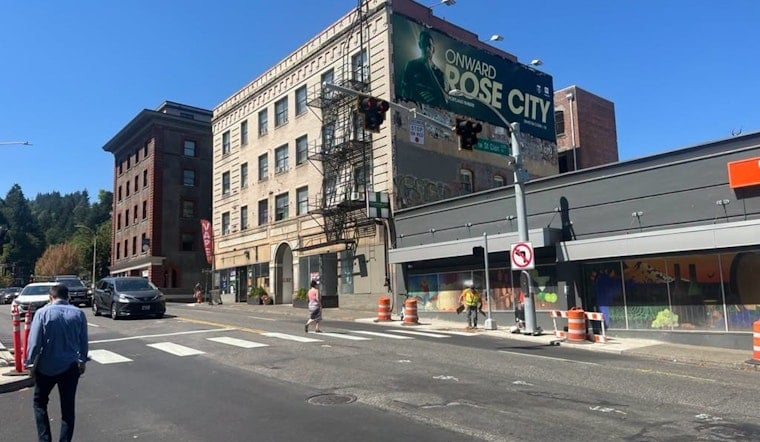
A new pedestrian hybrid beacon flipped on this week at West Burnside Street and SW St. Clair Avenue, giving people on foot their first safe way to stop traffic on a stretch of the busy corridor that had gone without a signal for roughly 1,000 feet. Pedestrians began using the beacon as soon as it was activated on Wednesday, according to the Portland Bureau of Transportation, closing a gap between existing signals at 21st and 23rd avenues that had long forced walkers to dash across multiple lanes of traffic on their own.
The beacon marks the completion of the W Burnside Street at St. Clair Avenue Pedestrian Crossing Project, a $1.1 million effort combining state, federal, parking-revenue, and local tax dollars, according to Portland's transportation bureau. The device, known as a pedestrian hybrid beacon, stays dark until a pedestrian presses a button to request a red stop signal, a design the Federal Highway Administration has found can cut pedestrian-involved crashes by up to 69% and total roadway crashes by 29%. Along with the new signal, PBOT rebuilt curb ramps to current accessibility standards, added a curb extension to shorten the crossing distance while keeping the narrow sidewalk clear of equipment, and installed enhanced streetlighting. A new left-turn restriction from SW St. Clair Avenue onto West Burnside now protects crosswalk users from turning vehicles as well, according to PBOT's Facebook post announcing the opening.
Funding Drew From Grants, Parking Fees and Cannabis Taxes
The project leaned on an unusual mix of revenue streams. Grant funding came through the Oregon Department of Transportation's All Roads Transportation Safety Program, with matching support from the NW Parking District and from Vision Zero cannabis tax revenue, per PBOT. That cannabis funding traces back to a 3% local tax on recreational marijuana sales that Portland voters approved in 2016, which Oregon Public Broadcasting reports has become a steady source of local matching dollars for the city's Vision Zero safety program.
West Burnside sits within Portland's High Crash Network, a set of just 30 corridors and 30 intersections that make up only 8% of the city's street mileage but accounted for 67% of traffic deaths between 2020 and 2024, according to ThatCarHitMe.com. The city has poured more than $193 million into those high-risk corridors since 2017, the same analysis notes, and citywide traffic fatalities fell to 39 in 2025, down from a record 69 in 2023 and the lowest count since 2018. Pedestrians still made up 51% of those deaths, the report found.
A Fatal Crash and a Fight Over Repaving
The new crossing also connects riders to a high-ridership TriMet bus stop served by lines 15, 18, and 20, linking the NW District and Goose Hollow neighborhoods to commercial destinations along Burnside. The stretch has proven dangerous before: in November, a 26-year-old driver was killed on West Burnside when a vehicle crashed into a tree on the eastbound shoulder, a crash Hoodline previously reported that the Portland Police Bureau investigated.
Even as the beacon came online, PBOT crews began updating curb ramps along West Burnside from 15th to 20th avenues on Thursday, work spanning six blocks that will meet accessibility standards before paving crews return in the fall to repave the impacted areas, per PBOT. But the concurrent repaving has drawn pushback from the Better Burnside Coalition, a group of local advocates who urged city officials this month to pause the resurfacing work. The coalition warned that repaving without a broader street redesign could actually increase driving speeds on a corridor already flagged for high crash rates, noting that narrow sidewalks and fast traffic remain unaddressed even with the fresh pavement, according to the Northwest Examiner.
Supply Chain Delays and Underground Surprises
Getting the beacon activated took longer than planned. PBOT had originally expected to finish the signal work earlier in the year, but crews had to pause installation between May and August while waiting on mast-arm equipment, since only one domestic manufacturer produces traffic signal mast arms that meet industry standards, the bureau said. Early excavation work also hit complications when crews accidentally damaged a sewer main and cut a private fiber-optic line underground, requiring emergency repairs coordinated with Portland's Bureau of Environmental Services before concrete could be poured.
The delays and detours reflect the broader strain on PBOT's budget. The bureau warned in February that more than half of Portland's street lane miles are in poor or very poor condition, while it faces an estimated $34.6 million shortfall through fiscal year 2027 due to declining gas tax revenue and lost federal grants, as Hoodline has reported. Major arterials like Burnside have suffered some of the worst pavement degradation, leaving PBOT to juggle safety upgrades like the St. Clair beacon against a mounting maintenance backlog across the city.





