

























































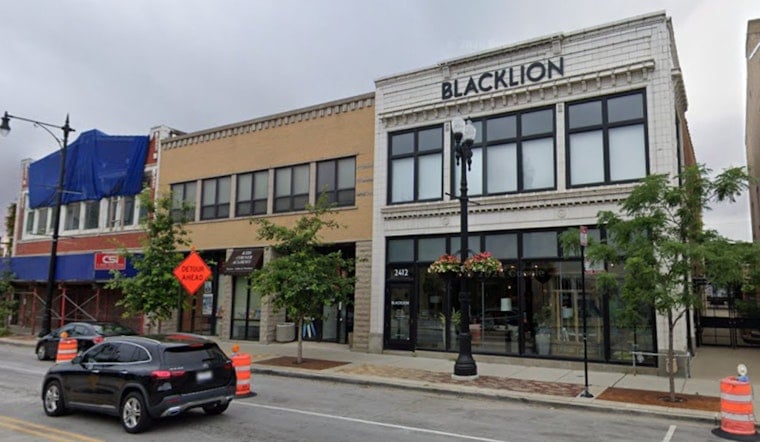
Tucked above a home décor showroom on Chicago's Motor Row, a new museum is asking visitors to look twice at the Kellogg's box in their pantry. The Chicago Brand Museum, which opened just after Memorial Day on the second floor at 2412 S. Michigan Ave., houses a sprawling collection of consumer packaging, logos, bottles, tins, and grocery-store displays that its founders spent decades gathering. Married couple Fred Richards and Elisabeth Emory built the 5,000-square-foot loft space themselves, using their own money, and now offer tours led personally by Richards.
As reported by the Chicago Tribune, Richards started collecting brand packaging in the 1990s while working on a dog-food account, and he came to Chicago in 1995. He has since designed packaging for Duracell, Old Spice, Swiss Miss, Swarovski, Pepto-Bismol, Starburst and Slim Jim, and he is credited with designing the most recent version of the Kellogg's name. Emory, who attended the School of the Art Institute of Chicago, has worked on Sharpie, Aldi and Juicy Fruit. The two met while working at competing design firms handling the same Mars Wrigley client, and they eventually rethought the Skittles rainbow together — Mars Wrigley later trademarked the redesigned rainbow globally, changing its curl from a downward frown shape to an upward smile, according to the Tribune's reporting.
Fifteen Years in the Making, Self-Funded From Start to Finish
The museum represents what the Tribune describes as a 15-year dream for the couple, dating back to 2011. They did not apply for grants, did not seek loans, and never approached corporate investors — the entire project was funded with their own money, per the Tribune's account. Richards told the paper their investment was easily in the low six figures, and he has insured the collection for six figures as well, a figure that excludes the museum's Andy Warhol pieces.
Emory owns the Blacklion luxury gift store on the building's lower level along with Richards, and visitors reach the museum by walking through that showroom. The pair has said the museum's total holdings run close to 15,000 to 20,000 pieces by Richards' own estimate, though the Tribune also reports the collection now numbers over 40,000 items, with nearly 20,000 on display at any given time. Emory told the Tribune that visitors initially see the exhibits as simply old packaging before gradually recognizing individual pieces as art in their own right.
From Warhol's Brillo Boxes to a Beijing Toy Gun
Among the collection's centerpieces is a tower of Kellogg's and Brillo boxes made by Warhol, displayed alongside more everyday artifacts: every iteration of the Tide box dating back to the original from 1947, an old Skittles wrapper, and packaging from Coca-Cola, M&Ms, Cornish Mint Humbugs, Brillo and Veuve Clicquot. The museum also displays plastic toy tommy guns once marketed to children in Beijing, along with multiple variations of the game Connect Four.
Some of the more curious artifacts trace how mascots and marketing evolved over decades. The Secret Chicago documented original 1952 instruction sheets for Mr. Potato Head from an era when the toy was sold only as face pieces and pins, requiring kids to supply an actual potato from the kitchen — Hasbro did not introduce a plastic potato body until 1964. Per the Tribune, the Coco Krispies mascot was formerly an elephant, and Sugar Frosted Flakes was once represented by ice pixies before Chicago advertising giant Leo Burnett changed the mascot to a Bengal tiger. Burnett's Chicago agency is also behind the Pillsbury Doughboy and the Keebler Elves, brand mascots that helped cement the city's role as a consumer packaged goods hub, according to Fueler.
The museum has also folded in modern technology, according to Secret Chicago's reporting: visitors can scan glass exhibit cases with a phone to pull up vintage television commercials and archival product history alongside the physical displays. One rare artifact tied to Chicago's own industrial history is an unopened pack of Juicy Fruit gum made for the 1893 World's Columbian Exposition, where founder William Wrigley Jr. first introduced the brand as a promotional freebie before it became his primary business, per the same outlet.
A Trash Pile as Art — and a Warning
Not everything on display is meant to be admired. The museum includes a collection of 1,810 pieces of household trash that Richards and Emory collected themselves over a full year, an exhibit meant to confront visitors with the volume of packaging waste a single family generates. The display draws on a 12-month waste audit that analytics firm Scrapp conducted on Richards' own household garbage, which found that 72% of discarded food packaging by weight was recyclable, while beverage packaging made up more than half of the family's total plastic waste, according to Scrapp's research.
That same yearlong experiment showed that deliberate consumer choices and material swaps could cut a single family's plastic footprint by as much as 82.4%, findings Richards presented to packaging industry executives at Pack Expo International in 2024, as reported by PKN Packaging News. Richards has said the museum as a whole reflects consumer behaviors and tastes, and that its aim is to blend art appreciation, marketing history and nostalgia in one space — the household trash exhibit adds a sharper edge of environmental accountability to that mix.
Housed in Chicago's First Cadillac Showroom
The museum's setting carries its own history. It occupies the top floor of what was Chicago's first Cadillac dealership building, designed by the architecture firm Jenney, Mundie & Jensen, according to the museum's own account of its location. The building sits on Motor Row, a stretch of South Michigan Avenue that the City of Chicago designated a Chicago Landmark on December 13, 2000, and that was added to the National Register of Historic Places in 2002 as the largest and most intact early automobile row in the country — at its peak, the district housed 116 different automobile makes.
The museum is also located beside the former Chicago Defender and Illinois Automobile Club buildings and near the former Chess Records recording site, and it displays the wooden table once used by Chicago Defender editors. The 2400-2412 S. Michigan Ave. complex won the 2018 Landmarks Illinois Richard H. Driehaus Foundation Preservation Award for Rehabilitation after a restoration converted the long-vacant former Cadillac showroom and Defender building into event space, per Landmarks Illinois. Today the Chicago Brand Museum is also used for advertising meetings and workshops, and it is open Thursday through Sunday with $25 admission.
Hoodline has previously covered preservation debates further down Motor Row, where the former E2 nightclub site was demolished in 2024 as its owner pursued plans for memorial housing. The Chicago Brand Museum's arrival adds a very different chapter to the same historic corridor — one built not around tragedy, but around the everyday packaging that lined American shelves for more than a century.





