

























































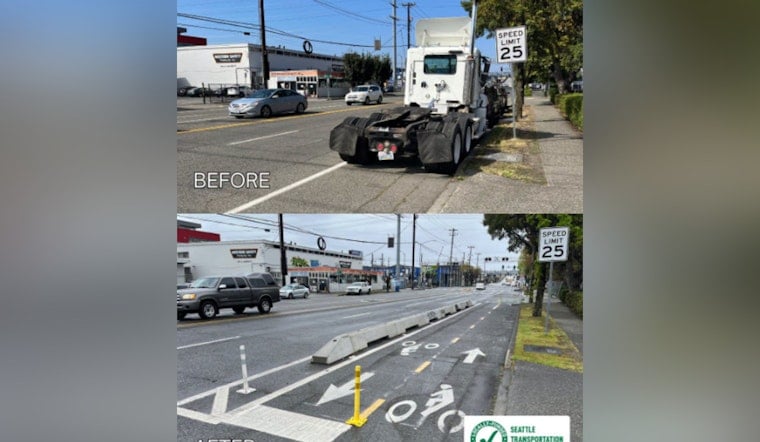
Crews with the Seattle Department of Transportation have finished a new stretch of protected bike lanes along S Lander St, adding fresh road markings, arrows, and turn boxes that link South Seattle's bike routes straight into Downtown. The 25 mph street now carries signage noting the work was paid for through the locally-funded, voter-approved Seattle Transportation Levy, and the finished corridor is meant to help people biking and scooting move between SODO, Downtown, Georgetown, and beyond.
According to a Seattle Department of Transportation post, the Lander St segment is the northernmost piece of a larger effort called the Georgetown to Downtown Safety Project, which is threading protected bike lanes along Airport Way S, S Alaska St, and 6th Ave S to stitch South King County's bike routes into the city core. The project sits at a notoriously tricky junction: 6th Ave S and S Lander St see heavy industrial truck traffic, so SDOT built in two-stage turn boxes and concrete barrier protection specifically to keep cyclists separated from turning freight vehicles, a design choice the agency says came directly from feedback submitted by local bike advocates.
A Corridor Built Around Freight Trucks
Not every stretch of the new route got the same treatment. On the east side of 6th Ave S near Lander, SDOT opted for flexible plastic posts instead of permanent concrete barriers, because Seattle City Light is scheduled to dig up that section of road within two years of the project wrapping up. It's a small detail, but it underscores how much coordination goes into threading bike infrastructure through one of the city's busiest industrial zones.
That difficulty is exactly why SODO has long been considered one of the toughest places in Seattle to get around without a car. Wide, freight-heavy arterials like 4th Ave S and 1st Ave S have historically lacked dedicated cycling infrastructure, and the area has seen multiple fatal bike crashes in recent years, according to The Urbanist. Cascade Bicycle Club put the Georgetown-to-Downtown connection on its list of the city's top five highest-priority safety projects starting back in 2021, citing the severe hazards posed by commercial truck traffic in the corridor.
Linking Into a Growing South Seattle Network
The new lanes tie directly into the southern end of the SODO Trail, an off-street path that runs alongside Sound Transit's Link Light Rail line toward Downtown, giving cyclists a continuous, mostly protected route north. Heading south, the connection links up with the 1.2-mile Georgetown to South Park path that SDOT finished in late 2025 after years of advocacy from groups including Duwamish Valley Safe Streets, per the South Seattle Emerald's reporting.
Lander St's transformation didn't start with bike lanes. SDOT previously spent $100 million building the S Lander St Bridge, which opened in October 2020 and separated car, pedestrian, and bike traffic from BNSF rail tracks that had once closed the street for more than 4.5 hours a day and were linked to three pedestrian deaths between 2011 and 2020, according to the Port of Seattle. The new bike connection represents the next chapter in turning that same stretch of road into a safer multimodal corridor rather than a barrier between neighborhoods.
More Change Still Coming
The funding for this latest work traces back to Seattle voters, who approved the $1.55 billion Seattle Transportation Levy in November 2024 with 66.5% support, replacing the earlier 2015 Move Seattle Levy as the city's main source for bike, pedestrian, and paving investments, per Ballotpedia. Hoodline previously reported on the levy's citywide rollout earlier this year.
Even with the ribbon-cutting moment on Lander St, SDOT's work here may not be permanent. Sound Transit's West Seattle Link Extension is planned to bring a new overpass structure and a relocated station near S Lander St, targeted no earlier than 2027, which would eventually require reconfiguring or replacing parts of the bike facilities SDOT just installed. For now, though, cyclists moving between Georgetown, SODO, and Downtown have a safer, more direct route than they've had in years.





