

























































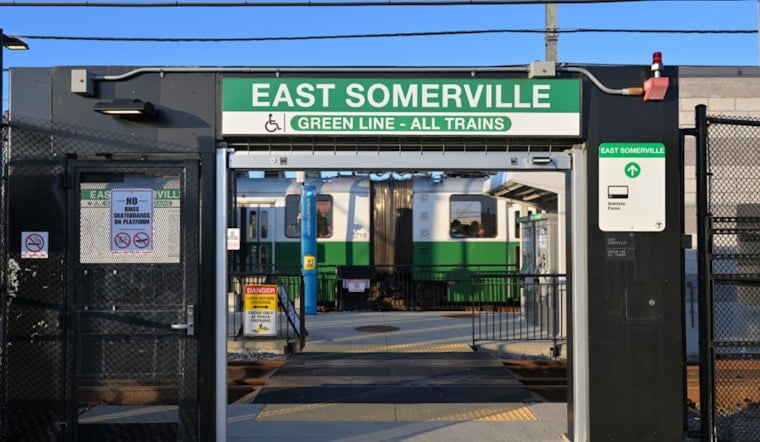
Newly surfaced video shows the exact moment an out-of-service MBTA Green Line trolley was struck by a speeding train at East Somerville Station in the early morning hours of February 9, 2025, a crash that injured six people and caused an estimated $6.6 million in equipment damage. The footage, obtained by a source and first aired this week, offers the clearest public look yet at a collision that had previously been described only through federal investigative documents and eyewitness accounts.
The video was obtained by WCVB, whose NewsCenter 5 team reported that the station had previously been denied access to the footage through official records requests before a source came forward with the clip. Reporters Phil Tenser and Brittany Johnson detailed how the westbound in-service train, which had already made three previous stops without incident according to the National Transportation Safety Board, struck a stationary two-car train that was parked at the station awaiting routing into the MBTA's Inner Belt Yard.
According to the NTSB's preliminary report, the striking train was traveling roughly 32 mph in a 25-mph zone when it ran past a red stop signal and continued into a 10-mph zone before the impact, which occurred at 12:22 a.m. in snowy, 26-degree conditions. The collision damaged four light rail cars and derailed one car on each train, with the MBTA providing the $6.6 million damage estimate to federal investigators. MBTA officials said at the time that they agreed with the facts established in the NTSB's preliminary findings.
Six Hurt, Operator No Longer With the Transit Agency
All six people injured in the crash — two passengers and four MBTA crew members — suffered non-life-threatening injuries. Four operators were taken to local hospitals, while one passenger was admitted to Massachusetts General Hospital for a neck injury, according to CBS News. The operator of the striking train was taken out of service following the derailment and no longer works for the MBTA.
The East Somerville crash was not an isolated failure. It came just four months after another Green Line incident on October 1, 2024, when an eastbound train carrying 50 passengers entered a 10-mph zone at 36 mph, ran a double red signal, and derailed at the Red Bridge interlocking near Lechmere Station, injuring seven people, per the NTSB. Hoodline has previously reported on newly released footage from that earlier derailment, which also occurred on newly opened Green Line Extension trackage.
A 16-Year Wait for Collision Prevention Technology
The pattern of speed and signal violations on the Green Line traces back further than either recent crash. Federal regulators with the NTSB first formally recommended an automated collision prevention system for the line in 2009, following a fatal 2008 rear-end crash in Newton that killed a train operator who had run a red signal at 38 mph, and a separate 2009 collision near Government Center that injured 49 people, according to CommonWealth Beacon. Sixteen years later, the Green Line remained the only MBTA light rail line lacking full automatic train protection.
Sixteen days after the East Somerville crash, the MBTA Board of Directors approved a $113 million contract with California-based Piper Networks to deploy the Green Line Train Protection System, canceling a previous $83 million contract with German firm BBR over lack of progress, WBZ NewsRadio reported. The new system is designed as a two-phase rollout: the first phase installs audible and visual alerts across the entire fleet that warn operators when they come too close to another train or exceed the speed limit, while the second phase's automatic braking technology will only be retrofitted on newer Type 9 and future Type 10 trains, since older Type 7 and Type 8 cars are slated for retirement, according to the MBTA.
State Regulators and a Legal Fight Over the Technology
Beyond the federal investigation, the Massachusetts Department of Public Utilities opened a parallel state safety probe after the crash and directed the MBTA to draft a written Corrective Action Plan addressing the structural crashworthiness of Type 7 light rail cars. By June 2026, MBTA crews had finished installing all trackside wayside infrastructure — including power cables, messenger cables, and anchors — for the new protection system across the Green Line's B, C, and E branches, work that included street-level installation along Huntington Avenue.
The vendor behind that infrastructure is also facing legal scrutiny. In May 2025, competitor Metrom Rail LLC filed a patent infringement lawsuit against the MBTA and Piper Networks in federal district court, alleging that Piper's Ultra Wide Band collision avoidance system copied Metrom's patented train-positioning technology. As of December 2025, the case remained pending in the U.S. District Court for the District of Massachusetts.
Hoodline reported on the crash's aftermath as it unfolded, from the initial hospitalizations to the multi-day service suspensions the MBTA later imposed to install the new safety infrastructure. The newly surfaced video does not change the established timeline of events, but it does give riders a firsthand look at a collision that, more than a year later, is still driving the transit agency's safety overhaul.





