

























































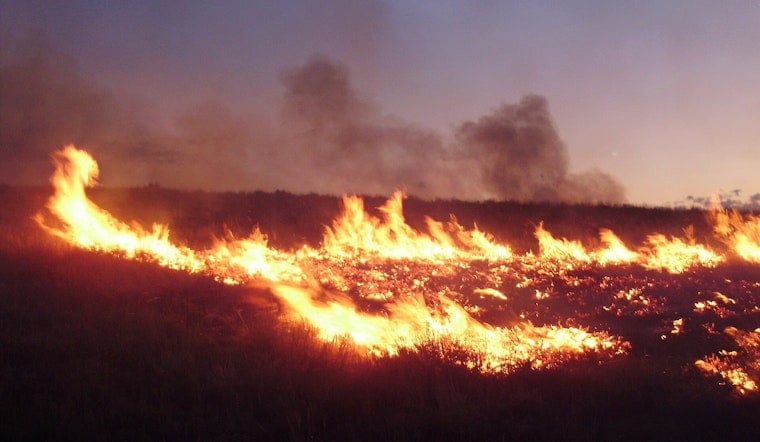
A large wildfire burning near NE 24th Avenue and Robinson Street in Norman forced the evacuation of the city's Vernon Campbell Water Treatment Plant Wednesday, pulling round-the-clock operators away from the facility responsible for the majority of the city's drinking water. Fire crews were still responding to the blaze as of Wednesday evening, and the size of the fire remained unclear.
According to News 9, officials confirmed the water treatment plant was being evacuated because of the fire, though it was not immediately clear whether any other evacuations had been ordered elsewhere in Norman. The station, which described the story as developing, did not report any injuries or damage to structures beyond the plant's proximity to the flames. The Vernon Campbell plant sits at 3000 E. Robinson Street, directly adjacent to the fire's reported location, on a roughly 36-acre property at the intersection of East Robinson Street and 24th Avenue, according to the City of Norman.
A Facility That Rarely Goes Dark
The stakes of pulling staff from the plant are unusual. Built in 1964 and since expanded to treat up to 17 million gallons of water per day, the Vernon Campbell plant serves as Norman's main facility for processing raw surface water, per the city's utilities department. It normally runs 24 hours a day, 365 days a year, with on-site technicians analyzing roughly 220 water samples daily to maintain water quality and pressure across the municipal grid — a level of continuous monitoring that keeps contamination out and pressure steady throughout the system.
Surface water processed at the plant accounts for approximately 60% of Norman's municipal drinking water supply, the city's utilities department notes. The remainder comes from 43 active groundwater wells, which supply about 32%, and wholesale water purchased from Oklahoma City, which makes up roughly 8%, according to Water360. Norman has drawn its surface supply from Lake Thunderbird since the 1960s.
Built-In Backup, But Untested Under These Conditions
Norman does have redundancy written into its water system. The city maintains a permanent consecutive connection with Oklahoma City's Draper Water Treatment Plant, allowing direct inter-utility transfers of emergency wholesale finished water during supply pinches or infrastructure emergencies, according to the Oklahoma Department of Environmental Quality. Whether the city needed to lean on that connection or shift load to its groundwater wells during Wednesday's evacuation was not addressed in available reporting.
The Vernon Campbell site also hosts a multi-megawatt solar photovoltaic array installed in 2022, generating more than 3,000,000 kWh of clean electricity annually as part of Norman's net-zero carbon goals, according to the City of Norman. It was the city's first large-scale renewable energy project. Whether the fire caused any physical damage to the plant's structure or the solar array, and how long the evacuation lasted, remain open questions as the situation develops.
A Dry, Wind-Whipped Summer Sets the Stage
Wednesday's fire did not erupt in a vacuum. Central Oklahoma has been gripped by a severe flash drought in recent weeks, with abnormally dry conditions expanding across 95.57% of the state in a single week, prompting neighboring Oklahoma County to declare a 14-day burn ban earlier this month. Persistent triple-digit heat has accelerated the drying of vegetation across the region.
The dry conditions follow months of warnings from local officials. The Norman Fire Department issued public safety advisories in January flagging heightened wildfire risk and outlining the city's permit requirements for open burning. The following month, the National Weather Service office in Norman issued Red Flag Warnings for central Oklahoma amid gusty southwest winds up to 40 mph and humidity levels dropping into the teens — the kind of fire weather that frequently triggers critical alerts across Cleveland and surrounding counties. Just a day before Wednesday's fire, a $1.7 million Norman mansion burned to the ground in a separate blaze that sent flames shooting some 90 feet into the sky.
The corridor where Wednesday's fire broke out also carries broader significance for Norman's water system. Under the city's AIM Norman infrastructure master planning initiative, municipal subcommittees have evaluated water main pressure improvements along the East Robinson Street and 24th Avenue corridor, which serves as a primary trunk line for water distribution across eastern Norman. This story is developing, and Hoodline will update it as more details become available.


