

























































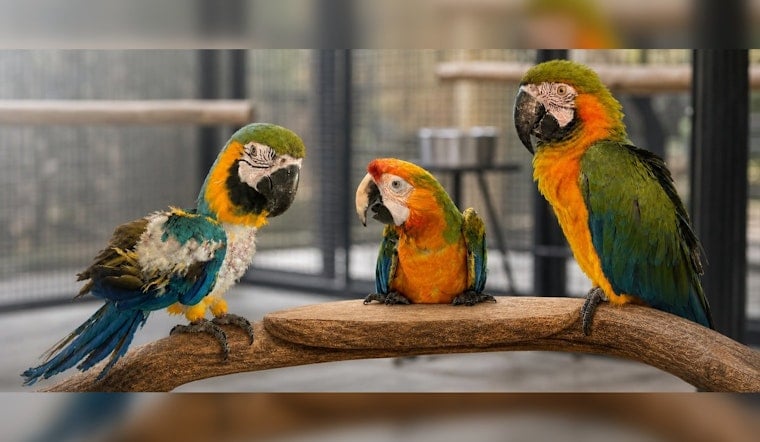
Three female macaws are recovering after being pulled from severely undersized cages in North Georgia, where investigators found ammonia fumes so strong that rescuers had to wear N95 masks to enter the property. One of the birds is now unable to use her right foot or perch correctly, and another resorted to severe self-mutilation before she was removed from the property on July 30.
The rescue was led by the Georgia Department of Agriculture Law Enforcement Division, with help from The Georgia Aviary, a Marietta-based nonprofit that runs a volunteer rescue and rehabilitation network for exotic birds, according to Atlanta News First. The property also contained 18 large dogs, per the same report. In a public statement about the operation, The Georgia Aviary confirmed its role in the seizure but said specific details about the county, address, and suspect were being withheld to protect the active investigation.
Underweight, Injured, and Living in Filth
The smaller of the three macaws, a hybrid, was found visibly underweight and has an uncertain outcome, according to Atlanta News First's reporting on statements from The Georgia Aviary. Michael Bautsch, founder and CEO of The Georgia Aviary, said the birds were deprived of their most basic needs. “No animal should have to live like that,” Bautsch said, per the outlet's account.
Bautsch said macaws require room to move, opportunities to climb and exercise, clean food and water, and daily mental stimulation — none of which the birds in this case appear to have had. Instead, the rescue location had strong ammonia fumes from accumulated pet waste, forcing rescuers to don protective masks before entering. That kind of exposure is not a minor inconvenience for birds: airborne ammonia concentrations as low as 25 to 50 parts per million can damage a bird's tracheal cilia and trigger severe lung inflammation, according to PawAI Lab, because parrots' unidirectional air-sac respiratory systems absorb airborne toxins rapidly.
A Bird Pushed to Self-Mutilation
One of the three rescued macaws resorted to severe self-mutilation, a behavior veterinary researchers link directly to the kind of extreme confinement described at the property. Feather plucking and self-mutilation affect an estimated 10% to 15% of captive parrots, commonly triggered by severe stress, lack of mental stimulation, or untreated injuries, per Oradell Animal Hospital. Large macaw species can live 30 to 60 years or more in captivity and possess emotional intelligence comparable to a 3- to 5-year-old child, according to PetMD, meaning decades of expansive space, social interaction, and enrichment are needed for the birds to stay healthy — a standard the cramped cages in this case fell far short of.
Georgia law treats this kind of case with a sliding scale of severity. Under Georgia Code § 16-12-4, failing to provide a captive animal with adequate food, water, sanitary conditions, or ventilation is misdemeanor animal cruelty, while maliciously causing severe disfigurement or rendering a body part useless rises to felony aggravated cruelty, punishable by one to five years in prison and fines up to $15,000, according to FindLaw. Separately, Georgia's Animal Protection Act requires state agencies impounding animals in cruelty cases to provide humane care and veterinary treatment, and it bars returning seized animals to an owner previously convicted of animal cruelty.
Part of a Broader Enforcement Pattern
The Georgia Department of Agriculture Law Enforcement Division investigates companion animal cruelty complaints statewide, executing search warrants and seizing neglected animals in coordination with local authorities. The division has led similar operations in recent months, including dog rescues in Catoosa County and a multi-agency dogfighting raid in Crawford County that removed dozens of animals from hazardous conditions. Hoodline also reported in February on a Pike County woman charged with animal cruelty after ten horses were found neglected in a separate Department of Agriculture investigation.
The shortage of qualified parrot rescue facilities across Georgia and the Southeast compounds cases like this one, since captive parrots live for decades and are often surrendered when caregivers can no longer meet their needs, according to GAgives. The Georgia Aviary is currently raising funds for a planned 12-acre permanent sanctuary in North Georgia intended to house rescued birds like these three macaws long-term. Whether criminal charges have been filed against the animals' owner, the exact county where the raid took place, and the fate of the 18 dogs found on the property all remain unresolved questions in the case.





