

























































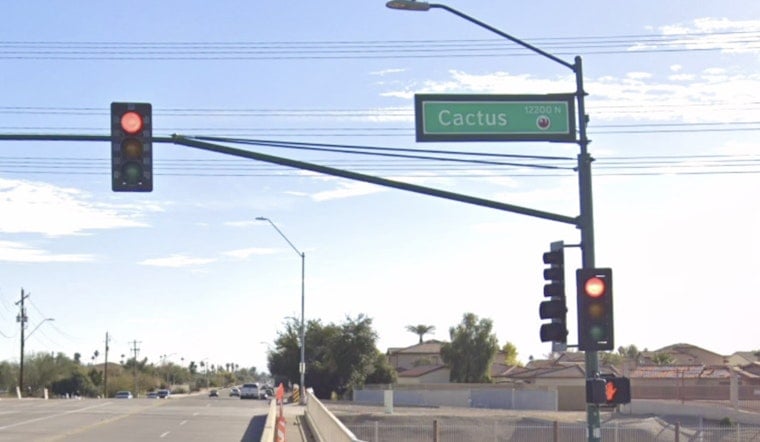
A man was left in critical condition and a woman was taken to the hospital in stable condition after a three-vehicle collision Friday afternoon at the intersection of 51st Avenue and Cactus Road in North Phoenix. The Phoenix Fire Department was called to the crash around 4 p.m., and two people in total were hospitalized following the wreck, authorities said.
According to KTAR News, Phoenix police took over the scene from fire crews to investigate. Under the City of Phoenix's own procedural guidelines, the department's Vehicular Crimes Unit is the specialized team dispatched to handle scene investigations and collision reconstruction whenever a crash produces fatalities or critical, life-threatening injuries, with medical care taking priority before detectives begin reconstructing how the three vehicles collided.
The intersection where Friday's crash happened is not new to serious wrecks. It ranked #81 on the Maricopa Association of Governments' list of the top 100 highest crash-risk intersections in the Phoenix metro area, a ranking built from crash frequency and severity data collected between 2017 and 2021, as the regional planning group's findings were reported by the Daily Independent. The association scores intersections across 27 member municipalities using a weighted formula that accounts for how often crashes happen and how severe they are.
A History of Serious Wrecks at This Corner
This isn't the first time the junction of 51st Avenue and Cactus Road, which sits directly on the border between Phoenix and Glendale along a busy commercial and residential corridor, has produced critical injuries. In November 2021, a two-vehicle crash there subsequently struck a pedestrian, leaving two people critically injured, according to a report at the time from 12News.
The corridor's troubles extend beyond this single intersection. Hoodline previously reported that a separate Cactus Road pileup near 35th Avenue sent six people, including four children, to hospitals, underscoring how high speed limits and multi-lane cross-sections along corridors like Cactus Road raise the risk of chain-reaction crashes. A similar pattern played out more recently in central Phoenix, where a six-car smashup at 16th Street and Thomas Road left 10 people hurt and drew its own Vehicular Crimes Unit investigation into speed and impairment.
Why This Stretch of Road Keeps Turning Deadly
The frequency of severe crashes along this part of North Phoenix reflects a broader statewide pattern. Maricopa County accounted for 88,094 of Arizona's 121,107 total motor vehicle crashes in 2024 — nearly 70% of all collisions statewide — according to Arizona Department of Transportation crash records reported by AZ Law Now. The county still recorded 594 traffic fatalities that year, though that figure was down 12.8% from 681 deaths in 2023.
Speeding remains the single largest contributing factor behind those numbers. ADOT's 2024 Crash Facts data, as reported by the Elmm Law Group, found speeding caused 417 deaths — 34% of all road fatalities in the state — and injured 20,722 people, ahead of alcohol impairment, which caused 347 deaths that year. It remains unclear whether speed played a role in Friday's crash, and police have not indicated what caused the three vehicles to collide.
City Safety Efforts and Possible Legal Fallout
Phoenix has been trying to address corridors like this one through its Vision Zero Road Safety Action Plan, adopted by the City Council in September 2022 with $10 million in dedicated annual funding aimed at reengineering arterial roads to eliminate traffic deaths and severe injuries. The plan periodically remaps a High Injury Network of streets and intersections where severe collisions cluster disproportionately. Just across the municipal line, Glendale has already made physical changes near this junction, installing bridge crash barriers on West Cactus Road just west of 51st Avenue to keep vehicles from departing into nearby canals that have prompted their own emergency responses over the years.
If investigators determine that speed combined with other moving violations created an immediate hazard, Arizona law allows for an aggressive driving charge under A.R.S. § 28-695, a Class 1 misdemeanor carrying up to six months in jail, a $2,500 fine, mandatory traffic survival school, and possible license suspension. Separately, under A.R.S. § 28-672 and the state's comparative negligence standard in A.R.S. § 12-2505, any driver found to have caused serious physical injury through a moving violation could face civil liability, with fault allocated among the drivers involved based on the crash reconstruction findings. It is not yet known whether Phoenix police plan to file citations or charges in connection with Friday's collision, or whether speed or a right-of-way violation triggered the initial impact.





