

























































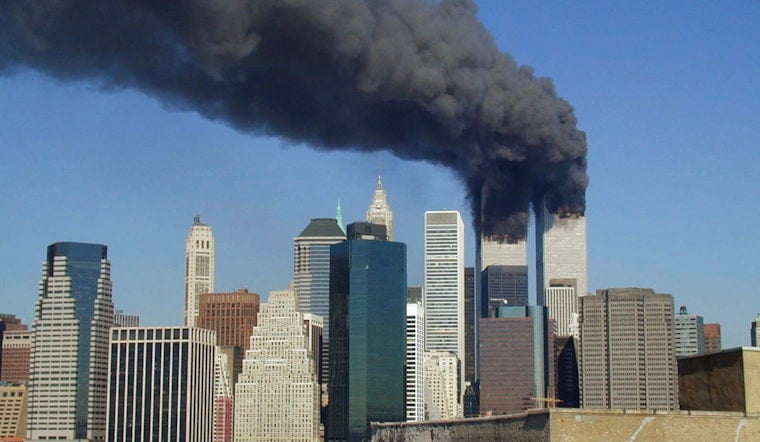
Greg Semendinger was airborne over Lower Manhattan within minutes of the first plane striking the World Trade Center's North Tower on September 11, 2001, and what he saw through his camera lens that morning has stayed with him for a quarter century. As an NYPD Aviation Unit pilot circling the towers, he photographed police, fire, ambulance and emergency service vehicles clustered at the damage site below — and some of the responders who climbed out of those vehicles, he said, never returned to them.
Semendinger received the call to get into the sky as soon as word came that a plane had hit the North Tower, according to Spectrum News NY1. He flew that day as a police helicopter pilot whose job, he said, was observation — to keep headquarters apprised of what was happening on the ground and call in additional resources as the crisis unfolded. He carried a camera with him, as he often did while flying for the NYPD Aviation Unit, and the images he captured that morning would eventually become part of the historical record of the attacks.
It was not Semendinger's first brush with catastrophe at the World Trade Center. He had responded to the 1993 bombing of the complex, and during that earlier attack he served as an NYPD Aviation Unit pilot who helped execute a rooftop evacuation that rescued 28 people from the North Tower, according to the National September 11 Memorial & Museum. That operation, in which officers rappelled onto the roof to clear a landing zone, gave him direct experience with what an aerial rescue at the towers could look like when conditions allowed for one.
A Rescue Plan That Never Came Together
On 9/11, Semendinger planned to use the North Tower roof for rescue operations, per the NY1 report. But the roof presented an immediate obstacle: a window-washing machine occupied the one clear section of that rooftop, since the equipment moved to a different World Trade Center roof corner each month. Semendinger said a helicopter probably could have landed a skid on part of the roof had the window washer not been sitting there, and that a larger helicopter might have attempted a hoist rescue if a person in need had been visible to the crew.
His team circled the North Tower for about 15 minutes weighing those options, but ultimately could not enter the South Tower area to conduct any rescue at all. Wind and thick black smoke blocked their view of people reportedly on the South Tower catwalk, making a rescue attempt there impossible to assess, let alone carry out. Semendinger said his team had the capability and knowledge to help but simply could not act because of the conditions on the ground and in the air that morning.
The obstacles he described on 9/11 stood in sharp contrast to 1993, and outside reporting has detailed why. Roof rescues on September 11 were stymied not only by dense smoke and thermal updrafts but also because roof access doors were locked under Port Authority fire safety guidelines meant to protect rooftop communications equipment, according to the Las Vegas Sun. Port Authority evacuation protocols directed occupants to descend the stairwells rather than seek a rooftop rescue, a policy that had not applied in the same way eight years earlier.
Photographing a Tower's Final Minutes
Semendinger photographed a person hanging on the outside of the North Tower, one of the images from that morning that has remained difficult to discuss. Over the radio, he warned that the North Tower might collapse and that people should leave the building. The South Tower had already caught fire at 9:03 a.m. that morning, and it collapsed after Semendinger had returned to Brooklyn to refuel — he was stationed at Floyd Bennett Field, where his team had gone to take on fuel in Brooklyn before the South Tower came down. The North Tower collapsed at 10:28 a.m.
Those photographs, taken on a Minolta film camera loaded with three rolls of film alongside 245 digital images, later took on a significance far beyond a single pilot's personal record, as reported by Police1. His photos showed the height and width of the dust cloud that swallowed Lower Manhattan, and federal investigators with the National Institute of Standards and Technology later used his aerial images to analyze perimeter column displacement on the South Face of the North Tower, captured just seven minutes before the tower fell, according to a Reddit archive citing NIST's research. Semendinger also submitted 240 of his digital photographs directly to the federal 9/11 Commission to aid its investigation into emergency response and the feasibility of rooftop evacuations that day.
A Career That Ended, and a Legacy That Didn't
Semendinger's helicopter, flown with pilot James Ciccone, was the only aircraft authorized in the restricted airspace directly surrounding the towers that morning, the outlet's reporting notes, since civilian and commercial air traffic across New York City had been grounded shortly after the attacks began. He served 35 years with the NYPD in total, including 14 years as a helicopter pilot with the Aviation Unit, before retiring in 2002.
In February 2010, NIST released 2,779 aerial photographs — including Semendinger's — following a Freedom of Information Act request filed by ABC News, making images that had sat largely unseen for years part of the public record. Jan Ramirez, chief curator at the National September 11 Memorial & Museum, called the body of work “a phenomenal body of work” essential to understanding the visual sequence of the collapse and the dust clouds that followed, and the museum has preserved the digital images among its core archival artifacts.
A quarter century on, Semendinger's photographs remain both a personal memory and a piece of forensic history — evidence engineers relied on to understand how the towers fell, and a record of a morning when a veteran pilot who had once helped save 28 lives from a rooftop found himself unable to reach the people he could see through his lens.




