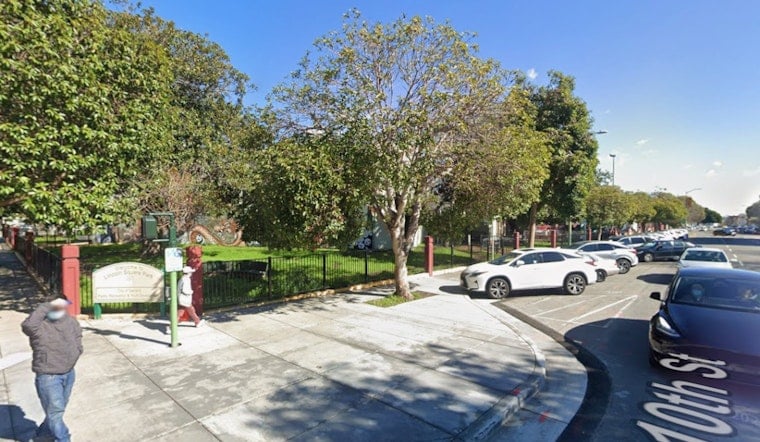
Oakland officials and Chinatown neighbors broke ground last Thursday on a rebuilt Lincoln Recreation Center, replacing a nearly 50-year-old building that had shrunk to four bathroom stalls, broken heating, and no air conditioning, even as it served roughly 2,000 people a day. The new two-story facility will be nearly triple the size of the original and will double as Oakland's first city-run climate resilience hub, with solar panels, battery storage, and a MERV 13 air filtration system meant to keep the building running during wildfires, power shutoffs, and earthquakes.
The $34 million-plus project, first reported by The Oaklandside, caps roughly a decade of organizing by neighbors who watched the old building deteriorate. Lincoln Recreation Center's director, Gilbert Gong, who spent many afternoons at Lincoln Square as a child, told the outlet that the rebuild is about more than concrete and steel. “The people part, along with the environmental aspect, is what the whole resiliency picture is all about,” Gong said, per the same account.
Oakland Mayor Barbara Lee said the city's investment in the site reflects a commitment to stronger, healthier, and more resilient communities, according to the report. The old building, first flagged as the city's highest-ranked parks and recreation capital improvement priority in 2019, had provided emergency shelter once before, during the 1989 Loma Prieta earthquake — a role city planners now want to formalize rather than leave to chance.
Decades of Wear, and Decades of Advocacy
The current Lincoln Recreation Center building is closed to the public during reconstruction, and the city public works team and SJ Amoroso Construction are set to demolish the old structure this month, per the Oaklandside report. Design work on the replacement began back in 2017, a year after Friends of Lincoln Square Park was formed in 2016 by community organizers Tiffany Eng and Ener Chiu alongside the Wa Sung Community Service Club, according to Friends of Lincoln Square Park. Municipal meeting records cited in that history show replacement proposals had stalled for nearly 30 years before the group's push gained traction.
The park itself carries deep civic history: Lincoln Square Park was designated Oakland Landmark No. 80 in 1983, recognizing its status as one of the city's seven original public squares dating to the 1850s, according to Friends of Lincoln Square Park. Before closing for demolition, the recreation center was a cultural anchor for Oakland Chinatown, regularly hosting Cantonese Opera, Tai Chi, Chi Gong, Chinese Folk Dance, a Mandarin Choir, and a Chinese Orchestra, per the City of Oakland.
A Neighborhood Built for Climate Stress
The census tract containing Lincoln Square Park has a median household income of $27,774, a 34.4% poverty rate, and ranks in the 100th percentile statewide for linguistic isolation, according to CalEnviroScreen 4.0 data cited in a city planning document. The surrounding blocks sit next to Interstate 880, Interstate 980, active freight rail corridors, and Port of Oakland truck routes, exposing residents to diesel exhaust, particulate pollution, and urban heat island effects, the same city document notes.
Those conditions are part of why the rebuild is designed to function as an emergency refuge and not just a gym. The new facility will operate as an independent microgrid for a few days during prolonged power outages, and will include refrigerators for neighbors' medication, shower stalls for overnight emergency stays, batteries for charging cell phones, and multilingual emergency preparedness trainings. The addition fulfills part of Action A-1 of Oakland's 2030 Equitable Climate Action Plan, adopted in 2020, which mandates at least three municipal resilience hubs by 2030 to serve frontline communities during environmental disasters, according to the city's planning document. Oakland has said it plans to build two more resilience hubs in public spaces, with the Lincoln Square addition serving as the city's first at a city-run site.
Stitching Together More Than $34 Million
Funding for the project came together in pieces over several years. Then-councilmember Nikki Fortunato Bas allocated $1.7 million from Measure KK in 2019, and a California Proposition 68 grant added $8.5 million in December 2021. State and local officials later announced $9.25 million from the California Department of Food and Agriculture's Community Resiliency Center Program in November 2023, according to the Asian Pacific Environmental Network, which has organized in Oakland Chinatown for over two decades.
Voters also played a role: the $850 million Measure U housing and infrastructure bond, passed in November 2022, helped prioritize the Lincoln rebuild alongside the fire-damaged Mosswood Community Center as top municipal facility projects requiring $76 million in combined city investment, per the City of Oakland. Altogether, the project has won two large state grants totaling $20 million, includes a $2 million federal earmark, and has raised more than $34 million in public funding, plus local, state, and federal money and private contributions, the Oaklandside reported. In June, the Oakland City Council scheduled a $28.4 million construction contract for the rebuild, one of the final administrative steps before the groundbreaking.
Earlier this year, Oakland secured a $150,000 Partners for Places grant with a $75,000 match from The California Endowment to support community-led sustainability initiatives and emergency planning in Chinatown ahead of construction, according to Friends of Lincoln Square Park. The Warriors and Kevin Durant Foundation previously resanded and refloored the indoor and outdoor basketball courts, a smaller-scale upgrade that predates the larger rebuild.
What Stays Open, What's Coming in 2028
Reconstruction is expected to take about 18 months, with the new Lincoln Recreation Center slated to open in summer 2028. Shah Kawasaki Architects designed the new two-story building, which will total more than 22,000 square feet compared to the old structure's roughly 7,500 square feet. The new gym will be double the size of the old one, and classrooms for afterschool and summer programs, indoor basketball courts, a rooftop garden, and 20 new trees are all part of the plan.
Not everything is closing at once. The smaller basketball courts, the junk boat play structure, and the original brick clubhouse building are expected to remain open during most of the construction period, according to the Oaklandside's reporting. Gong said he plans to keep fundraising for an endowment to keep the park accessible to all, a goal he frames as inseparable from the resilience mission itself.