

























































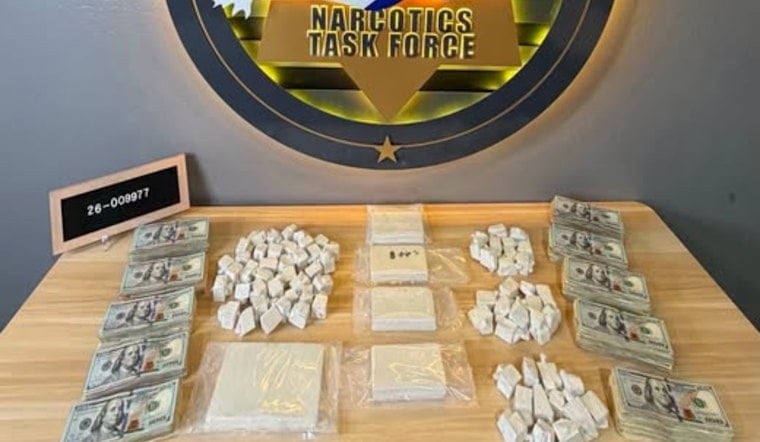
Alameda County narcotics detectives tore into a hidden fentanyl operation last Thursday, finding hydraulic presses, blenders and more than 3,800 grams of the drug stashed inside an accessory dwelling unit behind an East Oakland home. Five people were arrested and booked into Santa Rita Jail after investigators searched two properties tied to the case, and the investigation remains ongoing.
The Alameda County Narcotics Task Force served search warrants last Thursday at a residence in the 2400 block of 13th Avenue and an accessory dwelling unit in the 2700 block of 78th Avenue, according to the Alameda County Sheriff's Office. Task force detectives were assisted by the Sheriff's Office Community Oriented Response and Engagement deputies and its small Unmanned Aerial Vehicle unit during the operation. At the 13th Avenue home, deputies breached the front door after an extended knock-and-announce and detained a suspect along with four additional males.
Inside the ADU on 78th Avenue, detectives said they discovered what the Sheriff's Office described as a sophisticated setup for mixing fentanyl and pressing it into brick-shaped packages. The location held multiple hydraulic kilo presses, blenders, sifters, cutting agents, packaging materials, binders, scenting agents, personal protective equipment, Narcan and scales, per the same account. At the 13th Avenue residence, task force detectives also located more than $15,000 in bundled U.S. currency.
A Familiar Pattern in East Oakland
This is not the task force's first encounter with a residential pressing operation of this kind. Last year, the Alameda County Narcotics Task Force conducted Operation Bad Bunny, raiding an East Oakland home converted into a fentanyl lab with mechanical presses and chemical drums, an operation that led to six arrests and the rescue of a 3-month-old infant, as reported by CBS News. Months before that, in January 2025, the task force teamed with the California Department of Justice's fentanyl enforcement program on a multi-location sweep in East Oakland that seized 28 kilograms of fentanyl and $155,000 in cash, according to a Facebook post from the Alameda County Sheriff's Office.
The task force itself is a regional, multi-agency unit drawing personnel from local municipal police departments, the Alameda County Sheriff's Office, the California Highway Patrol, the County Probation Department and the Alameda County District Attorney's Office, and it frequently coordinates with federal agencies including the DEA and HSI, per NBC Bay Area. Earlier this year, an Oakland man was sentenced in federal court to six years in prison after a separate fentanyl pill-pressing operation was dismantled inside an Adams Point apartment near Lake Merritt, where federal agents seized four pounds of fentanyl, a hydraulic press and $42,000.
The Scale of What Was Seized
Fentanyl is an extremely potent opioid that has been linked to thousands of overdose deaths, and the quantities involved in Thursday's raid underscore why. According to the U.S. Drug Enforcement Administration, as little as 2 milligrams of fentanyl can be a lethal dose for most people, meaning the 3,800 grams seized in Oakland represents roughly 1.9 million potentially fatal doses, per a fentanyl fact sheet published by the Adams and Broomfield County District Attorney's Office.
The public-health stakes behind these seizures are stark locally. County opioid-related overdose deaths in Alameda County nearly doubled between 2019 and 2021, reaching 203 deaths as synthetic opioids like fentanyl drove the increase, with the mortality rate climbing to 12.09 per 100,000 residents that year, according to Alameda County Health data. A 2025 regional health report also found the greater Bay Area maintains higher drug overdose death rates than California overall, a trend the report links in part to economic pressures in a region where 10 percent of residents live in poverty.
What Suspects Could Be Facing
California law treats fentanyl manufacturing and processing operations harshly. Under California Health and Safety Code § 11379.6, manufacturing, processing or preparing controlled substances through chemical extraction or synthesis is a felony carrying a prison term of three, five or seven years and fines up to $50,000, according to legal analysis from Cron, Israels & Stark. The statute applies to intermediate processing steps such as cutting and mechanical pressing, the kind of equipment detectives say they found inside the 78th Avenue ADU.
Additional sentencing enhancements could also apply. California Assembly Bill 701, enacted in late 2023, amended Health and Safety Code § 11370.4 to add mandatory enhancements for fentanyl trafficking, tacking on three additional consecutive years for possessing more than 1 kilogram for sale, with enhancements scaling up to 25 additional years for quantities exceeding 80 kilograms, per LegiScan's legislative record. Separately, following the implementation of Proposition 36 in December 2024, courts must now issue a formal warning under Health and Safety Code § 11369 to anyone convicted of manufacturing or trafficking hard drugs like fentanyl, notifying them they could face murder charges if a batch they distribute causes a fatal overdose, according to the Los Angeles County Sheriff's Department.
It remains unclear whether prosecutors will pursue state charges against the five men now in Santa Rita Jail or refer the case for federal prosecution, and the Sheriff's Office has not detailed the specific formal charges filed against them. Investigators have also not said whether the 78th Avenue ADU was connected to a larger regional or transnational trafficking network. The Alameda County Narcotics Task Force says its investigation into the operation remains ongoing.





