

























































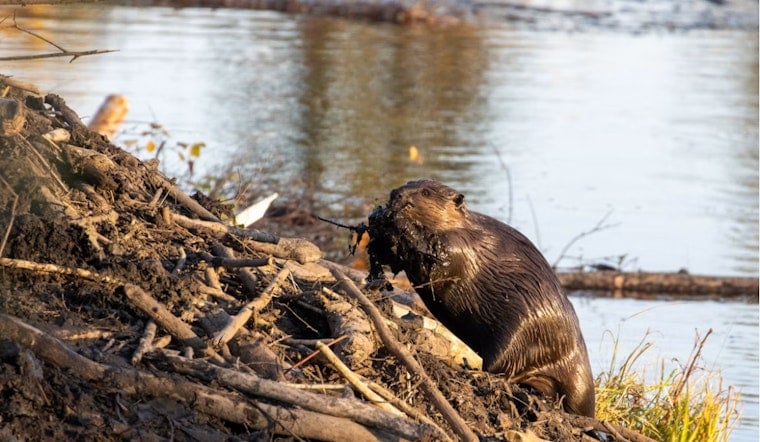
A beaver dam that has flooded a footbridge and trail on Oakland University's campus since 2023 finally has a fix that doesn't involve killing the animals responsible. Crews sank a device known as a pond leveler into the dam on Galloway Creek this month, a quiet pipe system that drains water past the beaver-built blockage without the beavers ever noticing it's there.
The device, sometimes called a Beaver Deceiver, is essentially a drainage tube engineered to hide its leak in the middle of a beaver pond, according to the Detroit Free Press, which first reported on the installation. Metal cages enclose each end of the tube, keeping beavers far enough away that they can't hear the rushing water that would normally trigger them to patch the leak, the paper reports. The pipe rests in the water on both sides of the dam, capping the water level at a height that won't damage the trail or footbridge while still letting the beavers keep their pond.
Beavers moved into the creek near Oakland University's campus in 2023 and built a dam under a footbridge that same year, causing flooding along the trail, per the same account. The Michigan Department of Environment, Great Lakes, and Energy issued a permit for the pond-leveler project on August 12, and the physical installation was carried out by staff from Beaver Leavers LLC alongside personnel from USDA Wildlife Services, according to posts shared in a Sierra Club Southeast Michigan Group Facebook post. Beaver Leavers founder Justin Jendza started the company in 2019 after training through BeaverCorps, the nation's primary certification program for non-lethal beaver management.
A State First Born From No State Rules
Until this permit, Michigan had no formal state process for approving non-lethal beaver flow devices, leaving lethal trapping as the default option for property owners dealing with beaver damage, according to OU AnimalBehavior. Michigan policies had generally encouraged beaver removal via lethal control, and state lawmakers had developed a preference for free-flowing streams, per the seed reporting. The Clinton River Watershed Council announced that Oakland University had installed Michigan's first beaver deceiver, framing the project as a pilot case that could shape future state permitting guidelines.
The dam sits along the 2.85-mile Alice R. Champion Nature Trail within Oakland University's 110-acre Biological Preserve, a wetland and forest area officially designated on January 20, 2000, to shield campus land from development, per the University of Michigan's Matthaei Botanical Gardens & Nichols Arboretum. Galloway Creek was hardly untouched ground before the beavers arrived — the U.S. Army Corps of Engineers and Oakland University had already completed a $3 million restoration project there in 2019, restoring 4,000 feet of stream channel and improving fish passage, according to the Clinton River Watershed Council. The creek is a tributary within the Clinton River Watershed, a system spanning more than 760 square miles across Oakland and Macomb counties before draining into Lake St. Clair.
Team Beaver and the Science Behind the Silence
An interdisciplinary group of Oakland University faculty and graduate students from psychology and biological sciences formed a coalition called Team Beaver in late 2023 to monitor Galloway Creek's hydrology and study how sound affects beaver damming behavior, according to the university's alumni magazine. That group is now tracking upstream and downstream water levels and sharing the data with EGLE, work aimed at helping the state codify permanent guidelines for non-lethal flow-control permits, per the Team Beaver Facebook post.
The submerged-pipe concept itself dates to 1994, when researchers at Clemson University Extension demonstrated that quiet intake pipes keep beavers from detecting flowing water, according to Beaver Solutions, a Massachusetts company that specializes in human-beaver conflicts. The trapezoidal cage structure often paired with these pipes, nicknamed the Beaver Deceiver, was invented in the 1990s by wildlife biologist Skip Lisle while he worked for the Penobscot Indian Nation in Maine to stop beavers from blocking road culverts, as reported by VTDigger. Pipe systems like these must be built so beavers can't detect water flowing into the intake, since the animals instinctively try to dam whatever is making that sound, and Beaver Solutions says properly designed levelers resolve most beaver-related flooding problems.
The Detroit Free Press reporting notes that beavers were nearly wiped out across North America by roughly 300 years of trapping and trading, and that trapping, industrialization and habitat loss pushed the animals out of large parts of Michigan. An Oregon-based nonprofit called Project Beaver has argued that beaver ponds attract a wide range of other wildlife and that devices like this let beavers keep building dams without creating problems for people, according to the Free Press. Beaver ponds are widely credited with drawing diverse species, adding an ecological argument to the case for coexistence rather than removal.
A Cautionary Tale From Georgia
The stakes of choosing lethal control over a device like Oakland's became visible earlier this year in the suburbs of Atlanta. In May, Hoodline reported that a homeowners association in Alpharetta, Georgia faced public backlash after authorizing underwater body-gripping traps that killed resident beavers, a decision that ignited anger once children spotted the dead animals in a neighborhood lake. Oakland University's approach avoided that kind of fallout by working through a permitted, non-lethal alternative instead.
Whether Michigan regulators will turn the Galloway Creek project into a permanent, streamlined permit category for other private and municipal landowners statewide remains an open question, as does how well the device will perform during Michigan's heaviest storm seasons. For now, the pond leveler is doing its job quietly, letting the campus beavers keep their dam while the trail and footbridge stay dry.





