

























































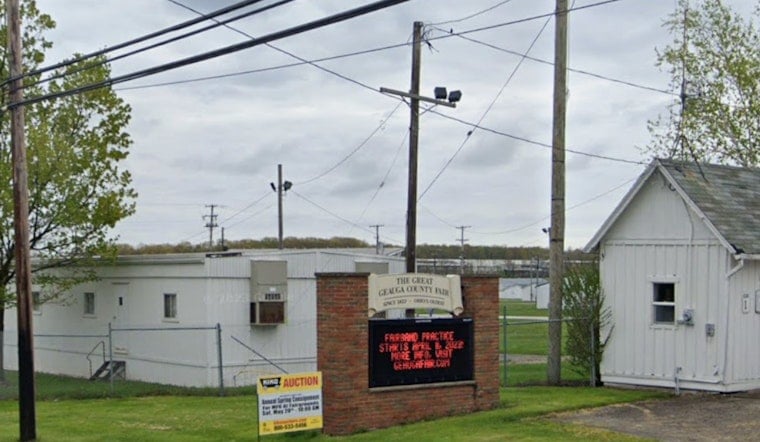
The Great Geauga County Fair swings open its gates Thursday in Burton for five days of rides, livestock competitions, demolition derbies and live entertainment, marking another chapter in a tradition that traces back more than two centuries. Running Sept. 3-7, the fair holds the title of Ohio's oldest continuous county fair, having operated every year since its founding without a break.
According to Cleveland.com, the Geauga County Agricultural and Manufacturing Society formed in 1823, and the first Geauga County Fair & Cattle Show was held that October in Chardon, Ohio, lasting just one day and featuring livestock in rail pens alongside agricultural and domestic exhibits. The fair later moved between Chardon and Burton before becoming permanently established in Burton in the mid-1800s. Community gatherings that predated the formal society go back even further, to June 1798, when early settlers in Burton held gatherings known as “jollifications” — a full 25 years before the agricultural society's founding, according to the Geauga County Agricultural Society.
Why Geauga Claims the Oldest-Fair Title
Trumbull County actually formed Ohio's first agricultural society back in 1818, but Geauga's fair holds the official distinction of being the state's oldest continuous county fair because it has run every single year since 1823 without interruption, according to Farm World. That unbroken streak has survived the Civil War, two World Wars, the Great Depression and more recent pandemics, per the same report. Cleveland.com notes the fair has continued annually despite the Civil War, two World Wars and the Great Depression, and today it stands as one of the oldest agricultural fairs still operating in the country.
The 151-acre fairgrounds in Burton host more than 12,000 to 13,000 static and livestock exhibits stretched across three miles of midways, according to the Geauga County Agricultural Society. Two of the fairgrounds' structures carry their own historical weight: the Domestic Arts Hall, built in 1856 and rebuilt in 1889, and the Flower Hall, built in 1890, were both listed on the National Register of Historic Places in 1979, according to the Geauga County Automatic Data Processing department. Both historic halls remain active exhibition spaces during the annual fair.
Schedule, Tickets and What's New for 2026
The fair runs Thursday through Monday at the Geauga County Fairgrounds, located at 14373 N. Cheshire St. in Burton, with exhibit halls and buildings open daily from 10 a.m. to 10 p.m. and the grounds themselves open from 9 a.m. to midnight, per Cleveland.com. Fair-day admission opens at $10 on Fun Day, with a one-day advance admission ticket costing $11.50 including fees and a five-admission pass priced at $51.75 including fees. Children 6 and younger get in free, and online ticket sales are final and nonrefundable.
Ride admission is separate from fair admission, with individual ride tickets costing $1 and all-day ride wristbands priced at $25, dropping to $15 on Labor Day for Family Day. Grandstand tickets are sold separately as well and do not include admission to the fairgrounds. Fairgrounds parking is free, and wagons ferry visitors from the parking areas to the entrances, according to Cleveland.com's report.
Each day of the run carries its own theme. Thursday opens with a chicken flying contest at noon and a demolition derby at 8 p.m. Friday is Senior Citizen and Veterans Day, with veterans and people 65 and older receiving free admission. Saturday brings the annual apple pie auction at 1 p.m. followed by another demolition derby at 7 p.m. Sunday is Band-O-Rama Day, capped by a truck and tractor pull at 6:30 p.m., and Labor Day Monday closes out the run as Family Day.
Entertainment Lineup and Century-Old Traditions
Beyond the derbies and pulls, this year's fair features horse and livestock competitions, a frog jumping contest, a rooster crowing contest, a diaper dash and a kiddie tractor pull. Entertainment includes a Sea Lion Splash show, the B & B Magic Show, woodcarving demonstrations, the Pirates of the Colombian Caribbean show and Sheriff Stretch's comedy and balloon shows, per Cleveland.com's rundown.
Youth agriculture remains central to the event through the Junior Fair program, which the Geauga County Agricultural Society established in 1938 to organize youth agricultural projects and the annual junior livestock auction, with exhibitors participating through 4-H and local agricultural organizations. The nonprofit society itself is governed by a board of fair directors representing all 16 Geauga County townships, plus five directors elected at-large, who oversee year-round operations in addition to annual fair planning.
The fairgrounds' history includes a stranger legal footnote. A 1972 performance by human cannonball Hugo Zacchini at the Geauga County Fair led to the landmark 1977 U.S. Supreme Court ruling in Zacchini v. Scripps-Howard Broadcasting Co., after a Cleveland television station filmed and broadcast his entire 15-second stunt without permission, according to Court News Ohio. The case established legal protections for an entertainer's right of publicity and remains a cited precedent in media law today.
The surrounding county's agricultural character shapes much of what fills the fair's static and livestock exhibits. Geauga County is home to Ohio's second-largest Amish population, with more than 20,000 Amish residents contributing to the county's agricultural output, maple syrup trade and fair participation, according to Destination Geauga. That local settlement ranks among the largest Amish communities in the world, a backdrop that helps explain why the fair continues to draw between 200,000 and nearly 300,000 visitors over its five-day run, with attendance peaking at 294,269 in a recent fair season, per the Geauga County Agricultural Society.





