

























































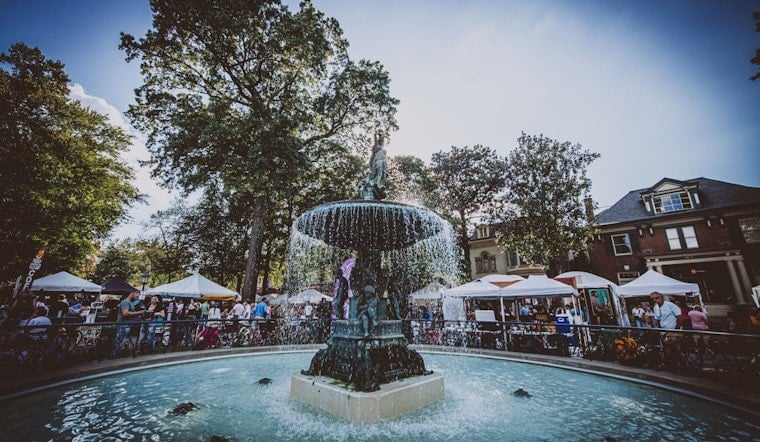
More than 600 artists from across the country will line the gaslit streets of Old Louisville from October 2 through October 4 as the St. James Court Art Show marks its 70th year, a milestone that traces back to a scrappy 1957 fundraiser held to fix a crumbling fountain. The free, rain-or-shine event spans roughly four square blocks of the historic neighborhood and has grown into one of the most decorated fine art festivals in the country.
The show's roots go back to October 1957, when St. James Court Association president Malcolm Bird and neighbor Ethel DuPont organized a neighborhood clothesline exhibit to raise money for a crumbling historic fountain and to offset the association's debt, according to the St. James Court Art Show. That first show, with artwork strung between trees on clotheslines, netted just $150. Today the event generates an estimated $5.5 million in local economic impact for Metro Louisville, according to WHAS11, drawing an estimated 250,000 visitors into the city every autumn.
This year's show has again landed near the top of the national rankings. Sunshine Artist Magazine placed the St. James Court Art Show No. 3 among 200 of the most profitable art festivals in the country, with rankings based on artists' reported sales from 2025, according to the Louisville Courier Journal. Sunshine Artist had previously named the show its No. 1 Best Fine Art and Design Show for the decade spanning 2010 to 2020, and ranked it No. 2 nationally in 2025. Howard Rosenberg, executive director of the St. James Court Art Show, called the recognition among the nation's top three fine art and design shows an incredible honor, the Courier Journal reports.
A Poster Tied to the Show's Own History
This year's official poster, created by artist Mark Bird, incorporates a painting of the historic Cawein House at 1436 St. James Court, a building Malcolm Bird, Bob Smith and Jim Perry renovated as part of the neighborhood's mid-century preservation push. Mark Bird first participated in the art show at age nine and produced the show's inaugural poster with C.M. “Sonny” Whittle back in 1981, according to the Courier Journal. For the 70th-anniversary edition, he revisited the same line drawing he created for that original 1981 poster. Bird has said the show has been integral to his artistic career.
The neighborhood setting is as much a draw as the art itself. Old Louisville is recognized as the largest historic preservation district in the country built almost entirely in Victorian architecture, encompassing the largest contiguous collection of Victorian mansions in the United States across more than 40 city blocks, according to GoToLouisville.com. The neighborhood is known for its historic homes. The city of Louisville formally designated Old Louisville a local Preservation District, per LouisvilleKY.gov. Old Louisville's preservation history remains part of the neighborhood's identity. According to a LouisvilleKY.gov housing needs assessment, historic district properties are worth about 14 percent more on average than comparable properties outside of historic districts.
Art Proceeds Fund the Neighborhood's Upkeep
The financial relationship between the festival and the neighborhood runs deep. Net revenues from the show are retained by participating neighborhood associations to fund Old Louisville's tree canopy, gas lights, sidewalks and fountain maintenance, per the show's own account. The governing association is a 501(c)(4) organized primarily around historic preservation, meaning ticket-free art sales effectively subsidize infrastructure upkeep that might otherwise fall to the city. According to the Kentucky Arts Council's 2025 annual report, art experiences in the commonwealth directly contributed to the tourism industry's $14.6 billion economic impact in 2025. According to the National Endowment for the Arts, cultural tourism in Berea brings in $5,000,000 in tax revenues each year to support city programs and initiatives.
The Conrad-Caldwell House Museum at 1402 St. James Court, an 1895 Richardsonian Romanesque mansion designed by local architect Arthur Loomis, serves as the show's central landmark. The historic house operates as a museum, according to the Conrad-Caldwell House Museum. The St. James Court fountain is part of the neighborhood's preservation history.
Same Founding Year, a Parallel Legacy
The art show's 1957 debut is part of Louisville's cultural history. The festival's history has also drawn attention in recent years. Ahead of this October's show, the Filson Historical Society hosted a free 70th-anniversary retrospective panel Wednesday with local historians and artists to explore the festival's evolution and its impact on the neighborhood since 1957.
What to Know Before You Go
The 2026 show runs Friday, October 2, and Saturday, October 3, from 10 a.m. to 6 p.m., and Sunday, October 4, from 10 a.m. to 5 p.m., spread across St. James Court, Belgravia Court, Third Street, the 1300 section of Third Street, Fourth Street and the West End Baptist Church area. Many streets throughout the footprint will be closed to traffic and parking for the duration of the event, according to the Courier Journal.
Food vendors will be scattered throughout the grounds, with food trucks specifically located on Hill Street between Third and Fourth streets, and the Fourth Street section offering gourmet-style foods not sold elsewhere at the show. Pets are not permitted, though service animals are allowed. Organizers say additional 70th-anniversary details will be announced at the show's Facebook page and at stjamescourtartshow.com.
Parking and Getting Around
Visitors can park at several nearby schools and lots, including Noe Middle School at 121 W. Lee St., Dupont Manual High School at 120 W. Lee St., Cochran Elementary School at 500 W. Gaulbert Ave., the Youth Performing Arts School at 1517 S. Second St., the Edison Center at 701 W. Ormsby Ave., and the Louisville Woman's Club lot behind 1322 S. Fourth St. Parking is also available at PARC's Brown Hotel garage at 658 S. 3rd St. for $12, and TARC is partnering with PARC to offer shuttle service to and from the show, with buses arriving roughly every 15 minutes.
Handicap parking will be available along the north lane of Hill Street between Sixth and Third streets, and on the east side of Sixth Street between Park and Magnolia avenues. Bike parking will be available at Central Park, near the Old Louisville Information Center and the Louisville Metro Police Department's 4th Division. Old Louisville sits about three miles south of downtown Louisville and three blocks north of the University of Louisville, making it an easy destination for visitors arriving from either direction.



