

























































Opera Baltimore is turning a stretch of the Jonestown neighborhood into an open-air stage this Sunday, launching a day-long festival that traces a century and a half of shared musical history between Baltimore's Black and Jewish communities. The inaugural event, called Voices in Solidarity: Baltimore's Black and Jewish Operatic History Festival, runs from 11:30 a.m. to 5 p.m. on August 30 and mixes free pop-up performances with a ticketed evening concert.
The festival begins with pop-up musical performances in the courtyard of the Star-Spangled Banner Flag House, according to WMAR 2 News. From there, attendees can join walking tours connecting sites throughout Jonestown, with the routes linking spaces roughly three or four blocks apart. The day builds toward an evening concert at the Reginald F. Lewis Museum, where soprano Sarah Duchovnay and baritone Daniel Rich are set to perform.
Nicole Steinberg, Opera Baltimore's cultural programs coordinator, said the festival is designed to confront both the harder and more hopeful chapters of that shared history. She said the event addresses both positive and negative aspects of history to help the community move forward and heal, per the station's report. Steinberg added that music can bring people together in spaces where conversations are difficult, describing it as an entry point that opens spaces to people who may not otherwise feel welcome.
A Century and a Half of Shared Artistic Ground
Organizers point to Black and Jewish communities having shared artistic influences for roughly a century and a half, a connection the festival's programming is meant to make visible. One touchstone is Billie Holiday's 1939 recording of the anti-lynching anthem “Strange Fruit,” which the same report notes was composed by a Jewish composer-songwriter. That composer was Abel Meeropol, a New York high school teacher and son of Russian-Jewish immigrants who wrote the words as a 1937 poem under the pseudonym Lewis Allan, according to PBS. Meeropol was reportedly moved to write the poem after seeing a photograph of a 1930 mob lynching in Indiana.
Duchovnay, who has roots in Pikesville, previously curated “Silenced Songs: Rediscovering the Lost Music of Jewish Composers,” a March 2026 panel and recital at the Engineers Club focused on Jewish women composers whose work was suppressed during the Holocaust, according to Opera Baltimore. She is a grandchild of Holocaust survivors, per the same event listing. That earlier program was part of the same year-long Voices in Solidarity initiative culminating in Sunday's festival.
Jonestown's Layered History as Backdrop
The choice of Jonestown as a venue is deliberate. The neighborhood has historically been both a Black and Jewish neighborhood, serving as a key entry point for German and Eastern European Jewish immigrants in the 19th and early 20th centuries before becoming a vibrant cultural center for African American residents and institutions, according to the Jewish Museum of Maryland. The neighborhood's Lombard Street was once known as “Corned Beef Row” for its dense concentration of Jewish delis.
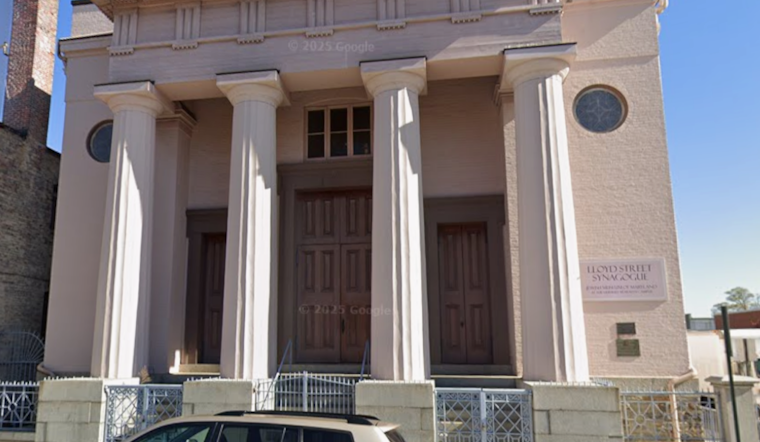
The museum, established in 1960, preserves the 1845 Lloyd Street Synagogue — the oldest synagogue in Maryland and third-oldest standing in the United States — alongside the 1876 Moorish Revival B'nai Israel Synagogue. It was created to prevent the demolition of the Lloyd Street Synagogue. The institution completed an 8,200-square-foot renovation of its front-of-house public facilities in early 2025, adding interactive spaces and a podcast recording studio meant to lower barriers between exhibition and community participation, as reported by Baltimore Magazine.
The Jewish Museum of Maryland is partnering with the Reginald F. Lewis Museum and Opera Baltimore on Sunday's event. At the evening venue, the Reginald F. Lewis Museum will feature artifacts documenting the intertwined histories of Black and Jewish communities, and Terry Taylor-Nock is associated with the museum, per WMAR 2 News. The Lewis Museum opened in 2005 and honors East Baltimore native Reginald F. Lewis, who in 1987 became the first Black American to build a billion-dollar company with TLC Beatrice International, according to Wikipedia.
State Grant Backs a Growing Civic Practice
Opera Baltimore's expansion into neighborhood-based programming has state backing. The company received a $50,000 grant from the Maryland Heritage Areas Authority in July 2025, part of $4.6 million distributed across 91 heritage projects statewide, to launch the Voices in Solidarity project, according to Baltimore Fishbowl. The matching grant program supports place-based heritage tourism and community economic development across the state.
Founded in 2009 as Baltimore Concert Opera, the company officially changed its name in June 2022 to reflect its expansion into fully staged productions with an orchestra, the outlet notes. That same year, it launched its civic practice programming with Opera on the Avenue, a West Baltimore community festival honoring soprano Anne Wiggins Brown, who originated the role of Bess in George Gershwin's 1935 opera “Porgy and Bess.” Brown grew up two blocks from West Baltimore's historic Arch Social Club.
Organizers describe Sunday's festival as part of Opera Baltimore's ongoing work to use vocal arts for community engagement, and they hope it marks the start of an extended effort to strengthen relationships between communities across Baltimore. Steinberg said organizers are thrilled to participate and to use music to support community change. Organizers also hope participants will build civic pride by examining shared history, framing the festival as a celebration of longstanding connections between Black and Jewish communities meant to encourage dialogue about the past, present, and future.
Daytime activities, including the walking tours and pop-up performances, are free and run from 11:30 a.m. to 2:30 p.m. The evening concert at the Reginald F. Lewis Museum follows from 3 p.m. to 5 p.m. and requires an $18 ticket, according to Opera Baltimore.





