

























































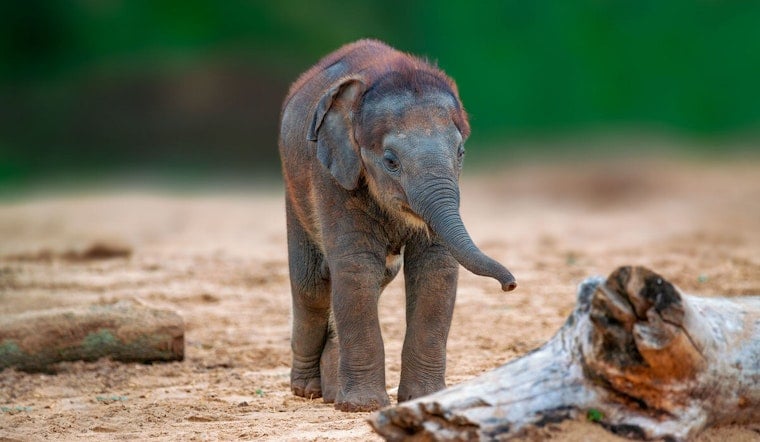
Tula-Tu, the Oregon Zoo's young Asian elephant, has received two doses of an experimental mRNA vaccine designed to protect her against elephant endotheliotropic herpesvirus, becoming the first elephant on the West Coast to get the shot. The calf, who now weighs more than 1,300 pounds after being born at just over 200 pounds in February 2025, is the 18th elephant in the country to receive the vaccine, and she is scheduled for a third dose this fall.
The milestone was reported by OregonLive, which detailed how the zoo's elephant care team has worked with Tula-Tu since shortly after her birth to train her to participate in her own health care. Steve LeFave, who oversees the Oregon Zoo's elephant care program, called the vaccination a huge milestone for the zoo, according to the outlet's report. Carlos Sanchez, the zoo's director of animal health, said Tula-Tu has had no negative side effects from the vaccine and is responding well to it, per the zoo's own account relayed in the same report.
A Virus That Kills Fast, Even in Healthy-Looking Calves
Elephant endotheliotropic herpesvirus, known as EEHV, is present but latent in many Asian elephants and can kill wild Asian elephants as well as those in human care. EEHV-HD, the hemorrhagic disease it causes, is the leading cause of death in young Asian elephants in human care, with a mortality rate as high as 80 percent and the ability to cause fatal internal bleeding within 12 to 24 hours of visible symptoms, according to the Smithsonian's National Zoo and Conservation Biology Institute. The disease primarily targets juvenile Asian elephants under eight years old, which puts calves like Tula-Tu squarely in the highest-risk window.
Portland knows that risk firsthand. In November 2018, six-year-old Lily died from EEHV at the Oregon Zoo, a loss that sparked protests and candlelight vigils outside the zoo gates from local advocacy groups calling for an end to captive breeding programs, as KGW News reported at the time. Lily died less than 24 hours after active EEHV was detected in her blood, underscoring just how narrow the window for intervention can be.
From a Houston Trial to a Portland Nursery
The vaccine now protecting Tula-Tu traces back to a research partnership between Baylor College of Medicine and the Houston Zoo that was established in 2009 following an elephant loss to EEHV. The world's first experimental dose of the mRNA vaccine was given on June 18, 2024, to Tess, a 40-year-old Houston Zoo elephant, in initial safety and immunogenicity trials, a milestone Hoodline covered in its report on the Houston elephant's vaccine first. Adult elephants were vaccinated first specifically to verify safety before the shot moved on to young, high-risk calves.
That caution paid off with real-world evidence. In July 2025, the Cincinnati Zoo & Botanical Garden reported that two vaccinated young elephants, Sanjay and Kabir, naturally contracted EEHV1A but cleared the virus without developing severe symptoms or requiring intensive care, becoming the third facility in the country to vaccinate its herd. Hoodline previously reported on how those young elephants beat the virus. Researchers at Baylor and the Houston Zoo announced in an Oregon Zoo news release dated July 2026 that vaccinated elephants can successfully withstand natural infection without developing severe disease, and on July 28, 2026, the same researchers published two companion peer-reviewed papers in the Journal of Virology detailing the multiantigen EEHV1A mRNA vaccine's development and providing the first clinical proof of vaccine protection in elephants.
Targeting the Most Common Strain
The mRNA vaccine Tula-Tu received targets EEHV 1A, the most common strain of the virus, and was still in clinical trials at the time of her doses. The Oregon Zoo hopes the vaccine will protect Tula-Tu until she develops her own antibodies against the disease, and her blood samples will be part of several ongoing studies. Carlos Sanchez said the Oregon Zoo's work could help protect future elephant calves, including those in range countries, where wild populations continue to struggle.
That underlying science goes back further than the live elephant trials. Preclinical research published in the journal Vaccines in May 2024 confirmed that the multiantigen EEHV construct successfully induced both antibody and T-cell immune responses in animal models, laying the groundwork for the formulation now being tested in zoo elephants nationwide.
Training a Calf to Help Save Herself
None of this is possible without behavioral training that lets young elephants participate willingly in their own care. Elephant care teams use positive-reinforcement operant conditioning with target poles and dull contact tools, enabling calves to voluntarily present body parts and hold still for injections without sedation, with elephants able to end training sessions at any time, per the Cincinnati Zoo & Botanical Garden. The Oregon Zoo team used that same approach to train Tula-Tu to participate in her own health care, and the zoo continues routine blood monitoring of its elephants, including Tula-Tu's mother Rose-Tu, who weighs 7,500 pounds, and Sampson, who weighs more than 10,000 pounds.
Local diagnostics have made that monitoring far faster than it used to be. Blood tests for EEHV were once available only at a laboratory in Washington, D.C., but the Oregon Veterinary Diagnostic Laboratory at Oregon State University in Corvallis began offering the test locally, according to a post from the Oregon State University Carlson College of Veterinary Medicine. That change allows Pacific Northwest facilities to monitor viral levels in elephant blood with far quicker turnaround than shipping samples across the country.
A Legacy Dating Back to Packy
The Oregon Zoo has a long history with Asian elephants, dating to April 14, 1962, when Packy became the first Asian elephant born in North America in 44 years, living in Portland for nearly 55 years until his death in 2017. That legacy runs alongside the deeper stakes for the species: the Asian elephant is categorized as Endangered on the IUCN Red List, with global wild populations estimated at fewer than 52,000 individuals across 13 range countries after declining by at least 50 percent over three generations, according to the U.S. Fish and Wildlife Service. Zoos can closely monitor elephants in their care and obtain blood and other fluid samples in ways that are far harder to replicate in the wild, which is part of why researchers see facilities like the Oregon Zoo as a testing ground before any vaccine could reach elephant range countries in Asia. How quickly that experimental vaccine could scale for international distribution remains an open question, even as Tula-Tu prepares for her third dose this fall.





