

























































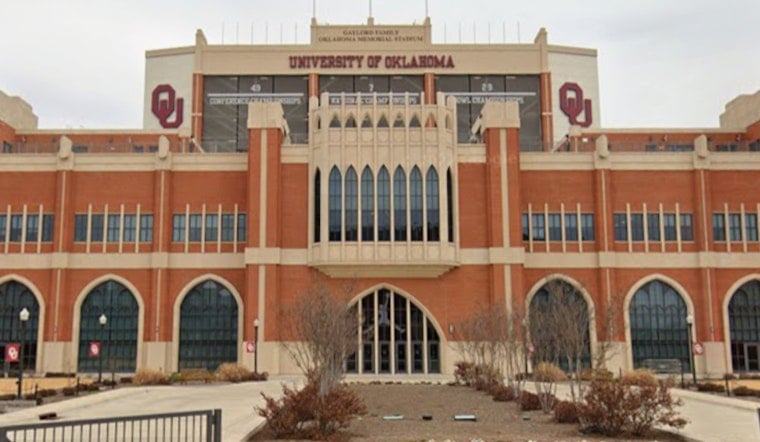
The University of Oklahoma has enrolled 6,437 freshmen for the Class of 2030, marking the largest freshman class in Oklahoma state and university history and the school's sixth consecutive enrollment record. The milestone caps what OU officials describe as the fastest enrollment growth the Norman campus has seen in five decades, and it's already reshaping the physical footprint of campus, from new residence halls to a planned parking garage.
Incoming class sizes at OU have grown 45% over the past six years, according to The Journal Record. This year's class also set a record for Oklahoma resident freshmen for the fourth consecutive year, even as the university leans heavily on out-of-state recruiting to keep growth on pace. That out-of-state push isn't new: nonresident freshman enrollment surged 64% between 2015 and 2024, according to an internal presentation to the OU Board of Regents cited by the Oklahoma Council of Public Affairs, offsetting a drop in Oklahoma's high school college-going rate from 49% in 2015-16 to 36% in 2022.
University President Joseph Harroz Jr. said there has never been a more exciting time to be a Sooner, per the same account, while Jeff Blahnik said the historic freshman class signals OU's momentum and the bright future being built together. The Class of 2030 includes 702 students who earned a high school GPA of 4.0 or higher and 299 who graduated first in their high school class. Roughly 28% of the incoming class identify as first-generation college students, the first in their families to attend college.
A State Mandate Behind the Numbers
The growth isn't happening in a vacuum. In spring 2023, Oklahoma Governor Kevin Stitt issued a statewide mandate challenging OU to grow its total student enrollment across all campuses to 40,000 by 2030, according to KTOK. Stitt issued an identical challenge to Oklahoma State University to help meet projected state workforce needs. Driven by six straight years of record freshman classes, OU's total headcount across all campuses surpassed 36,500 in fall 2025, representing a 16% total enrollment increase at the Norman campus over recent years, the station reports.
Financial aid has scaled up alongside enrollment. Oklahoma's Promise-qualified students increased 19% over the previous year, and the program now qualifies 917 incoming students, according to The Journal Record. Need-based aid has grown 39% over the past seven years, while scholarship support for resident undergraduates has climbed 38% over that same span. The Class of 2030 also includes 137 Oklahoma State Regents' Scholars.
Under OU's Crimson Commitment financial aid program, qualifying Oklahoma's Promise recipients receive guaranteed coverage of full tuition and up to $10,000 per year in mandatory student fees for four years, according to the University of Oklahoma. That structure helps explain why 58% of OU undergraduates graduate without student debt, compared with 45% of undergraduates nationally, per The Journal Record.
Tuition Still Climbed Even as Aid Expanded
The affordability push comes even as tuition has risen. The Oklahoma State Regents for Higher Education approved a 3.0% annual increase in full-time resident undergraduate tuition and mandatory fees at OU for the 2025-26 academic year, compared with a statewide public undergraduate average increase of 1.9%, according to the Oklahoma State Regents for Higher Education. Ten public institutions in the state held resident undergraduate tuition flat for that year.
For the 2026-27 academic year, the regents set OU's resident undergraduate tuition and mandatory fees at $349.50 per credit hour, made up of $184.40 in tuition and $165.10 in fees, according to OKcollegestart. That's notably higher than Oklahoma State University's $322.70 per credit hour, making OU the pricier of the state's two flagship institutions even as it expands aid for lower-income Oklahomans.
New Dorms and a Parking Garage Race to Keep Up
Physical campus capacity has had to scramble to match the enrollment surge. OU opened McCasland Hall, with 560 beds, last year, and this year opened South Hall, which holds about 580 beds for first-year students, per The Journal Record. Both halls represent Phase 1 of a comprehensive First-Year Housing Master Plan designed to replace aging 1960s-era dormitory towers, following the May 2023 demolition of the historic Adams Center complex, according to Sooner Magazine. OU's original 2021 housing plan had anticipated only 1% annual student growth, a projection the actual freshman surges quickly outpaced.
Construction of the new first-year residence village was bolstered by a $10 million gift from the McCasland Foundation in December 2024, leading to the naming of McCasland Hall, according to the University of Oklahoma. The grant honors OU alumni Tom McCasland Jr. and Mary Frances McCasland Maurer Michaelis and funds modern residence units along with storm shelter facilities.
Housing isn't the only infrastructure under pressure. OU is planning a five-level parking garage with more than 650 spaces, and the university is also developing a Life Sciences Laboratories building spanning 105,000 square feet that will include teaching labs, research space, classrooms and an auditorium, per The Journal Record.
Efficiency Reforms Alongside Growth
State regents have also pushed OU toward efficiency even as it expands. Following a statewide academic productivity review in late 2024, OU eliminated 14 low-producing degree programs, including eight undergraduate degrees, five master's programs, and one doctoral program, according to the Oklahoma Council of Public Affairs. State higher education regents had ordered across-the-board audits in 2024 to reallocate public funding toward high-demand employment sectors.
To reduce total higher education costs and accelerate degree completion, OU has also submitted plans to state regents to establish 90-credit-hour, three-year bachelor's degree programs in fields such as cybersecurity and social work, the Oklahoma Council of Public Affairs reports. The initiative aligns with state executive orders aimed at streamlining general education requirements and moving students into the workforce faster, even as the university's freshman classes keep breaking records year after year.





