

























































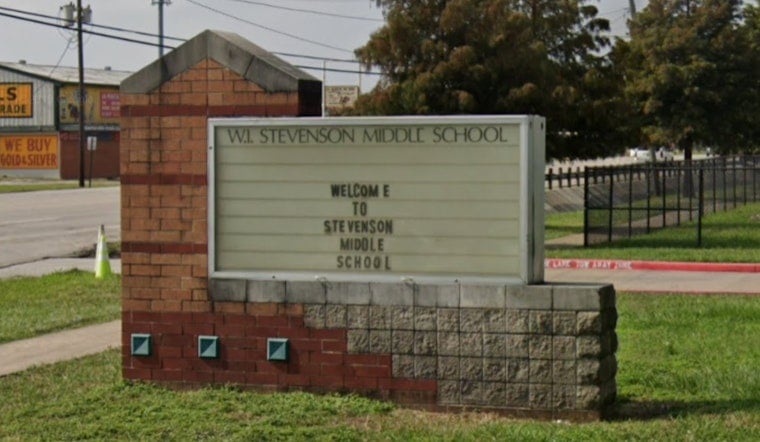
Weeds as tall as four to five feet have swallowed a stretch of sidewalk near Winkler Road and Old Galveston Road in southeast Houston, making it hard for middle schoolers to walk safely to class and just as hard for drivers to see them coming. A downed school zone sign lies flat on the ground nearby, low-hanging utility lines droop overhead, and a pedestrian crossing signal at the intersection isn't working, leaving students to cross near busy traffic right outside W.I. Stevenson Middle School.
Steven Saucier, a resident who raised the concerns, has been pushing for months to get someone to fix it. As reported by KHOU 11, Saucier filed a 311 request with the city of Houston back on July 7, then reached out separately to Harris County when he learned the sidewalk in question sits just outside Houston's city limits. He told the station the weeds are a major safety issue that requires city action, and he said he can't recall the location looking this bad in years.
Stevenson Middle School, located at 9595 Winkler Drive, opened in January 1994 to relieve overcrowding at Deady Middle School and now serves roughly 1,000 students in grades six through eight, according to Houston Independent School District. The overgrown vegetation has made it difficult for students at the campus to use the sidewalk safely and difficult for drivers to spot pedestrians, per the station's report, and the intersection grows especially congested when school lets out for the day.
A Sidewalk Caught Between Three Jurisdictions
Part of what has stalled a fix is that the right of way at the intersection belongs to three separate entities: the city of Houston, the city of South Houston, and Union Pacific Railroad, the same report notes. Some of the property may possibly be owned by Union Pacific, though that has not been confirmed. KHOU 11 said it had contacted the South Houston city secretary for comment and was still awaiting a response from Union Pacific as of publication.
Union Pacific has acknowledged its responsibility to manage vegetation within its right of way and plans to schedule crews to address the growth at the location, the station reported. Saucier suggested the vegetation should be trimmed on a recurring basis, roughly every six months, rather than left to grow unchecked between complaints.
Houston's own code offers some clarity on who is supposed to be responsible for sidewalks in the first place. Under Houston's Code of Ordinances, adjacent property owners — not the municipality — are legally responsible for maintaining and repairing public sidewalks that run alongside their property, according to LINK Houston. That framework helps explain why responsibility for a hazard like this can fall into a legal grey area when railroads, private landowners, and multiple cities all touch the same stretch of pavement.
What The Law Says About Overgrown Weeds
Houston's Chapter 10 code classifies grass or weeds taller than 9 inches as a public nuisance, exposing property owners or managing agents to daily municipal fines ranging from $50 to $2,000, per the Houston Apartment Association. Texas law goes further in extreme cases: under Texas Health and Safety Code Section 342.008, municipalities can abate weeds or brush taller than 48 inches without prior notice if they pose an immediate danger to public safety, then recover the cost through a property lien, according to the Texas Municipal League.
Ordinarily, though, cities must give property owners written notice of a high-weed violation and seven days to fix it before crews can step in and abate the growth themselves, the Texas Municipal League notes. For property in unincorporated Harris County, outside Houston's city limits, Harris County Public Health enforces the Texas Neighborhood Nuisance Abatement Act, which gives owners 30 days from notice to eliminate high weeds within 300 feet of a residence or business. Saucier told KHOU 11 he had not heard back from Harris County despite reaching out.
There has been some movement on the city side. A staff member from a Houston City Council member's office said they have been working with Saucier on the location, and city officials told him his request had been pushed forward and made a priority, according to the station's report.
A Sidewalk Backlog Years in the Making
The Stevenson Middle School stretch is a small piece of a much larger problem. A 2024 analysis by LINK Houston found that only 57% of Houston streets have sidewalks at all, that 39% of existing sidewalks are in poor or sub-par condition, and that completing the citywide sidewalk network would cost an estimated $13.2 billion. Houston Public Works does run a Safe School Sidewalk Program that builds city-funded sidewalks up to four blocks from existing public schools, but those applications require adequate right-of-way and typically face multi-year backlogs.
The city's sidewalk ordinance also lets developers pay a voluntary fee in lieu of building sidewalks themselves, funneling money into a municipal fund, but LINK Houston noted in late 2024 that millions of those collected dollars had gone unspent. Regionally, the Houston-Galveston Area Council coordinates Safe Routes to School planning across an eight-county area that includes Harris County, aiming to improve pedestrian infrastructure along the routes students actually walk. For now, families near Stevenson Middle School are left waiting to see whether Union Pacific's promised crews, city code enforcement, or Harris County officials act first.





