

























































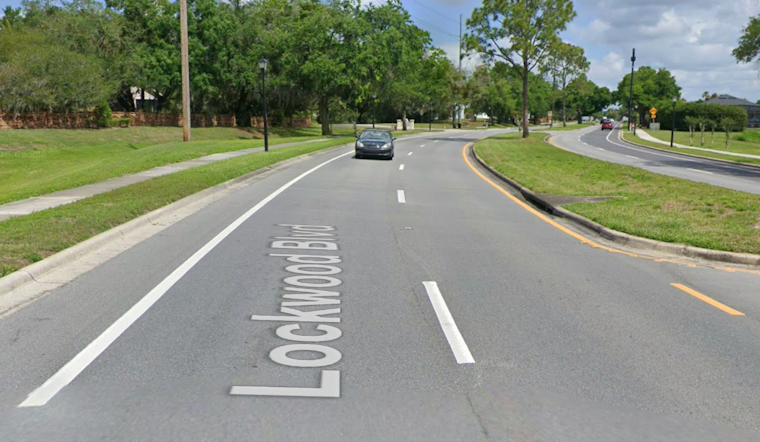
An Oviedo man armed with his father's pruning shears walked down Lockwood Boulevard early Wednesday night with one goal: destroying a license plate reader camera he said made him feel constantly watched. What 24-year-old Evan Meyer didn't know was that the camera he tore from its pole and smashed against the pavement was a decoy, planted by Oviedo police after a string of real camera thefts weeks earlier.
According to WFTV, a police sergeant watching the area reported seeing a tall man dressed in black, wearing gloves and a face covering, approach the camera with pruning shears in hand. The man knocked the camera from its pole, smashed it against the ground until it broke into several pieces, then ran north along Lockwood Boulevard. He stopped only after the sergeant activated emergency lights and ordered him to halt. Officers identified the suspect as Meyer, who was arrested near the intersection of Lockwood Boulevard and Arrowroot Place.
Meyer admitted to taking his father's pruning shears from the garage specifically to destroy the camera, per the outlet's report on the arrest affidavit. He told police the shears were meant only to damage the device, not to be used as a weapon against officers. Meyer said he was uncomfortable with a Flock camera positioned near his street and told investigators that nearby surveillance cameras made him feel as though there was a constant eye on him. He also said he had read negative information online about Flock Safety and its cameras before deciding to act, according to the arrest affidavit cited by the outlet. What Meyer apparently did not know was that the device was a replica incapable of collecting any license plate data at all.
Police Set a Trap After Real Cameras Vanished
The decoy wasn't a random precaution. Real Flock Safety cameras had been stolen from the Lockwood Boulevard corridor in late July, prompting Oviedo police to install replica units that collected no data around 10 p.m. the following Wednesday, paired with physical surveillance to catch whoever came back. That surveillance is exactly what caught Meyer days later.
Meyer now faces a grand theft charge, a criminal mischief charge for causing at least $1,000 in damage, and a charge for damaging computer or electronic equipment. Under Florida Statute § 812.014, third-degree grand theft applies to property valued between $750 and $20,000 and carries up to five years in prison and a $5,000 fine. Criminal mischief becomes a third-degree felony under Florida Statute § 806.13 once damage reaches $1,000, also punishable by up to five years behind bars. The computer and electronic equipment charge stems from Florida Statute § 815.06, which criminalizes willfully destroying or damaging equipment tied to a computer or electronic device operated on behalf of another entity — a statute distinct from ordinary property damage laws and specifically aimed at protecting networked hardware like Flock's cameras. Meyer's total bond was set at $7,500.
A City Already Arguing Over Flock Cameras
Meyer's arrest landed just three days after the Oviedo City Council held a public meeting where residents pushed back hard against the city's Flock camera program, citing Fourth Amendment privacy concerns, as Hoodline reported in its council review of Flock cameras. Oviedo signed a five-year, $128,000 lease with Flock Group Inc. in September 2025 to install eight automated license plate readers at the city's perimeter, and the network became operational in February 2026. Seminole County as a whole has an estimated 190 Flock cameras running across its various jurisdictions as of August 2026, according to privacy tracking data cited in local reporting — a density that helps explain why residents like Meyer describe feeling surveilled at every turn.
Meyer's stated reasoning echoes concerns raised well beyond Oviedo. An investigation published by The Washington Post in August 2026, as detailed by Poynter, found dozens of cases where law enforcement officers improperly used Flock Safety cameras to track individuals without authorization, a revelation that pushed Flock to announce mandatory case-number logging and default data deletion after seven days. Flock Safety's network spans more than 80,000 automated license plate readers across 49 states, deployed by roughly a third of all U.S. law enforcement agencies, according to the ACLU.
Part of a Broader Backlash Against Surveillance Cameras
Meyer's actions fit into a wider pattern documented nationally. The Guardian has reported on a growing vigilante movement against automated license plate readers in 2026, with activists and residents in multiple states cutting down, spray-painting, or removing Flock camera poles. Similar acts of camera vandalism and related police investigations have surfaced elsewhere in Florida this year, including in Cape Coral, according to WINK News.
The tension between that backlash and municipal surveillance contracts is playing out in city halls elsewhere too. St. Charles County recently killed its own Flock program after a worker was found to have used the cameras to track an ex-partner, a case Hoodline covered in its report on tracking an ex. Whether Oviedo's council follows suit remains an open question, but Meyer's arrest ensures the debate over the city's $128,000 camera network won't fade quietly.





