

























































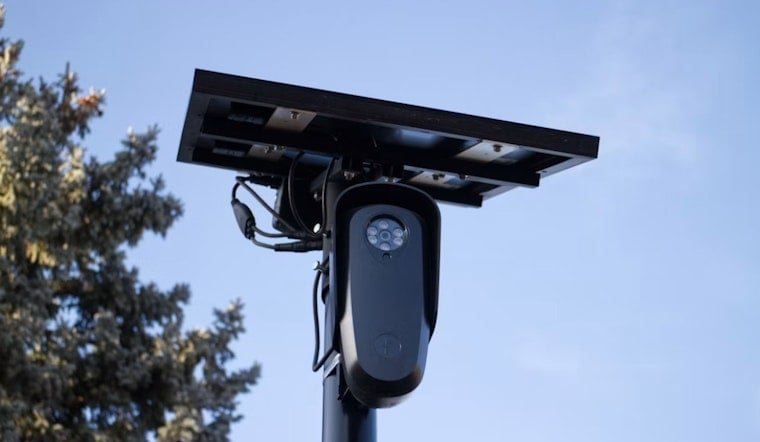
Parker police officials pitched the town council on a new package of drones and license plate reader cameras Monday, telling elected leaders the technology could shave crucial seconds off emergency response times as the town's population keeps climbing. The council took no formal vote and gave no direction, but the roughly hour-long study session revealed just how far the department wants to expand its use of aerial and camera surveillance tools.
The proposal would tack on about $175,000 a year to the Parker Police Department's existing $530,000 annual contract with Axon, according to the Denver Gazette. Commander Jake Schuster told council members the technology could enhance response times and provide for Parker citizens, framing it as a way to address staffing challenges as the town has grown from 58,512 residents at the 2020 census to an estimated 72,147 people spread across 22.4 square miles as of the start of this year, per the Town of Parker.
Police officials recommended a phased rollout rather than a full buildout all at once. The initial phase would include one drone hive, made up of three docked drones, plus 10 additional automated license plate reader cameras and the software platforms needed to run them, the Gazette's report notes. Any expansion beyond that opening deployment would come later, and only after officials evaluate how the first phase performs.
A Week of Testing Yielded Mixed Results
The pitch wasn't purely theoretical. Parker's police department ran a one-week drone pilot in June that logged 112 missions, according to the same account. Drones beat officers to the scene on roughly 22% of those calls, giving responding units a head start on situational awareness before they even arrived.
Officers rated the drones as useful in about 90% of deployments during that test window, and in 4.5% of incidents the drones alone helped resolve the call without requiring a patrol unit to respond at all. Schuster described the broader system as a potential force multiplier, saying the technologies could give officers more information before they arrive and help investigators solve crimes more efficiently, per the Gazette.
Under the proposal, drones would only launch in response to specific calls for service, not for routine neighborhood patrols. Once dispatched, the aircraft would stream live video to officers and dispatchers before police reach the scene, giving responders a real-time picture of a situation as it unfolds. Axon representatives said the underlying system would rely on Skydio drones for the first-responder function, and the license plate cameras would supplement Parker's existing network of Flock reader cameras rather than replace it.
Council Presses on Data Ownership and Access
Privacy dominated much of the discussion. Council members pressed officials on how footage and data would be stored, who could access it, and what safeguards would prevent misuse, according to the Gazette's account of the session. Axon representatives told the council that Parker would retain ownership of all collected data, and that sharing information with outside agencies would require specific agreements rather than automatic participation in any national network.
Officials also stressed limits on what the system could actually do. The proposed setup will not be able to identify individuals automatically, though it could track a specific person once an operator selects that target within a given incident. Town officials said they intend to develop formal policies governing deployment, data retention, transparency, and accountability before any implementation moves forward, and police officials emphasized that no purchase decision has been made.
Colorado law already sets some outer boundaries on how long that kind of footage can sit in storage. Under Colorado Revised Statutes §24-72-113, passed in 2014, video or images captured by government passive surveillance cameras must be destroyed within three years unless the material is tied to an active criminal investigation, according to the Colorado Division of Criminal Justice. State lawmakers had considered going further this year: Senate Bill 26-070 would have required warrants to search license plate data older than 72 hours and capped retention at 30 days, but sponsors pulled the bipartisan measure in April after acknowledging they lacked the votes, per the Institute for Justice. That leaves individual towns like Parker to set their own guardrails.
Parker Isn't Acting in Isolation
The council's caution echoes a broader regional pattern. Douglas County commissioners already approved a similar public safety technology initiative, one that Hoodline previously reported cost $22.8 million over 10 years, covering drones, license plate readers, and a real-time information center for the county sheriff's office. Nearby Aurora fully launched its own Real Time Information Center and Drone as First Responder program in November 2025, using Axon's Fusus platform to fold drones, plate readers, and camera feeds into one system, according to Colorado Politics.
At the same time, Parker's elected leaders have shown they're willing to slow down commercial drone activity even as they weigh expanding police drone use. The town council approved an emergency nine-month moratorium in July on land-use approvals for commercial drone dispatch and delivery facilities, a response to inquiries from operators including Walmart and Wing. Neighboring Castle Rock passed its own six-month emergency pause on commercial drone delivery hubs around the same time, giving officials there room to study noise, safety, and land-use impacts.
For now, Parker's police drone and camera proposal remains just that — a proposal. Monday's study session ended without a council vote or formal direction, leaving the department's roughly $175,000-a-year expansion plan on hold while officials work out the policy details that council members say need to come first.





