

























































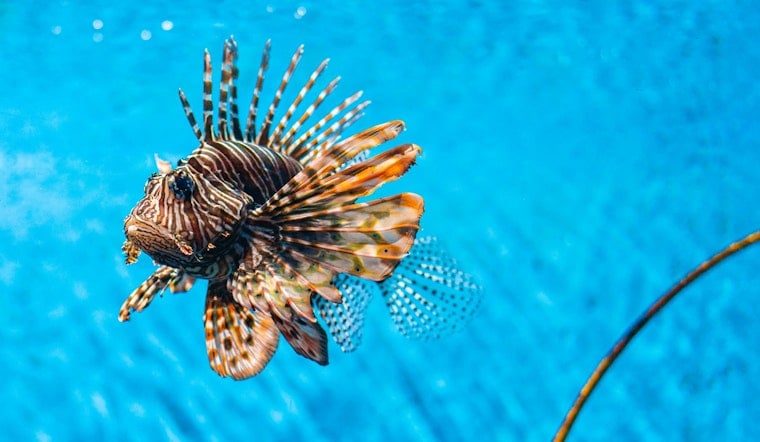
Pensacola divers will get their first shot at a brand-new statewide tournament this September, as the Florida Fish and Wildlife Conservation Commission hosts its inaugural Pensacola Lionfish Invitational Tournament and Festival at Plaza de Luna on Palafox Pier from September 24 through September 27. The four-day event combines a competitive lionfish removal tournament with a public festival featuring educational exhibits, tastings, raffles and family activities.
According to Tampa Free Press, competitive registration is open to individual divers as well as teams of up to four participants, and multiple teams may fish from the same vessel. Team rosters lock once registration closes, and no substitutions are allowed after that point, the outlet reports. Divers who want to guarantee a specific shirt size need to register by Friday, August 21, while the final deadline for paid registration required for prize eligibility falls on September 24 at 7 p.m.
A Discount for Divers Already in the Game
Anyone who has already logged at least one lionfish in the 2026 FWC Lionfish Challenge qualifies for a discounted $75 registration rate for the Invitational, per the Florida Fish and Wildlife Conservation Commission. That challenge got a structural overhaul in April, when FWC replaced its traditional champion categories with five new award divisions: Lionfish King, Lionfish Queen, Commercial Champion, Junior Harvester for divers under 18, and Veteran Champion. Photos from 2025 show past titleholders Commercial Champion Donald Vautrinot and Lionfish King Paul Carlson posing with their catches in Pensacola, a reminder that the Challenge circuit already has local roots even as the Invitational itself is new.
Rules, registration forms and the full festival schedule are posted at reefrangers.myfwc.com/lionfishinvitational. The agency has framed the tournament as a way to turn organized diving into a measurable conservation tool, stating that “conservation is a community effort, and every lionfish removed makes a difference.”
Why the Removal Effort Never Really Stops
Lionfish are not native to the Gulf, and they outcompete native fish for food and habitat, which is precisely the problem organized tournaments are designed to address by pulling large numbers of the predators out of the water at once. The biological math behind that urgency is stark: a single mature female lionfish can release up to 30,000 eggs every four days in warm water, adding up to more than 2 million eggs a year that drift on currents for roughly 25 days before settling on new reefs, according to marine biology research cited by both FWC and NOAA. Because lionfish reproduce that fast and have no natural predators in the Atlantic, complete eradication is not considered ecologically realistic, which is part of why Panhandle hotspots like Destin and Pensacola keep running these removal events year after year.
NOAA research documents just how much damage the species can do once established, showing invasive lionfish consume more than 70 native marine fish and invertebrate species and can cut juvenile native reef fish recruitment by as much as 80 percent on heavily invaded reefs. Pensacola has hosted smaller community removal derbies before this new state-run Invitational; FWC's own event logs show the 2023 Pensacola Lionfish Shootout brought in 2,488 lionfish, evidence that local divers were already engaged before the state stepped in with a bigger event. Nearby Destin offers a sense of scale for what a well-organized Panhandle tournament can pull off — divers at May's Emerald Coast Open, widely considered the world's largest lionfish tournament, removed more than 20,000 lionfish from Gulf waters during pre-tournament and main-event competition.
Statewide Numbers Keep Climbing
The push in Pensacola fits into a broader statewide trend. FWC reported that divers pulled a record-breaking 31,774 invasive lionfish out of Florida waters during the 2024 Lionfish Challenge, the highest annual total since the program began in 2016. That scale of removal effort helps explain why the agency keeps investing in new regional tournaments like this one, and why lionfish population pressure elsewhere in the state has become a recurring theme this year.
Florida also keeps the legal barriers to entry low. Under state administrative rules, recreational divers using pole spears, Hawaiian slings, handheld nets or lionfish-specific spearing devices do not need a recreational fishing license to target the species, and there are no daily bag limits or minimum size restrictions on what they bring up. Commercial sale of lionfish still requires a valid Saltwater Products License, a distinction that matters for anyone hoping to turn a tournament haul into restaurant fare.
From the Water to the Plate — and the First-Aid Kit
Festival organizers lean on culinary demonstrations and tastings for a reason beyond entertainment. An April 2025 economic study published in the Agricultural and Resource Economics Review found that consumer willingness to pay for lionfish dishes stayed well below what people would pay for traditional commercial fish, even after being told about the ecological benefits of eating the invasive species. Building public appetite for lionfish meat is part of why state wildlife officials view a viable commercial market as a necessary long-term control mechanism, pairing spearfishing derbies with the kind of tasting demonstrations planned for Plaza de Luna.
Handling the fish themselves requires some caution before they ever reach a fillet knife. Lionfish carry 18 venomous spines along their dorsal, pelvic and anal fins that inject heat-labile neurotoxins on contact, and the standard treatment is hot water immersion between 100 and 110 degrees Fahrenheit to break down the toxins and ease the pain. The meat itself carries none of that venom and is considered safe to eat once properly cleaned. This year's festival continues a decade-old tradition dating to February 2015, when FWC formally established statewide Lionfish Removal and Awareness Day to promote public education and coordinate Panhandle festivals like this one.





