

























































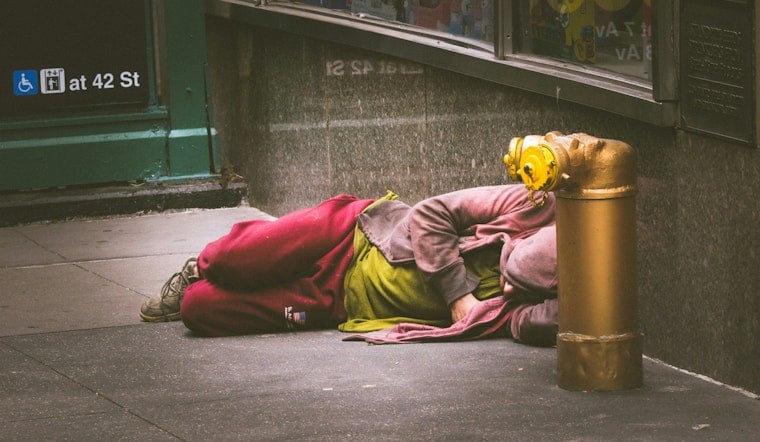
Barbara Lear has been sleeping outside since February, and this past summer nearly broke her. During a stretch of three straight days above 100 degrees in Philadelphia, she says it got so hot outside that she could barely breathe. She ended up hospitalized for breathing problems and was given steroids to recover.
Lear's ordeal is part of a pattern advocates say exposes a dangerous gap in how Philadelphia protects unhoused residents from summer heat, according to WHYY. The city's Code Red alert, triggered when forecasters predict at least three consecutive days with a heat index of 95 degrees or higher, deploys additional street outreach teams to hand out water, resources, and shelter referrals. But unlike winter's Code Blue, which automatically expands overnight shelter capacity, Code Red carries no such guarantee, leaving many unhoused Philadelphians to face dangerously hot nights without a guaranteed indoor bed.
That distinction has become a rallying point for the Good Works Coalition, a group that includes homeless people, advocates, and service providers. The coalition wrote an open letter to Mayor Cherelle Parker's administration calling for stronger heat protections, including summer resources that mirror what's available in winter, a 24/7 heat respite-and-navigation site, safer and cleaner shelter conditions, and better communication about where cooling centers are and when they're open.
A Brutal Stretch of Triple-Digit Days
The urgency behind those demands traces back to early July, when Philadelphia recorded three consecutive days with temperatures reaching 101 degrees or higher — only the third time since official record-keeping began in 1873 that the city hit triple digits on three straight days, per reporting by the Philadelphia Inquirer. Philadelphia recorded eight heat-related deaths in 2026, a toll that underscores how dangerous the season has become even with the city's warning systems in place.
James Sanders, 52, passed out while waiting for an emergency shelter bed outside the Mike Hinson Resource Center, according to the coalition's account relayed to the outlet. At Temple Health's emergency department, unhoused patients were treated for dehydration, fatigue, heat stroke, and severe hyperthermia — conditions that, left untreated, can cause organ damage. Arch Street United Methodist Church called ambulances for unhoused guests suffering heat-related illness during the same stretch.
What the City Did — And Didn't Do
During the early-July heat wave, Philadelphia extended hours at dozens of libraries, recreation centers, and partner organizations to serve as cooling centers, suspended residential utility shutoffs, and provided transportation from shelter intake centers to shelters. The Philadelphia Water Department opened hydration and misting stations between City Hall and Lemon Hill. The Parker administration also increased monitoring of shelter conditions and kept additional winter shelter beds open year-round through the summer, adding hundreds of beds in 2026 as part of a broader push that included opening low-barrier facilities like Hope 220 on Broad Street.
Still, those additional beds are only funded through the end of fiscal year 2026, raising questions about what happens once that funding runs out. Philadelphia's official Point-in-Time count from February found 5,163 people experiencing homelessness citywide, including 711 unsheltered individuals — a 39 percent drop in unsheltered homelessness from 2025's count of 1,178, even as sheltered homelessness rose 2 percent to 4,452, per the city's tally reported by the same outlet.
Advocates Point to Phoenix as a Model
Cheryl Hill, a city official quoted in the report, said Philadelphia is evaluating best practices and whether more extreme-heat action is needed. Dr. Trisha Acri told the outlet the city needs more summer resources like those available in winter. Service providers have also asked for a simple paper or printable list of consistent cooling centers, since the city's online cooling-center map is difficult to use for people without consistent internet access.
Advocates have pointed to Phoenix, Arizona, as a contrasting model. That city opens heat relief sites starting May 1 and keeps them running through the entire summer, including one 24/7 heat respite center that operates around the clock, a structure Hoodline has compared to Sun Belt cooling efforts elsewhere. Philadelphia, by contrast, is not planning a 24/7 cooling-center network, and the city currently has no equivalent overnight protection under Code Red to match its winter Code Blue sheltering.
Air Quality Added Another Layer of Danger
The heat wasn't the only hazard unhoused Philadelphians faced this summer. Canadian wildfire smoke made the city's air quality very unhealthy in mid-July, and street outreach workers responded by handing out surgical and KN95 masks. The Office of Homeless Services says it will evaluate whether to develop a formal air-quality emergency response with more resources, but for now, Philadelphia lacks a consistent formal policy for unhoused people during air-quality emergencies.
Compounding the uncertainty, the city's Department of Public Health does not track the housing status of heat victims, making it difficult to know precisely how many of the eight heat-related deaths in 2026 involved unhoused residents. Meanwhile, not everyone in need is aware help exists at all — one unhoused woman identified only as Honey told the outlet she was unaware of the Code Red declaration or the cooling-center hours meant to help her.
A City Still Weighing Its Next Move
Philadelphia's Heat Health Emergency framework, which opens cooling centers and pauses residential utility shutoffs, is declared when the heat index is expected to reach between 98 and 106 degrees depending on the heat wave's duration and time of year. That system traces back decades: the city recorded 118 heat-related deaths during the catastrophic 1993 heat wave, which prompted Philadelphia to pioneer its extreme heat warning system in the first place. From 2016 through 2025, the city averaged five heat deaths a year, a dramatic improvement attributed to those protocols even as average summer temperatures have climbed roughly 3 degrees over the past century.
Environmental mapping from the city's Department of Public Health and Office of Sustainability shows air temperatures can vary by up to 22 degrees across Philadelphia neighborhoods due to the urban heat island effect, with tree-sparse areas of North, West, and South Philadelphia facing the highest heat vulnerability. That inequity compounds the risk for unhoused residents already concentrated in the city's hottest, least shaded blocks. Nationally, homelessness rose 18.1 percent between 2023 and 2024 to more than 771,000 people on a single night, according to Project HOME, citing federal housing data — a trend that raises the stakes for how cities like Philadelphia manage extreme weather risk for people without stable shelter.
Financial strain has also shaped what the city can do. An April 2024 investigation by the Philadelphia Office of the Inspector General found the Office of Homeless Services had overspent its budget in prior years by delaying vendor payments and rolling millions in emergency shelter costs into later fiscal years just to keep emergency beds open — a history that helps explain why expanding summer protections quickly remains complicated, as Hoodline has previously reported on shelter conditions. For now, the Good Works Coalition's demands sit before an administration that says it's still evaluating what more it can do, while residents like Lear wait out each new heat wave without knowing whether a bed will be available when the sun goes down.



