

























































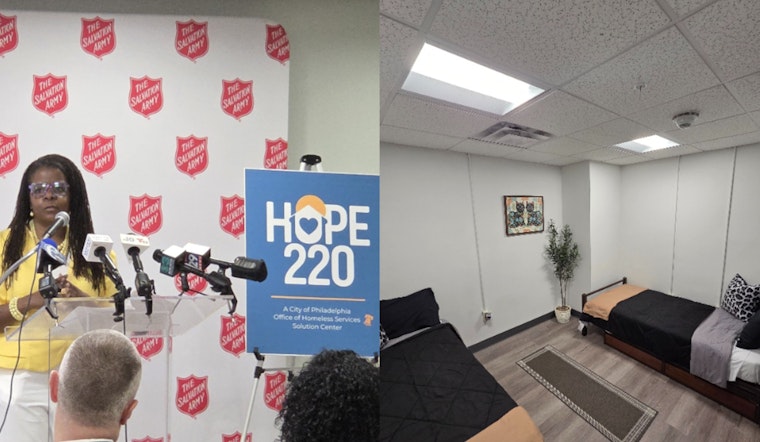
Hope 220, a city-backed "solution center," has quietly taken over part of the old Hahnemann University Hospital at 220 N. Broad Street, offering low-barrier temporary housing and on-site services for people living on the street. Operated by The Salvation Army, the site pairs shelter with medical care and housing navigation. Mayor Cherelle L. Parker spotlighted the space in a Facebook reel on March 23, 2026, calling it a shift in how the city responds to street homelessness and positioning it as one piece of a larger push to grow shelter capacity across Philadelphia.
What Hope 220 Provides
Hope 220 is set up as a low-barrier "solution center" where residents can work with case managers, get help with housing navigation, and receive basic health care while staff look for permanent housing placements, according to WHYY. Jefferson Health is providing on-site primary care at no cost, and The Salvation Army is handling daily operations for roughly 90 beds, the outlet reports.
Funding and partners
The center launched with private dollars pulled together through PHL Cares, a business-led effort that coordinates donations and matching support from local employers, as described by DiscoverPHL. Local leaders say the approach is designed to match business philanthropy with city services so low-barrier options can reach people where they are.
How Hope 220 Fits Into The City's Plan
The opening folds into Mayor Parker’s One Philly plan to create 1,000 new long-term shelter and transitional beds across the city, a target she outlined in her FY27 budget address to City Council. In those remarks, the mayor called HOPE 220 "more than a shelter" and cast it as a coordinated step toward moving people off sidewalks and into stable housing, according to the Office of the Mayor.
Early returns and concerns
Officials say the facility is sitting at about half capacity as outreach workers and service providers work to match people on the street with available beds; staff have reported early wins, including residents who reconnected with benefits or family supports, according to WHYY. The scale of the challenge is still stark. Philadelphia’s 2025 Point-in-Time count recorded about 1,178 people living unsheltered, a figure local outlets have used to call for more long-term housing options, as reported by Billy Penn.
City officials and business donors are touting the Hope 220 setup as a practical bridge between emergency shelter and permanent housing, while advocates warn that sites like this only make a dent if they translate quickly into stable placements. Mayor Parker echoed that urgency in her March 23 Facebook reel, saying Hope 220 "represents a shift in how we respond to homelessness," and calling for continued investment and coordination. The mayor’s post is available on Facebook.


