

























































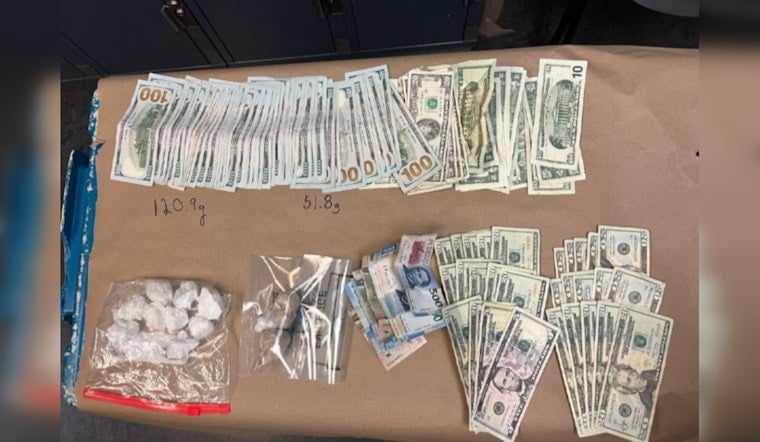
A 29-year-old man who sold fentanyl in Portland is heading to federal prison for more than eight years after a traffic stop on Interstate 5 last summer uncovered a stash of heroin, pre-packaged fentanyl bindles, and thousands of dollars in cash hidden inside his car. Eduardo Misael Garcia-Sanchez, a Mexican national, pleaded guilty to possession with intent to distribute fentanyl, and a judge determined he qualified as a career offender because of past drug-dealing convictions, according to the U.S. Attorney's Office.
The case traces back to August 5, 2025, when an Oregon State trooper pulled over the car Garcia-Sanchez was driving after drug task force investigators had followed the vehicle as it left Portland, as reported by The Oregonian/OregonLive. Investigators said they spotted a large bundle of cash and what appeared to be heroin inside the vehicle, and a subsequent search turned up more than 50 grams of heroin along with 10 individual bindles of fentanyl that prosecutors said appeared pre-packaged for sale. Federal court records reviewed by the U.S. Department of Justice put the exact haul at 120.9 grams of fentanyl powder, 51.8 grams of heroin, and $5,349 in cash, with investigators noting the vehicle had been identified as a key supply source for multiple Portland-area street dealers.
A Sentence Shaped by Prior Convictions
The final sentence — 100 months, or eight years and four months, plus four years of supervised release — followed Garcia-Sanchez's September 3, 2025 federal grand jury indictment, according to the Justice Department. That length wasn't just a function of what was found in the car. Under federal Sentencing Guidelines §4B1.1, a defendant can be classified as a career offender if they were at least 18 at the time of the offense and have at least two prior felony convictions for violent crimes or controlled substance offenses, a status that mandates a higher sentencing range, per Eisner Gorin LLP.
Federal prosecutors established that Garcia-Sanchez met that threshold based on his history of drug-dealing convictions, which is why a relatively modest seizure from a single traffic stop translated into a sentence stretching past eight years. The prosecution was brought under Operation Take Back America, a Justice Department initiative aimed at directing federal resources toward dismantling drug trafficking organizations and cartel-linked suppliers across U.S. communities.
How Task Forces Tracked the Car
The surveillance that led to the stop was conducted by the Clackamas County Interagency Task Force, which operates under the Oregon-Idaho High Intensity Drug Trafficking Area initiative — a structure that pools county, state, and federal resources against regional drug networks, according to the Oregon-Idaho HIDTA threat assessment. That task force regularly coordinates interdictions with Oregon State Police across the Portland metro area, reflecting how deeply intertwined local and federal drug enforcement has become in the region.
The danger posed by even small quantities of what task force officers found is difficult to overstate. Synthetic fentanyl is 80 to 100 times more potent than morphine and 30 to 50 times more powerful than heroin, with a dose as small as two milligrams considered potentially fatal to an adult, according to the Justice Department. That potency helps explain why federal agencies have prioritized cases like this one even when the seized quantities, measured in grams rather than kilograms, are smaller than some other regional busts.
Part of a Broader Enforcement and Policy Shift
Garcia-Sanchez's sentence lands in the same range as other recent federal drug cases out of Oregon. Hoodline previously reported that an Oakland-based drug middleman received an eight-year federal sentence after being intercepted with multi-kilogram quantities of fentanyl and methamphetamine bound for Pacific Northwest street markets, suggesting federal judges in Portland have kept up strict, multi-year sentences for repeat distributors.
The case also arrives as Oregon's drug policy landscape continues to shift. House Bill 4002 took effect in September 2024, re-criminalizing personal possession of small amounts of hard drugs like fentanyl and heroin as Class C misdemeanors while creating deflection frameworks meant to steer offenders into treatment, according to OPB. The law repealed core decriminalization provisions of 2020's Measure 110.
Meanwhile, state health data suggests the broader crisis may be easing slightly even as prosecutions continue. Oregon Health Authority figures released in May showed 1,544 people died from drug overdoses statewide in 2024, a 16% decrease from 1,833 deaths in 2023 and the state's first annual decline since 2016 — though fentanyl was involved in more than 90% of those fatalities. The same data showed 62.2% of fatal overdoses in Oregon that year involved multiple substances, commonly synthetic opioids combined with stimulants or heroin, a pattern reflected in Garcia-Sanchez's car carrying both fentanyl and heroin together.



