

























































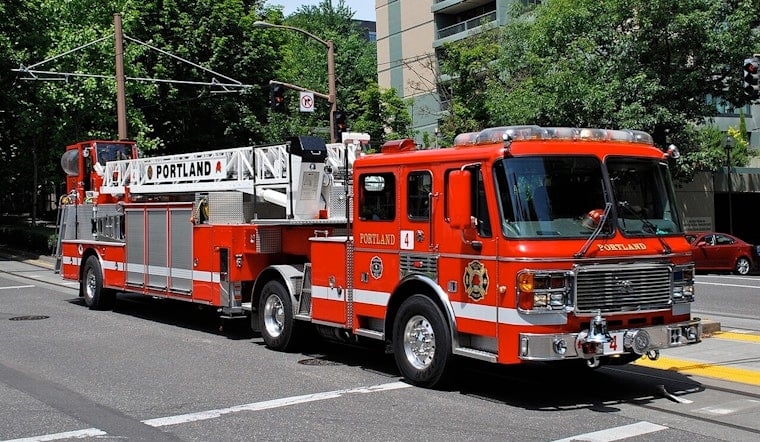
A fire climbing up a Portland hillside on Friday moved faster than fire engines stationed below could keep pace with, cutting off their water supply and forcing an upgraded response so incoming crews could launch a direct attack from higher ground.
Flames Outpace Engines Below
According to Portland Fire & Rescue, the incident was upgraded for additional resources because the fire was making a run up the hill into an area the engines below could not reach with their water supply. The bureau said incoming resources would be able to make a direct attack once they arrived, addressing the gap left by engines whose hoses could not stretch far enough uphill to reach the advancing flames.
The tactical problem described by Portland Fire & Rescue is a familiar one in the city's hillier neighborhoods. When hydrants are inaccessible or too far from a fire on a steep slope, crews are required to run long uphill hose lays from downhill engines or tie into more distant secondary hydrants just to get water where it is needed, per department protocol described on the bureau's Facebook page.
Why Portland's Slopes Are So Dangerous
Areas like Forest Park and the surrounding West Hills are considered among the city's highest natural hazard zones for exactly this reason. Steep slopes and dense forest canopy put more than 70,000 residents at risk from wildland-urban interface fires, as detailed by Willamette Week. Fire moves faster uphill than on flat ground, which is why a blaze that starts small at the base of a hill can quickly outrun the crews and equipment positioned below it.
Portland Fire & Rescue Station 27 sits at an elevation of 1,120 feet in the West Hills and was specifically built to handle this kind of terrain, including limited hydrant networks and steep-slope wildland responses, according to Susan LiChun Lee Realty. Stations positioned in the hills give the bureau a head start on hillside incidents, but the challenge of matching water supply to a fast-moving fire on a grade remains a persistent operational hurdle.
A Summer Already Stretching Fire Crews Thin
Friday's hillside response comes during a stretch that has already tested Portland Fire & Rescue's capacity. On August 3, the bureau sent 88 firefighters — nearly half its active shift workforce — to battle a fourth-alarm fire at the vacant Centennial Mills facility in Northwest Portland, as reported by FOX 12 Oregon. Days earlier, on August 7, crews in the Cully neighborhood had to call for backup after a 100-by-50-foot brush and grass fire threatened a commercial metal building, according to Hoodline's earlier coverage.
Conditions across the region have made rapid fire spread more likely all summer. The National Weather Service issued Heat Advisories for Portland in early August as temperatures neared 100 degrees, drying out vegetation and setting up the kind of fuel that lets flames race across sloped ground. Multnomah County health officials also issued mandatory wood-burning restrictions on August 6, marking four consecutive Red Days driven by extreme weather, ground-level ozone, and drifting smoke from regional blazes including the Grasshopper Fire near Mt. Hood.
Burn Ban Violations Have Already Drawn Scrutiny
Portland Fire & Rescue and the Multnomah County Fire Defense Board put a seasonal burn ban in place on June 15, prohibiting outdoor debris burning, fire pits, and open flames citywide due to elevated heat and dry vegetation. The ban has not stopped every resident from lighting fires: on July 26, crews responded to a backyard brush fire at the home of District 4 City Councilor Mitch Green, who said he had not realized the burn ban was in effect when he was clearing brush, per Willamette Week's report.
To reduce the fuel that lets fires climb hillsides in the first place, Portland Fire & Rescue works year-round with Portland Parks & Recreation and the Forest Park Conservancy to clear non-native vegetation like English ivy and laurels from steep park corridors. That vegetation management is meant to slow exactly the kind of uphill fire run that forced Friday's upgraded response, though it does not eliminate the risk on Portland's steepest terrain.





