

























































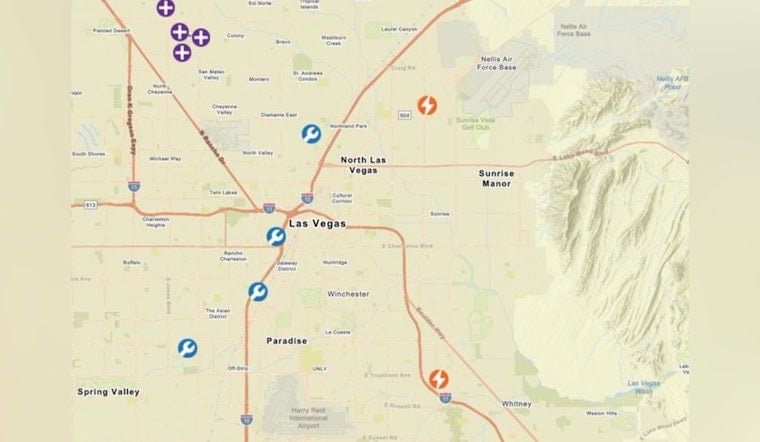
Traffic signals went dark across multiple corridors in the Las Vegas valley on Sunday after power outages knocked out electricity in several areas, prompting a public alert from the region's transportation agency urging drivers to treat every non-functioning signal as an all-way stop. The warning came as crews worked to restore power following what local reporting described as circuit faults disrupting service across the metro area.
RTC Southern Nevada, the transportation planning and transit authority for the region, posted the alert on its social media account, warning residents that “multiple power outages” had been reported and directing the public to check its website for further updates, according to RTC Southern Nevada. The agency operates the Freeway and Arterial System of Transportation, known as FAST, which actively manages more than 1,700 traffic signals, 1,300 traffic cameras, and 70 ramp meters throughout the Las Vegas valley, according to RTC Southern Nevada's own reporting on its board activities.
The outages that darkened signals Sunday followed primary distribution circuit faults in Clark County that triggered sudden power losses across key corridors in the Las Vegas metropolitan area, as reported by the Review-Journal. Automated circuit protection systems are designed to isolate high-voltage faults by dropping local power, which can leave entire intersections without functioning signals until crews complete repairs.
What Nevada Law Requires at Dark Intersections
Under Nevada Revised Statute 484B.257, drivers approaching an intersection with an inoperative traffic signal are legally required to treat it as though a stop sign had been erected at each entrance, coming to a complete stop before entering the crosswalk or intersection, according to Nevada's statutory code. That legal obligation is the basis for RTC's alert reminding motorists that a dark signal is not optional to navigate carefully — it is a mandated stop.
Right-of-way confusion at these intersections can also carry legal consequences. Under Nevada right-of-way laws found in NRS 484B.267, when two vehicles arrive at a multi-way stop simultaneously, the driver on the left must yield to the vehicle on the right, and failing to do so carries misdemeanor penalties and four demerit points, per the Nevada DMV. Failure-to-yield incidents at un-signaled intersections represent a significant share of urban traffic accidents in the valley.
A Grid Under Strain
NV Energy's southern division serves roughly 1 million electric customers across Las Vegas, North Las Vegas, Henderson, and unincorporated Clark County, in addition to supporting an annual tourist population exceeding 40 million people, according to figures reported by NV Energy. That scale means even localized circuit faults can ripple across major commercial and transit corridors relied on by both residents and visitors.
NV Energy is in the middle of building Greenlink Nevada, a 350-mile, 525-kilovolt transmission line project running from Las Vegas to Yerington that is scheduled to enter service in May 2027 and is meant to reinforce grid reliability amid rapid urban growth and rising transmission demands. The utility also began daily demand pricing in Southern Nevada this year, charging residential customers based on their single highest 15-minute usage peak each day, a strategy intended to smooth the load stress that contributes to localized outages, according to Nevada Public Radio.
Sunday's outages were not the valley's first this year. On August 2, an underground equipment failure in southwest Las Vegas cut electricity to nearly 2,600 NV Energy customers near Warm Springs Road and Durango Drive, an incident Hoodline previously covered, and underground distribution faults of that kind can take hours to isolate and repair. In March, pole-mounted equipment damage in Henderson's Cadence neighborhood knocked out power to more than 1,300 customers and forced a local charter school to cancel classes.
Copper Theft Has Also Darkened Streets
Outages are not always tied to equipment failure or grid strain alone. Local law enforcement and NV Energy officials have repeatedly pointed to substation vandalism and copper wire theft as recurring causes of localized blackouts and dark streetlights across the Las Vegas valley, according to KTNV-TV. It remains unclear which factor, if any beyond the circuit faults reported Sunday, contributed to this latest round of outages.
For now, RTC's guidance is straightforward for anyone navigating the valley's darkened intersections: treat every non-functioning signal as a stop sign, come to a full stop, and yield according to Nevada's right-of-way rules until power and signal operations are restored.




