

























































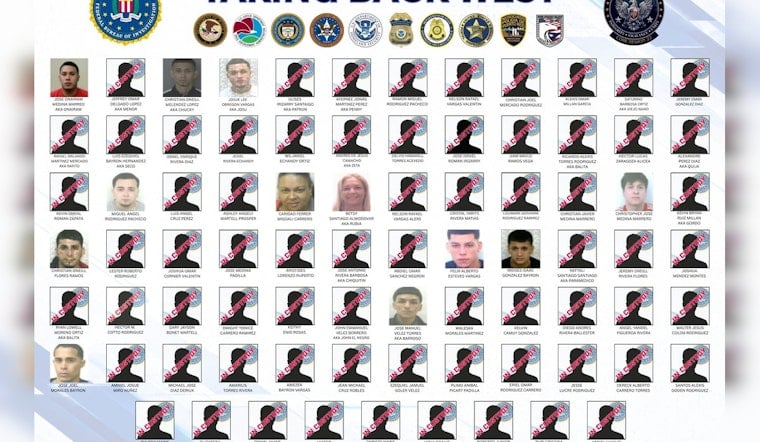
Federal prosecutors have charged 81 alleged members of a Puerto Rico gang known as Los Bajadeo, accusing the group of flooding western Puerto Rico with cocaine, fentanyl, heroin, crack cocaine and marijuana since 2021. Seventy of those defendants were arrested this week, and Attorney General Todd Blanche personally traveled to Puerto Rico as the case was announced alongside a separate wave of arrests in Ecuador and two more lethal U.S. military strikes on suspected drug boats.
According to The National News Desk, prosecutors say Los Bajadeo, also known as LBD, distributed at least 2,200 kilograms of cocaine and at least 340 kilograms of fentanyl or fentanyl-laced narcotics beginning in 2021, generating an estimated $49 million in proceeds. A U.S. Department of Justice press release published the same day filled in more of the operational picture, revealing that a federal grand jury in Puerto Rico returned the indictment on August 19 and that 13 SWAT teams and FBI San Juan personnel carried out the mass arrests, according to a U.S. Department of Justice statement.
Mayagüez Housing Projects Named as Gang's Base
Court filings cited by the Justice Department show federal prosecutors are seeking a narcotics forfeiture of more than $49.7 million from Los Bajadeo, alleging the gang concentrated its drug distribution operations inside public housing projects in Mayagüez. A Homeland Security Task Force led the multi-agency operation that built the case, per the same department statement. Blanche said the administration has zero tolerance for criminal activity and is committed to what he called innovative approaches and partnerships to eliminate drugs, cartels and violent crime.
Blanche's Puerto Rico trip built on groundwork he laid before becoming attorney general. As Deputy Attorney General in March 2025, he established Operation Take Back America to redirect Justice Department resources toward dismantling cartels and gangs and toward border enforcement, according to AP News. That initiative has now become the backbone of a broader push that stretches from a West Texas immigration case surge to a $100 million bounty campaign against Jalisco cartel leadership.
Ecuador Raids Net 26 Arrests, a Ton of Cocaine
The same week brought a parallel offensive in South America. U.S. and Ecuadorian authorities conducted a joint operation targeting Los Choneros and Los Lobos, two organizations described in reporting as powerful criminal groups accused of moving drugs throughout the region, resulting in 26 arrests, a metric ton of seized cocaine, roughly $1 million in U.S. currency, and dozens of firearms, vehicles and an airplane, per The National News Desk. Anadolu Agency reported a wider tally for the binational effort, codenamed Operation Factoria and Operation Jerico, putting the total at 36 simultaneous raids across six provinces and 43 total arrests, including two Mexican pilots allegedly flying for the Jalisco New Generation Cartel, according to Anadolu Agency.
The legal groundwork for direct U.S. military involvement in Ecuador dates back nearly a year. The State Department formally designated Los Choneros and Los Lobos as Foreign Terrorist Organizations and Specially Designated Global Terrorists on September 4, 2025, a status that opened the door for U.S. Special Forces to provide onshore intelligence and planning support to Ecuadorian military units starting in March 2026, according to a Human Rights Watch report published in July. That designation followed similar U.S. moves against Ecuadorian maritime networks detailed in Hoodline's earlier fishing fleet sanctions coverage.
Deadly Strikes Resume After Unexplained Pause
At sea, the U.S. military resumed lethal strikes against suspected drug-trafficking vessels this week after a pause of more than two months, carrying out two strikes that together killed six people. The first strike hit a vessel in the eastern Pacific and killed two people, whom U.S. Southern Command described as narco-terrorists; the second targeted a vessel traveling an established drug-trafficking route in the Caribbean and killed four, per The National News Desk. The U.S. military said intelligence confirmed the vessels were involved in narcotics trafficking.
PBS NewsHour reported that the strike campaign, known as Operation Southern Spear, began nearly a year ago in September 2025 but went quiet for more than two months following major earthquakes in Venezuela in June, before resuming in late August. U.S. Southern Command data cited by PBS NewsHour shows the military had already destroyed 64 speedboats, three low-profile vessels and one semi-submersible narco-sub, and had killed at least 227 people in 68 reported strikes on suspected drug boats before this week's pair of strikes.
Questions Over Legality and Effectiveness Persist
The expanding maritime campaign remains sharply contested. United Nations officials and international human rights organizations have condemned the lethal boat strikes as extrajudicial killings that violate international law, according to the Human Rights Watch report. The impact of the sea strikes on disrupting illegal drug flows into the United States also remains unclear, and data cited by The Guardian complicates the strategic case for the strikes: Drug Enforcement Administration figures show 74 percent of U.S.-bound cocaine travels through the Pacific while only 8 percent moves via Caribbean fast boats, and most fatal fentanyl reaches the country overland through Mexico rather than by sea, per The Guardian.
The administration is also working to expand its footprint on land across the region. Defense Secretary Pete Hegseth announced that Colombia, Guatemala and Honduras had agreed to allow U.S. military operations against cartels on their territory, though Guatemala's government publicly denied any such agreement exists, PBS NewsHour reported. That diplomatic friction underscores the scale of what the Trump administration describes as an expanding campaign against drug cartels built on cooperation with governments across Latin America, even as the on-the-ground and at-sea results of that campaign remain a matter of dispute.





