

























































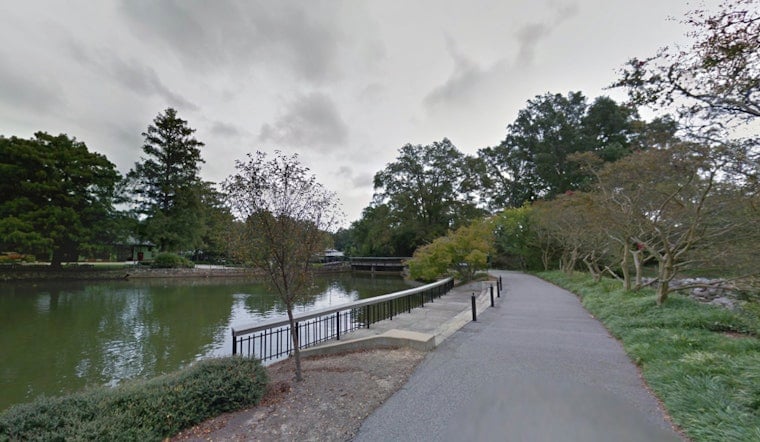
The lake at Raleigh's Pullen Park is finally coming back. City contractors are refilling the 2.75-acre Lake Howell this week, months after draining it completely to replace crumbling concrete retaining walls that had cracked in dozens of places over the decades.
The refill is really a test. According to The News & Observer, contractors will fill the lake with a mix of groundwater and water diverted from Rocky Branch, the stream that runs between Lake Howell and Western Boulevard, then drain it again after a few days at capacity so engineers can inspect the new walls for erosion or shifting. Gary Claiborne, who oversees the Lake Howell work for the city parks department, said the checks are meant to confirm the new system holds up under water pressure before the lake is filled for good.
Once that final fill happens, the lake will need to be ready for one of Pullen Park's biggest annual draws. Claiborne said the lake must be filled in time for Holiday Express, the Christmas-themed train and lights event that the paper reports draws thousands of people over more than two weeks in December, with the city planning to install the holiday lighting in October.
A Wall System Built to Last Decades
The retaining walls being replaced were decades old and cracking in many places, prompting the city to overhaul the roughly four-to-five-foot walls around both the lake's perimeter and its island. City contractors are placing new metal railings atop the rebuilt walls, and the city expects the new concrete-block wall system, which resembles designs used for retention ponds and highway projects, to last at least 50 years, per the News & Observer's reporting.
The work is part of a $2 million rehabilitation project that the city required to be completed by September. Raleigh's City Council awarded a $1,853,500 construction contract to Compendium Contracting, LLC in December, according to city meeting records, after the firm submitted the lowest bid among five contractors evaluated the previous month. Engineering firm Dewberry designed the structural specifications for the project, per the North Carolina electronic Vendor Portal, with the scope exempting only a small, stable shoreline section near the dam at the lake's eastern end.
Before crews could touch the walls, they had to deal with what was living in the lake. Contractors netted as many fish as possible, including sunfish, bluegill and bass, and moved them to a small adjoining pond before the water was released through the dam into Rocky Branch, a process the News & Observer's reporting says took two to three days. The city did not dredge the lake bottom as part of the project, and Lake Howell, which has a depth of as much as 10 feet in the center, was drained last winter to give crews full access.
Walkways and Water Recreation on Different Timelines
Walkways around the lake and out to its island are expected to reopen by the end of September, alongside completion of the broader rehabilitation project. The city also replaced underwater pipes that regulate water flow and circulation as part of the work. But not everything is coming back on the same schedule: because the lake was fully drained for construction, public pedal boat rentals are suspended for the entire 2026 season and are not expected to resume until spring 2027, according to Islands Magazine. Ducks, geese and pedal boats are among the activities Lake Howell normally hosts once it's back to full capacity.
The closures tied to the project ran wide across the park. Raleigh Parks shut down Pullen Park's amusements, playgrounds and picnic shelters entirely from February 2 through March 31, giving construction crews full access for the lake demolition, before partially reopening main attractions on April 1 while keeping the lake area fenced off, according to the City of Raleigh. Standalone amenities like the Pullen Aquatic Center and tennis courts stayed open throughout construction. Hoodline first reported on the coming shoreline closures back in January.
A Lake Named for a Park Founder
Lake Howell itself carries some history. It was built in the 1930s by the Works Progress Administration, replacing a small pond that previously occupied the site, and was named for Wiley Howell, who served as Pullen Park's manager, repairman, landscaper and zoo keeper, working at the park for 48 years before his death in 1936.
The lake sits inside a park with an even longer story. Pullen Park opened in the late 1880s as North Carolina's first public park, founded after local philanthropist Richard Stanhope Pullen donated 66 acres of farmland, and it's now recognized as the fifth-oldest operating amusement park in the country, according to The Cultural Landscape Foundation. Pullen and Howell personally designed the original grounds and planted its first magnolias and oaks. The park's history includes a pivotal civil rights moment, too: in August 1962, four Black teenagers and two white friends staged a peaceful swim-in protest at Pullen Park's racially segregated pool, prompting the City Council to temporarily close city pools before voting to fully integrate Raleigh's park system in 1963, according to ArcGIS StoryMaps.
Today the park draws more than 1 million visitors a year, per ELGL, and its attractions have kept evolving even as the lake work played out. In April, Raleigh Parks debuted a new fully electric C.P. Huntington miniature train that circles Lake Howell, replacing the park's old propane-powered engine to cut emissions in line with the city's climate goals. The park's hand-carved Dentzel carousel, added to the National Register of Historic Places in 1976, remains one of its signature draws alongside the lake that's now just days away from holding water again.



