

























































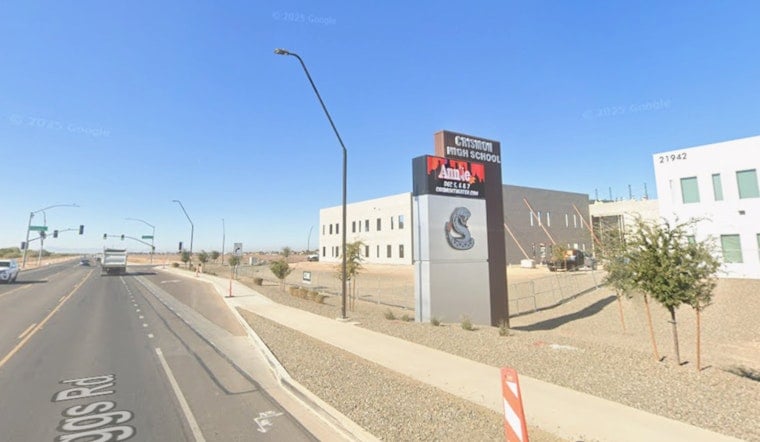
A Queen Creek mother is demanding statewide heat safety standards for students after her ninth-grade daughter got sick waiting roughly 20 minutes outside Crismon High School for a delayed school bus during an Extreme Heat Warning. Bianca Gilmore said her daughter came home flushed, asking for water, complaining of a headache, and needing to sit down on the couch to recover.
Gilmore described the incident to ABC15 Arizona, which first reported that parents and community members across the Valley are increasingly worried about how schools handle student safety during extreme heat. In response to what happened, Gilmore has reached out to state lawmakers and the Arizona Department of Health Services to push for statewide student safety standards rather than leaving heat protocols up to individual districts.
The 20-minute wait unfolded as the National Weather Service in Phoenix had issued an Extreme Heat Warning, with Valley afternoon temperatures forecast to climb between 106 and 115 degrees, a stretch of dangerous weather Hoodline detailed in its coverage of an ASU hockey player’s heat collapse earlier the same week. That kind of heat has been a recurring theme across the Phoenix metro this month, from athletes to concertgoers who lined up for hours outside Valley venues.
District Points to Its Existing Response
Queen Creek Unified School District says it prioritizes student safety and provides a supervised, air-conditioned cafeteria stocked with water for students affected by transportation delays, per the district's response reported by ABC15. The district also says it will continue evaluating its procedures and communication to make sure students have safe indoor options whenever buses run late.
The district's transportation department operates a fleet of 113 buses that ferry students to 14 district schools and six external campuses across the southeast Valley, according to the Queen Creek Unified School District. Managing that scale of daily bus routes during a summer of extreme heat warnings adds pressure to a system already stretched thin during peak temperatures.
No State Mandate for Bus Air Conditioning
Part of what fuels Gilmore's frustration is a gap in state law. Arizona regulations allow school buses to be equipped with air conditioning but do not require it, according to the Arizona Administrative Code as outlined by the Legal Information Institute. That leaves cooling equipment decisions up to individual districts and their fleet budgets rather than a uniform statewide rule.
State rules do address idling buses in the heat: buses operating above 75 degrees are permitted to idle for up to 60 minutes within a 90-minute window specifically to keep heating or air conditioning systems running, per the Arizona Legislature. But there's no equivalent statewide mandate covering how long students should be allowed to wait outdoors for a delayed bus during an active heat advisory.
How Other Agencies Handle Heat Thresholds
Other corners of Arizona's public health and education systems already draw firmer lines. The Arizona Department of Health Services issued back-to-school guidance this month advising schools and families to move outdoor activities indoors during Extreme Heat Warnings, enforce shaded hydration breaks, and give students a 10-to-14-day heat acclimatization period. Neighboring Peoria Unified School District conducts daily heat index reviews in August and September, automatically shifting to indoor “rainy day” schedules and halting outdoor activities once heat index levels hit danger thresholds, according to information published by Peoria Unified School District.
High school athletics operate under their own strict thresholds. Arizona Interscholastic Association guidelines for 2026–2027 classify the state as a high-exposure region requiring Wet Bulb Globe Temperature monitoring every 30 minutes during outdoor sports, with mandated rest breaks or cancellations as conditions worsen, according to Perry Weather. Those athletic standards, however, don't automatically extend to general dismissal times or bus waiting periods, which is precisely the gap Gilmore is asking lawmakers to close.
A Statewide Health Burden
The stakes behind Gilmore's push are measurable. Arizona emergency rooms recorded 5,974 heat-related illness visits in 2024 and more than 4,700 in 2025, alongside over 5,140 heat-related exposure deaths statewide between 2013 and 2024, according to the Arizona Department of Administration. Those numbers reflect a public health burden that has already prompted broader state action, including Governor Katie Hobbs' 2024 Extreme Heat Preparedness Plan, which created the nation's first statewide Chief Heat Officer role, and new workplace heat safety guidelines adopted by state regulators in April, reported by Cronkite News.
For now, Gilmore's daughter has recovered, but her mother says the episode outside Crismon High School shouldn't have happened in the first place, especially with an Extreme Heat Warning already in effect. Whether her calls to state lawmakers and health officials lead to firmer statewide rules for bus delays remains to be seen, even as Queen Creek Unified says it will keep reviewing its own procedures and communication with families.





