

























































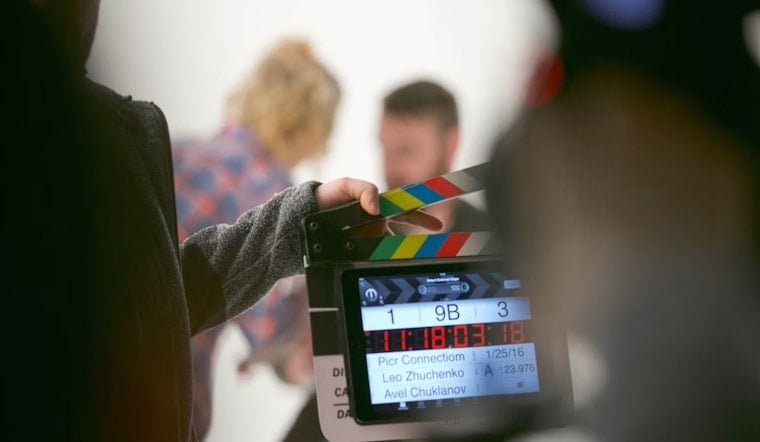
Eleven up-and-coming Bay Area filmmakers spent two days getting pointers from industry veterans this month at Bay List, a summit designed to keep local storytelling talent from fleeing to Los Angeles. The cohort toured Pixar Animation Studios in Emeryville, Lucasfilm, Dolby Laboratories and the Screen Actors Guild office in San Francisco by chartered bus, soaking up advice on budgets, scripts, casting and postproduction before their projects even reach the pre-production stage.
The event was founded by actor and filmmaker Rafael Casal, who also hosted the cohort throughout the summit, according to the San Francisco Chronicle. Casal spent about two years organizing the inaugural Bay List event and told the paper he is unsure when the next one will take place. The summit selected 10 projects from its 11 participating filmmakers, chosen through a collaboration with industry professionals, and this year's roster of collaborators included Daveed Diggs, Ryan Fleck, Anna Boden, Tom Hanks' Playtone company, Stephen Curry's Unanimous Media, Boots Riley's Cinemama, and W. Kamau Bell's Who Knows Best Productions.
Ten Scripts, One Shared Goal
The selected projects span a wide range of genres and settings. Reinhard Cate brought the thriller screenplay Terp, which follows an asylum officer interviewing a former Afghan interpreter while suspecting the man is not who he claims to be. Cate said the summit inspired him to sharpen his work and make films in the Bay Area that could actually succeed there, per the same Chronicle account.
Kausar Mohammed, who grew up in San Jose, created Exorsisters, about three Muslim sisters who inherit a family tradition of performing exorcisms. She hopes to shoot the project in the South Bay and said she believes groups can rise together. Other projects included Isabelle Barbier's Guts; Karna Warrior's Chomolungma, set in India in 1924; Sean Lynch's Whiskey Bent and Hell Bound; Rusteen Honardoost's Ramona, about a wheelchair user seeking a career and romance; Sining Xiang and Patrick Boyd's The Ghost Wedding, set in 1980s San Francisco; Joe Veix's The Hole Story; Tosin Coker's Femi; and Shirin Najafi's Bad Counselors, about a Los Angeles high school counselor who accepts a bribe from a family navigating medical costs and wealth politics.
Mentors Preach Self-Reliance Over Waiting on Hollywood
Comedian and filmmaker W. Kamau Bell, who co-founded the Oakland-based Who Knows Best Productions with his wife Melissa Hudson Bell after CNN ended his docuseries United Shades of America, told the cohort not to wait for Hollywood's permission to create, according to the Chronicle. He also advised that content can serve as a business card, building an audience before a major project is even released. Bell's Oakland company, detailed by The Oaklandside, trains the next generation of East Bay filmmakers and reflects a broader push by summit mentors to build permanent production infrastructure in the region.
Filmmaker Cheryl Dunye urged Bay Listers to remain flexible and build international relationships through film festivals. Roman Coppola, who shared stories and advice from the industry, told participants that filmmakers cannot catch the bus unless they are at the bus stop — a line meant to underscore the need for persistence and preparation before opportunity arrives.
A Nonprofit Backer With Web3 Roots
The summit's final dinner and drinks were sponsored by Decentralized Pictures, a nonprofit co-founded by Coppola and executives from his father Francis Ford Coppola's American Zoetrope studio. The organization, as Decrypt has reported, operates as a 501(c)(3) Web3 platform that uses a community voting model to award film funding and mentorship to emerging independent creators, and it has awarded more than $1 million in funding to date.
The closing gathering took place at Cafe Zoetrope in North Beach, a fitting bookend given the venue's history. American Zoetrope began in San Francisco in 1969, founded by Francis Ford Coppola and George Lucas as an alternative to the traditional Hollywood studio system, operating out of the historic 1907 Sentinel Building where Cafe Zoetrope sits today.
Bay Area's Long Struggle to Keep Filmmakers Home
Bay List's mission echoes a familiar Bay Area story: local filmmakers who succeed often decamp for Los Angeles, drawn by financing, studio infrastructure and mentorship networks that Northern California has historically lacked. Rafael Casal and Daveed Diggs starred in and produced the 2018 Oakland-set film Blindspotting, which later became a Sundance breakout turned Starz series in 2021 — a template for the kind of homegrown success Bay List hopes to replicate.
That struggle has also drawn policy attention. San Francisco Mayor Daniel Lurie signed updated “Scene in San Francisco” film incentive legislation in February, expanding the city's cash rebate program to up to $1 million per production, offering 10% to 20% back on qualifying local spending and a full refund on city agency fees and permits, according to KQED. From its 2006 inception through early this year, the program distributed $7.6 million in rebates, generating $26 million in local wages for more than 16,000 crew members and actors and $69 million in spending at San Francisco businesses, per San Francisco Patch.
California's statewide Film and Television Tax Credit program also offers a 5% bonus for productions that shoot outside the 30-mile Los Angeles Studio Zone, an incentive meant to draw directors to regions like the Bay Area. Facing production flight to other states and countries, state lawmakers proposed expanding the tax credit budget to $750 million annually and raising base credit rates to 35% last year, as the state's entertainment sector saw a 30% drop in union pension contributions between 2022 and 2024. Even with those incentives, filmmakers still face steep production costs in Northern California compared with out-of-state hubs.
Grassroots efforts have sprung up alongside the municipal and state programs. Bay Area filmmakers and organizers formed the East Bay Film Collective in mid-2023 to build local production resources, advocate for local incentives, and keep entertainment jobs in Oakland and Berkeley. Whether initiatives like Bay List and Decentralized Pictures' Web3 grants can supply enough early-stage capital to carry projects through post-production and distribution remains an open question for the local film scene.




