

























































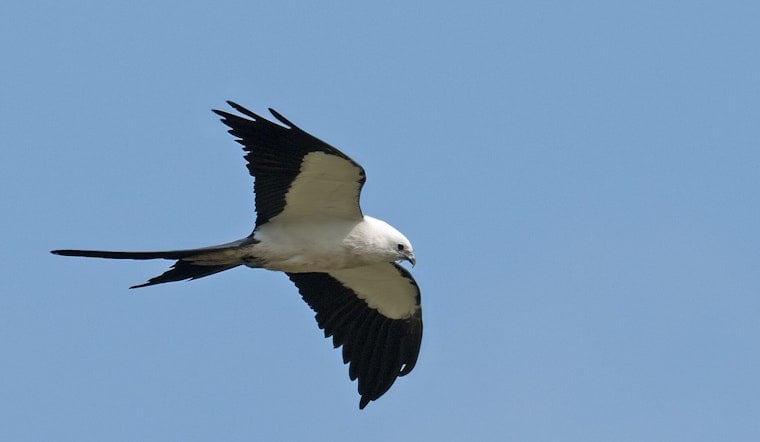
A pair of swallow-tailed kites has done something never before documented on Cape Cod: raised chicks to the point of flight. Local birder and retired teacher Peter Trimble first spotted nesting activity outside the Christ the King Parish thrift shop in Cotuit on August 22, and within days he and other observers had photographed adult kites carrying food to their young, along with a separate juvenile being fed by another adult in Mashpee.
Mass Audubon confirmed the milestone in its Cape Cod bird sightings report on August 25, according to Mass Audubon, which reported that birders observed two adult swallow-tailed kites feeding two recently fledged juveniles in the presence of a Mississippi kite. As reported by the Cape Cod Times, Trimble witnessed two adults and two juveniles together in Mashpee, and Mark Faherty, science coordinator at Mass Audubon's Wellfleet Bay Wildlife Sanctuary, said the discovery confirms the birds are indeed nesting on Cape Cod.
Trimble, who has been a bird enthusiast since age 6 and has occasionally spotted swallow-tailed kites on the Outer Cape for 40 years, told the paper the birds first appeared consistently in Mashpee, Cotuit and Sandwich around 2020. In 2025, he had spotted breeding Mississippi kites on Cape Cod and photographed swallow-tailed kites carrying sticks, but there was no evidence that year of fledged chicks. Faherty separately observed about six adult swallow-tailed kites around Santuit Pond in Mashpee in 2025, according to the same account, suggesting the birds had already established a small colony in the area before this summer's confirmed breeding.
A Tropical Bird Far From Its Southern Range
Swallow-tailed kites are typically found in the Southeast, migrating between wintering grounds in Brazil and breeding areas in Florida, per the Cape Cod Times report. The birds have a four-foot wingspan and a deeply forked tail that functions like an aerial rudder, according to the National Audubon Society, which lets them snatch flying insects, frogs and lizards in their talons and eat them entirely in flight without ever perching. The Cape Cod Times notes the birds also feed on snakes, chipmunks and baby birds, and that they travel and tend to breed in clusters, with little tolerance for cold weather driving their long migration as far south as Brazil.
Roughly 60% to 65% of the estimated 15,000 to 25,000 breeding swallow-tailed kites in the United States nest in Florida, according to Florida Keys Hawkwatch, which makes a successful nesting attempt as far north as Massachusetts exceptionally rare. The birds appear to have reached Cape Cod initially because southern and westerly winds blew them off course, the Cape Cod Times reported, though Faherty said the population's continued presence suggests they now appear to be migrating to the Cape intentionally.
A Population Rebounding From Historic Collapse
The species' newfound presence on Cape Cod echoes a much older range that was lost to habitat destruction. Swallow-tailed kites historically bred as far north as Minnesota and Wisconsin along the Mississippi River Valley, once occupying 21 U.S. states before deforestation and habitat loss in the 20th century collapsed that range down to just six or seven southeastern states by 1940, according to The Nature Conservancy.
Since then, the species has been climbing back. North American Breeding Bird Survey data compiled by the Cornell Lab of Ornithology show swallow-tailed kite populations grew by nearly 6% per year between 1966 and 2019, pushing the global estimate to roughly 260,000 birds. That rebound has coincided with the population reaching what the Cape Cod Times described as an all-time high count in Massachusetts this year, as the birds' numbers have begun to grow in recent years.
Mississippi Kites Are Following a Similar Path North
The swallow-tailed kites were not the only unusual raptors on scene. A Mississippi kite was present alongside the fledglings in Cotuit, per Mass Audubon's report, and Trimble noted that Mississippi kites — a species indigenous to Oklahoma, Florida and South Carolina — were last spotted in Connecticut and New Hampshire about 20 years ago. That timeline aligns with a broader pattern documented by the Hitchcock Center for the Environment, which notes Mississippi kites have steadily pushed their breeding territory northward since the 2000s, establishing nesting outposts in New Hampshire in 2004 and Connecticut in 2008.
Protected Land and Mosquito Control Play a Role
Habitat is central to why the birds have settled here. The 287-acre Santuit Pond Preserve, spanning Mashpee and Barnstable, was assembled as Cape Cod's largest land bank acquisition specifically to protect contiguous pine-oak forests, maple swamps and wildlife habitat, according to the Barnstable Land Trust. The preserve provides exactly the mix of forests, wetlands and protected land that swallow-tailed kites prefer for nesting, and the birds need a constant supply of flying insects to sustain themselves and their chicks.
That insect supply is helped, somewhat counterintuitively, by local mosquito management. The Cape Cod Times reports that the Barnstable County Mosquito Control Project uses an approach that benefits birds like swallow-tailed kites, treating sources of mosquito larvae rather than conducting generalized aerial spraying that might otherwise wipe out the flying insects the kites depend on.
Will the Fledglings Come Back?
Swallow-tailed kites gather in large pre-migratory roosts before flying roughly 5,000 miles to wintering grounds in southern Brazil, often departing as early as August, according to The Nature Conservancy. That timing means the Cotuit and Mashpee fledglings now face their first migration south, with no certainty about whether they, or their parents, will return next year to build on what Faherty and other observers hope becomes a lasting Cape Cod breeding colony. For now, Faherty said he hopes the kites will continue returning to the Cape, a sentiment that reflects both the excitement and uncertainty surrounding what local naturalists are calling an unprecedented moment for New England birding.





.jpg)