

























































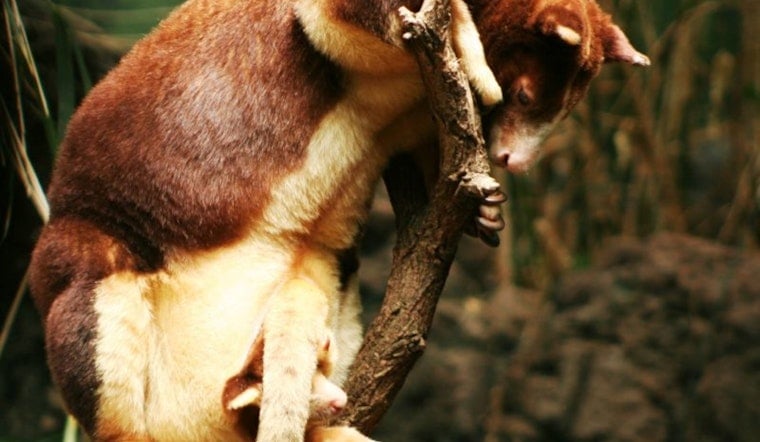
A rare Matschie's tree kangaroo joey is beginning to poke its head out of its mother's pouch at the San Antonio Zoo, giving visitors near Wild Australia's Lory Landing a fleeting glimpse of one of the world's most endangered marsupials. The joey belongs to Finni, the zoo's resident female tree kangaroo, and Tobai, the resident male, and for now it still spends most of its time tucked safely inside her pouch.
The birth was announced as part of the Association of Zoos and Aquariums' Species Survival Plan, a coordinated breeding effort among accredited zoos designed to maintain healthy, genetically diverse populations of threatened species, according to WOAI. Tim Morrow said every Matschie's tree kangaroo birth marks a meaningful step toward protecting and preserving the species for generations, calling the joey's arrival an exciting moment for the team and for conservation efforts worldwide, per the station's report. Matschie's tree kangaroos are found only on the Huon Peninsula of Papua New Guinea, and fewer than 2,500 adults are estimated to remain in the wild.
Unlike the ground-dwelling kangaroos most people picture, Matschie's tree kangaroos have muscular forelimbs roughly equal in length to their hind legs, sharp claws for gripping bark, and long, uncurled tails for balance — adaptations that let them spend most of their lives as high as 100 feet up in rainforest canopies, according to The Revelator. Female tree kangaroos carry their young for roughly 44 days, the longest gestation of any marsupial, after which the jellybean-sized newborn crawls into the pouch and stays there for eight to 11 months before fully emerging, according to the San Diego Zoo Wildlife Alliance. For now, the San Antonio joey mostly pops its head out before retreating back inside, and the zoo expects it to spend more time visible as it grows over the next several months, the same account notes.
A Pouch Becomes a Public Health Lesson
San Antonio Zoo has turned the joey's development into a community health initiative, partnering with Methodist Healthcare to draw parallels between the marsupial's pouch time and human newborn care. Samantha Pierce said parents can discuss skin-to-skin contact with their care team before delivery, per the station's report. That practice, known as kangaroo care, involves placing a newborn directly against a parent's bare chest after birth when medically appropriate, and it takes its name from the close contact between a kangaroo mother and her joey.
Skin-to-skin contact can offer real health benefits for newborns, including helping regulate body temperature, breathing and heart rate, per the same account. The zoo released video of Finni's routine veterinary checkup through a Facebook post in June, using the joey's bond with Finni to illustrate the concept for expecting parents.
Decades of Conservation Behind One Birth
San Antonio's success with the species is not new. Back in July 2015, the zoo welcomed another Matschie's tree kangaroo joey born to a mother named Libby, one of only six born in captivity across the entire United States that year, according to MySA. The new arrival continues that decade-plus track record while also connecting to habitat protection thousands of miles away.
Conservation groups work directly with communities in Papua New Guinea to protect the rainforest habitat tree kangaroos depend on. The YUS Conservation Area, established in 2009 as Papua New Guinea's first national conservation reserve, includes more than 190,000 acres of rainforest and was created through an agreement among 35 indigenous villages that banned hunting, logging and mining, according to the Tree Kangaroo Conservation Program. That program marked 30 years of community-led conservation work on the Huon Peninsula this past May, coordinating with 50 local villages to protect cloud-forest habitat, as reported by TVWAN PNG News.
Habitat loss and hunting continue to threaten the species' survival despite those decades of local effort, and pressure from agricultural expansion and resource extraction persists in the wild even as the field programs mature. Captive breeding coordinated through the AZA's Species Survival Plan is meant to safeguard genetic diversity in zoo populations while off-site exhibits like San Antonio's help fund and publicize the in-situ habitat protection underway in Papua New Guinea, according to the Tree Kangaroo Conservation Program.
Part of a Broader Zoo Expansion
The joey's arrival lands during a period of heavy investment at the San Antonio Zoo, which opened its two-acre, $15 million-plus Congo Falls habitat in December 2025, bringing gorillas back after 30 years. That project was part of a broader, multi-year effort to modernize exhibits across the park. Other major zoos have made similar moves toward tree kangaroo exhibits recently — Seattle's Woodland Park Zoo opened its Forest Trailhead exhibit featuring the species in April, the first time it had been on view there in over a decade.
Visitors hoping to catch the San Antonio joey can look for it near Wild Australia at Lory Landing, though its appearances will likely stay brief for now. As the joey grows over the coming months, zoo staff expect it to spend increasing time outside the pouch before eventually leaving it for good.





