

























































Raytheon has secured $1.3 billion in combined contracts from the Missile Defense Agency and the Army Contracting Command, funding production of ship-based missile interceptors and an anti-tank weapon system that dates back to the Vietnam War. The awards, announced Friday, split the work between manufacturing hubs in Tucson, Arizona, and Huntsville, Alabama, keeping both cities at the center of the nation's air-and-missile defense supply chain.
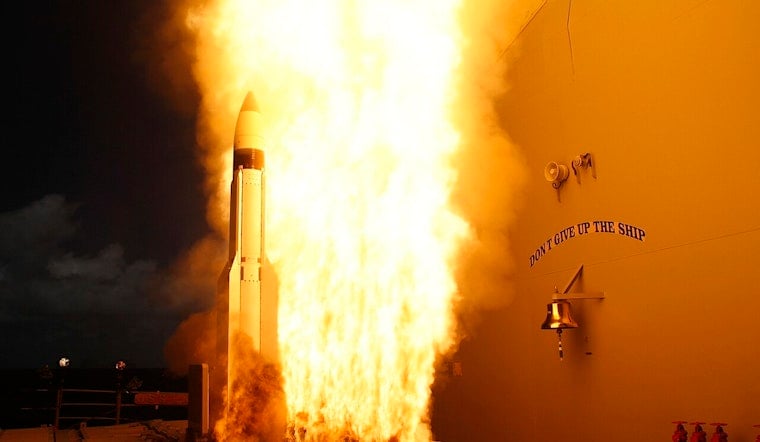
The larger of the two awards, a $745.4 million contract for Standard Missile-3 Block IIA interceptors, is a noncompetitive, undefinitized contract action identified as HQ0851-26-C-E002, according to a contract announcement from the Department of War. At the time of award, the deal obligated $275.6 million in U.S. procurement funds alongside $277.7 million in Foreign Military Sales funds from Japan's Ministry of Defense, with the U.S. government and Japan's Ministry of Defense listed as clients on the contract, per MLive. Raytheon will manufacture and assemble the SM-3 interceptor system, which is deployed on Navy ships, with an estimated completion date of February 28, 2031, and work split between Tucson and Huntsville.
A Legacy Weapon Gets a Half-Billion-Dollar Boost
The second award, worth $536 million, is not a new program but a modification — designated P00025 — to an existing contract, W31P4Q-23-C-0026, that raises the cumulative value of the Army's TOW Weapon System contract to $750.8 million, the Department of War's release states. Raytheon will begin full-rate production of the TOW system and provide engineering services under the deal, with all work performed in Tucson through August 31, 2027. TOW missiles are integrated on more than 15,000 ground, vehicle and helicopter platforms and, per Raytheon, are used by more than 40 international armed forces.
The TOW modification builds on a run of recent Army orders for the same anti-tank system. The Army previously awarded Raytheon $271.4 million in September 2025 and another $193.7 million in January 2026 for full-rate production of TOW missiles at the Tucson plant, according to Defense Blog. That outlet also reported that the Army has settled on a strategy to extend the operational service life of the Vietnam-era system, along with its ground and vehicle platforms, through the rest of the 2020s — a sign the decades-old weapon still has a role the Pentagon isn't ready to retire.
Who Oversees the Money
The two contracts run through different chains of command, both headquartered in Alabama. The Army Contracting Command at Redstone Arsenal administers the TOW missile contract, while the Missile Defense Agency, also based in Huntsville, serves as the contracting activity for the SM-3 program, according to official Department of War listings. That geographic overlap means Huntsville plays host to the oversight of both efforts even though the bulk of near-term hardware assembly happens in Arizona.
The SM-3 Block IIA interceptor itself is a joint U.S.-Japan product. It was co-designed and co-developed by Raytheon and Japan's Mitsubishi Heavy Industries as part of a cooperative effort to counter short- to intermediate-range ballistic threats, per Naval Technology. Raytheon moved the interceptor into full-rate production in mid-2024 after validating its design across the Tucson and Huntsville facilities, the outlet reported — a step that helps explain why large-scale orders like Friday's are now coming through. Once built, the interceptors are deployed on U.S. Navy and Japanese Aegis-equipped guided-missile destroyers as well as land-based Aegis Ashore sites in Europe, according to the Missile Defense Advocacy Alliance.
Part of a Bigger Pattern for Raytheon
Friday's awards are the latest in a string of major interceptor deals for Raytheon's parent company, RTX. In its 2024 annual report, RTX disclosed a prior $1.9 billion contract to produce SM-3 Block IIA rounds for the U.S. and Japan's Ministry of Defense, underscoring how the joint program has grown into a recurring, multibillion-dollar revenue line. Hoodline previously reported on a $344 million Navy missile deal awarded to the same Tucson facility in 2024, and on continued momentum for the company's broader missile business, including talks over Patriot production tied to Ukraine.
Together, the two new contracts illustrate a split strategy at the Pentagon: pouring money into next-generation interceptor technology that won't be fully delivered until 2031, while simultaneously extending the life of a Cold War-era anti-tank weapon through 2027. Both tracks run through the same two cities, keeping Tucson's assembly lines and Huntsville's contracting offices busy well into the next decade.





_SM-3_start.jpg)