

























































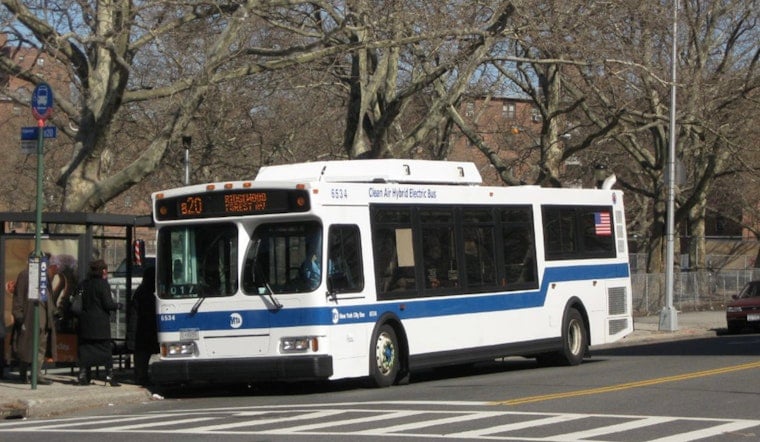
City planners have unveiled a proposed bus rapid transit corridor along Van Brunt and Columbia Streets, paired with parking maximums that would be the first of their kind in Brooklyn, as officials try to keep thousands of new residents from turning Red Hook's narrow streets into a permanent traffic jam. The plan would limit through-traffic on those corridors to buses and trucks, forcing other drivers to turn right at several intersections rather than cutting through the neighborhood.
The proposal, detailed by city planners at a task force meeting on July 31, is aimed squarely at Brooklyn-Queens Expressway spillover traffic that already uses Hicks, Columbia, and Clinton Streets as shortcuts, according to Streetsblog New York City. That spillover has long slowed the B61 bus, Red Hook's primary transit link and, per the outlet, the closest mass transit option to the redevelopment site, while also degrading pedestrian safety in the surrounding blocks. The busway concept is designed to free the B61 from that congestion and reduce background traffic volumes that delay buses, according to Chris Hrones, as quoted in the same report.
A Busway Built Around a 122-Acre Redevelopment
The transit proposal is the mitigation piece of a much larger undertaking: the 122-acre Brooklyn Marine Terminal site in Red Hook is slated to receive 6,000 new housing units, per the same account. The Economic Development Corporation, which leads the marine terminal redevelopment, is aiming to secure the right to redevelop the site through a general project plan, with an environmental impact statement expected to move forward in early 2027, according to EDC spokesperson Seth Schuster as cited in the report.
Getting there means confronting a hard geographic reality. The redevelopment site sits more than a mile from the nearest subway stop — a gap that Transportation Alternatives has described as leaving Red Hook's roughly 10,000 residents a 15-to-20 minute walk from the Smith-9th Streets station on the F and G lines. The group's data shows the B61, which carries over 7,300 daily riders, has historically posted some of the slowest average bus speeds in the city, hampered by double-parking and BQE overflow.
Trip Targets and a New Street Grid
The redevelopment's mobility goals are ambitious: the plan targets 65 percent of trips by public transit, 19 percent by walking or biking, and just 16 percent by car or taxi, the Streetsblog report notes. To support that shift, the city plans to open two new north-south streets as part of the port redevelopment, including extensions of Van Brunt Street and Conover Street. A closed block of Columbia Street north of Hamilton Avenue will become a car-free plaza under the plan.
Parking maximums in new buildings would range from zero to 0.6 spaces per housing unit, with parking infrastructure centralized in a few locations on the marine terminal site rather than scattered throughout the neighborhood. Those caps would go further than the citywide zoning changes approved in December 2024 under NYC Department of City Planning's City of Yes for Housing Opportunity amendment, which eliminated residential parking mandates in Inner Transit Zones like Western Brooklyn but stopped short of capping vehicle spaces outright.
Skeptics Question Whether New Roads Invite More Cars
Not everyone is convinced the plan will work as intended. Hank Gutman warned that new roads on Van Brunt and Conover Streets would encourage more driving, and he urged officials to ban trucks from the busway entirely, arguing that most trucks currently using Columbia Street are already there illegally. Assembly Member Jo Anne Simon, meanwhile, cited a lack of clarity in transportation planning as her reason for opposing the current proposal, per the Streetsblog report.
Other locals see the forced turns as a necessary deterrent. Jeff Smithline said forced turns combined with navigation apps rerouting drivers would help keep traffic off Columbia Street, while Sam Frommer argued that simply making driving and parking harder would push people toward other options. Danny Pearlstein said building a busway and restricting parking would address traffic concerns and reduce street congestion, according to the same account.
The BQE Question Still Looms
The city has also weighed other fixes, including a DOT review of closing the Atlantic Avenue on-ramp and MTA consideration of a direct bus line to Lower Manhattan through the Hugh Carey Tunnel, as well as broader improvements to bus connections serving the area. But the Mamdani administration has not revealed plans for the future of the Robert Moses-era expressway itself, leaving the busway and parking caps as the most concrete transportation moves on the table for now.
City officials stress the redevelopment does not prohibit car ownership or driving, and instead prioritizes transit, walking, biking, active ground floors, open space, and climate resilience. According to EDC, the busway changes will not advance until marine terminal redevelopment begins construction, meaning the proposal remains contingent on a general project plan process still working its way through review. The Brooklyn Marine Terminal redevelopment continues to be advised by a task force as the plans head toward formal environmental review.
The transportation proposal follows a string of decisions tied to the broader $3.5 billion Vision Plan the task force approved last September, which set aside 60 acres for a modernized port alongside housing and public open space, according to NYCEDC. Hoodline has previously reported on Lander's quiet BMT support, and the neighborhood has already seen one tangible change from the planning process: the phased closure of a DOT concrete recycling facility on Columbia Street that had drawn complaints over heavy truck traffic.





