

























































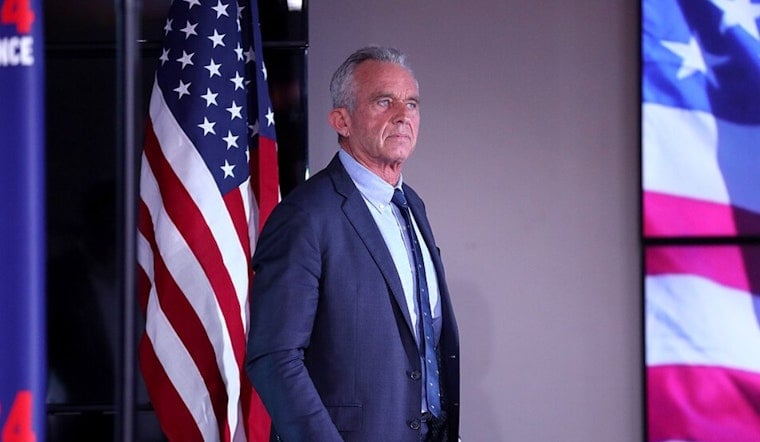
Health and Human Services Secretary Robert F. Kennedy Jr. stood inside a National City homeless shelter yesterday to announce a sweeping federal policy change that ties housing assistance to addiction treatment, marking a sharp break from the two-decade-old Housing First model that has guided federal homelessness spending. Kennedy was joined by White House Office of National Drug Control Policy Director Sara Carter and Housing and Urban Development Secretary Scott Turner at the San Diego Rescue Mission's South County Lighthouse, the site chosen to unveil the new Best Practices Toolkit for what officials are calling a Treatment First approach.
Kennedy criticized what he described as waste, fraud and abuse in federal homelessness spending, arguing that taxpayer dollars have not produced the results the government expected, according to 10News. The station reports that Kennedy has been in recovery for 43 years and said his own history with addiction shaped his support for the treatment-first framework. Under the old Housing First model, permanent housing was offered without requiring people to complete treatment first; the new toolkit instead begins with reaching people in crisis and stabilizing them, then continues through early recovery, treatment, and primary and specialty care before ending with stable housing, per the same station's reporting.
The White House's own announcement, released alongside the toolkit on Wednesday, frames the shift around federal data, estimating that 75% of homeless Americans battle drug addiction and 78% suffer from mental health conditions. Organizations applying for certain federal homelessness funding will now be required to use the Treatment First approach, the station reports, and officials emphasized that faith-based organizations like the San Diego Rescue Mission are central to that model going forward.
Why National City Was the Backdrop
The South County Lighthouse opened in June 2024 inside a former church on Euclid Avenue, becoming the South Bay's first permanent shelter with 30-day emergency beds for 162 people, according to KPBS. Hoodline previously covered its Padres-backed opening. In its first full year, the facility provided emergency shelter and trauma-informed services to 858 unhoused individuals, according to the San Diego Rescue Mission's own 2025 impact report.
Robert Marbut Jr., a senior adviser with HUD, recommended that the drug control policy office visit the San Diego Rescue Mission, and he said the facility showcased everything federal partners were trying to accomplish, per 10News. Carla Vanegas, outreach director at the San Diego Rescue Mission, was nine months pregnant and living in a drug house before entering recovery, the station reports; she now helps offer the mission's treatment-focused program to people encountered on the street. Federal officials also said naloxone that saves people's lives remains compatible with the Treatment First approach, even as they rejected the idea of distributing foil intended to facilitate continued drug use, according to the station's account. Harm-reduction programs generally provide naloxone to reverse opioid overdoses along with other supplies meant to reduce disease and death among people who continue using drugs.
Regional Ties and a Growing East County Network
The National City shelter already functions as a regional hub. In June 2026, the El Cajon City Council approved a $210,262 agreement with the San Diego Rescue Mission to fund bed space at the South County Lighthouse for unhoused individuals identified by El Cajon's street medical outreach teams, according to the Regional Task Force on Homelessness. Hoodline has tracked El Cajon's alignment with faith-based, recovery-oriented providers in earlier coverage, including a rejected state cleanup grant and the mission's broader East County ambitions.
The Wednesday announcement is not an isolated HHS effort. It aligns with President Trump's July 2025 executive order, “Ending Crime and Disorder on America's Streets,” which directed federal housing and health agencies to phase out support for unconditional Housing First programs, according to the Penn State Law Review. During the same Southern California trip, Kennedy and Turner traveled to Los Angeles to criticize the Los Angeles Homeless Services Authority and threaten to withhold federal housing funds unless local governance shifted toward recovery-focused models, the Los Angeles Times reported.
Legal Fights and Competing Research
The federal push has already run into legal resistance. A U.S. District Court judge in Rhode Island issued a summary judgment ruling in July finding that HUD's attempt to cut Continuum of Care funding for Housing First programs without proper administrative notice was procedurally improper, according to Smart Cities Dive. The ruling underscores an unresolved fight over whether federal agencies can legally redirect grant dollars away from traditional Housing First models.
Research on outcomes remains contested. A systematic review of 26 studies published in early 2026 found that Housing First models decreased homelessness by 88% and improved housing retention by 41% compared with Treatment First approaches. Locally, though, Point-in-Time data released by the Regional Task Force on Homelessness in May 2026 showed unsheltered homelessness dropped 11% across San Diego County while sheltered homelessness rose 12%, a shift the task force attributed largely to expanded local emergency shelter capacity like the Lighthouse.



.jpg)