

























































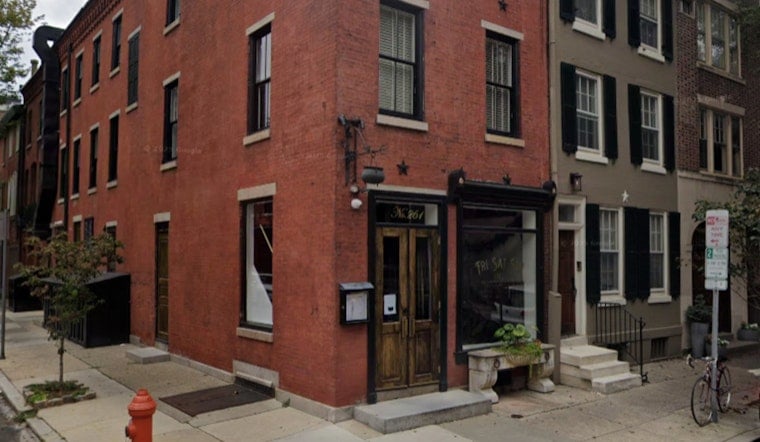
Friday Saturday Sunday, the Michelin-starred restaurant tucked into a Rittenhouse Square-area townhouse, has landed $1.5 million in Pennsylvania state funding to expand into two adjacent rear properties, transforming its current 3,000-square-foot footprint into a much larger dining destination. The grant will anchor a $7.5 million redevelopment project that owners say could create 100 jobs over the next several years.
The funding comes through Pennsylvania's Redevelopment Assistance Capital Program, according to CBS News Philadelphia, which reported the restaurant plans to transform two adjacent properties into a single expanded space near the square. The grant application, detailed by the Philadelphia Business Journal, lays out plans for an open kitchen, group dining areas, and a dedicated sweets room the application claims will be the first of its kind on the East Coast. KYW Newsradio has put the full scope of the redevelopment at $7.5 million, with the jobs figure tied to the project's build-out over the coming years.
A Sweets Room and a Movable Feast
Chef-owner Chad Williams, a Black Philadelphia native, described the ambitions of the project in stark terms in the restaurant's grant filing, stating it would become one of the most ambitious restaurants in the United States and the first minority-owned establishment of its scale in the nation, per the Business Journal's reporting. Williams elaborated on the vision to Philadelphia Magazine back in March, describing a movable feast format where diners would progress through distinct rooms over the course of a meal, alongside a rooftop herb garden and a show kitchen.
That reimagining would be a dramatic leap from the restaurant's current scale. Friday Saturday Sunday now operates out of a compact 3,000-square-foot townhouse serving roughly 200 covers a night, according to the same Philadelphia Magazine account. Uniting the current building with two adjacent rear properties would let the kitchen and dining rooms sprawl in ways the current space simply cannot accommodate.
From Weekend Diner to National Acclaim
The building at 261 S. 21st St. has a history that predates its current fame by decades. It first opened in April 1973 as a weekend-only neighborhood spot, run for four decades by original founder Weaver Lilley, before Chad and Hanna Williams bought it in 2015 and reopened it in late 2016 as an upscale fine-dining establishment, as reported by PhillyVoice.
Since then, the restaurant's trajectory has been steep. It won Outstanding Restaurant nationally at the 2023 James Beard Foundation Awards in Chicago, one of the highest honors in American dining. It earned a Michelin star in November, one of the first Philadelphia restaurants to receive the distinction after the Michelin Guide expanded its coverage to the city, according to the Philadelphia Inquirer. Most recently, North America's 50 Best Restaurants ranked it No. 40 on its 2026 list, recognizing chef Williams's eight-course tasting menu that blends French technique with African diaspora influences.
The restaurant's acclaim isn't limited to the dining room upstairs. As Hoodline previously reported, the downstairs 14-seat Lovers Bar, run by bartender Paul MacDonald on an à la carte, walk-in basis separate from the tasting room upstairs, was named a finalist for Outstanding Bar at both the 2025 and 2026 James Beard Awards.
Strings Attached to the State Money
Pennsylvania's Redevelopment Assistance Capital Program comes with conditions that will shape how the expansion unfolds. Grantees must secure at least a 50% non-state financial match and comply with the state's competitive bidding and prevailing wage laws, according to guidelines from the Commonwealth of Pennsylvania Office of the Budget. RACP funds are also issued on a reimbursement basis, drawn from state general obligation bond financing rather than paid upfront.
Those requirements leave several practical questions unresolved for now, including the timeline for municipal zoning and building permit approvals and the exact construction phasing needed to unite three separate parcels into one dining destination. How the Williamses will structure the required matching investment alongside the state's reimbursement process also remains to be seen as the project moves from grant application to construction.



