

























































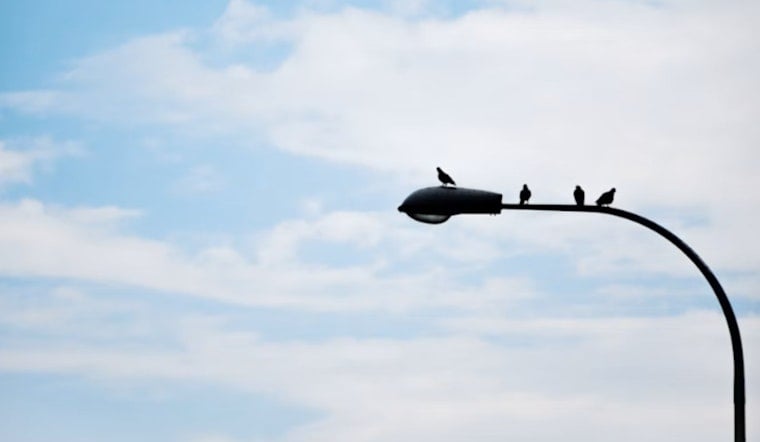
A Riverwest grandmother named Carmen says she has not felt safe after dark since the streetlights near her home went out, and she is far from alone. The Milwaukee Department of Public Works has confirmed that people are stealing copper wiring from city streetlights, leaving entire stretches of road dark for days or weeks at a time.
Carmen told WISN that the streetlights from her home to Center Street stopped working, and that the darkness has changed how her family moves through the neighborhood at night. “At night, I'm afraid to go to bed,” Carmen said, adding that her grandson is afraid to walk the street even with the dog by his side. She said the lights near Booth and Clark in Riverwest had been out for 10 days.
Frustrated by the lack of answers, Carmen said she started calling the city on August 15, 2026, and has since contacted the city, her alderperson and the mayor's office several more times. On one occasion, she called City Hall after hours for about three hours trying to get someone to address the outage.
DPW Confirms Ten Recent Thefts Across Multiple Neighborhoods
According to DPW, there have been 10 copper wire thefts in recent weeks, part of a pattern that has pulled copper wiring from streetlights in Riverwest, Riverside Park, Harambee and Rufus King. A DPW spokesperson said the department did not have a timeframe for repairs to the tampered-with streetlights, though DPW said it plans to send a crew to fix them. Milwaukee Mayor Cavalier Johnson was aware of the streetlight wire theft issue, per the station's report.
The scale of disruption traces back to how much of Milwaukee's electrical grid was built. The city maintains roughly 77,000 streetlights and 10,000 alley lights, and many run on older “series circuit” networks dating to the early 1900s, according to CBS 58. Because high-voltage power flows sequentially from lamp to lamp on those circuits, severing a single wire can darken an entire block at once, and those older circuits cannot support modern LED fixtures until they are converted to lower-voltage systems.
A Modernization Push Repeatedly Interrupted by Thieves
The city's Department of Public Works has been working to convert nearly 54,000 eligible street and alley lights to energy-efficient LED fixtures by 2026, as detailed by Urban Milwaukee. That effort has already been slowed by theft before. In July 2025, a circuit replacement project in the Rufus King neighborhood was halted for three weeks after thieves stole copper wiring and plastic piping, leaving residents from N. 12th to N. 19th streets without streetlights during the delay, according to FOX 6 Milwaukee. DPW officials at the time noted the incident followed a similar copper theft on the city's south side in 2024.
The theft problem extends beyond streetlights. In August 2026, three men were charged with felony burglary after breaking into a vacant school building on Lincoln Avenue with saws and headlamps to strip copper piping and electrical wiring, FOX 6 Milwaukee reported; the school had previously suffered fire damage before the break-in.
Record Copper Prices Fuel the Thefts
Soaring metal prices help explain the incentive behind the thefts. Global copper futures and U.S. scrap metal prices hit historic highs in August 2026, with COMEX benchmark copper trading over $6.60 per pound and clean bare bright copper wire fetching scrap payouts between $5.20 and $5.90 per pound, according to Trading Economics, with prices up more than 50% year-over-year amid global supply constraints.
Under Wisconsin Statute § 943.20, stealing scrap metal or copper is charged as a Class I felony once the property's value exceeds $2,500, and state law defines that value to include all repair and replacement costs, not just the stolen material's resale worth. Separately, Wisconsin Statute § 134.405 requires scrap dealers to record seller ID photos, license plate numbers and signed affidavits, and to hold those transaction records for two years in an effort to deter illegal resale of stolen copper.
Even so, regional dynamics may be working against that deterrent. After Minnesota passed a 2025 law requiring scrap sellers to obtain a $250 state license following widespread streetlight copper thefts in St. Paul, Midwest scrap recyclers warned that illegal sellers could shift operations across the state line to unlicensed yards in Wisconsin, according to KARE 11. St. Paul spent $1.2 million repairing damaged streetlights in 2023 alone.
The Disproportionate Cost of Repairs
The financial toll of copper theft on public infrastructure is national in scope. U.S. Department of Energy estimates indicate copper wire theft causes nearly $1 billion in utility damages nationwide annually, with every $100 in stolen copper triggering up to $5,000 in repair costs, a gap Hoodline has previously reported extends to telecom networks as well, with AT&T logging more than 10,400 copper wire theft incidents across its U.S. network in 2025.
Other cities have already turned to structural fixes rather than relying solely on enforcement. Minneapolis began replacing stolen streetlight copper wire with lower-value aluminum wiring in 2024, while Los Angeles is advancing a $125 million property tax assessment in 2026 to harden its grid and shift toward solar-powered lighting. Whether Milwaukee officials will pursue similar alternatives to its copper-dependent series circuits remains an open question, even as DPW works through its LED conversion plan and crews prepare to address the outages Carmen and her neighbors have been reporting since mid-August.





