

























































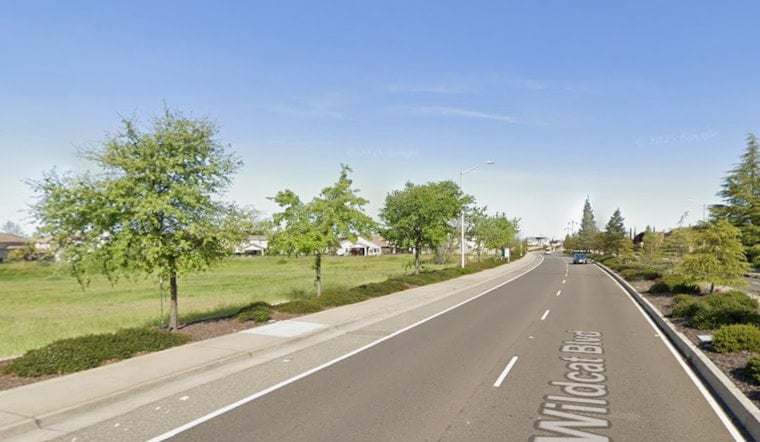
The Rocklin City Council is set to resume consideration of Sierra Wilds Apartments, a proposed 120-unit affordable housing complex at 1800 Wildcat Boulevard that sits directly beside Maria Montessori Charter Academy. The project would occupy about 4.67 acres of a 6.34-acre property, and the council continued its hearing on May 12 to allow for more public comment, questions, and deliberation. Months later, the fight over traffic, construction noise, and a shared school garden remains unresolved.
According to the Sacramento Bee, the development would include four three-story apartment buildings, a community center, a swimming pool, a tot lot, a barbecue area, and a dog park, along with 180 surface parking spaces. Of the 120 total units, 118 would be reserved for households earning between 30% and 80% of area median income, with an average affordability level around 60% of AMI, and two units set aside for on-site managers. Placer County set that benchmark at $120,800 for a four-person household in 2025, according to Placer County, which is the regional yardstick used to calculate who qualifies for the units.
The developer, Pacific West Communities, is a subsidiary of Eagle, Idaho-based The Pacific Companies, described by The Real Deal as one of California's largest affordable housing developers. The company submitted its application under California Senate Bill 330 and the State Density Bonus Law, seeking design review and an environmental exemption for a fully affordable complex, per the Sacramento Bee's reporting. City staff have recommended approval of a notice of exemption, but the city and developer disagree on whether the project actually qualifies for exemption from full CEQA review, the paper reports.
Why Rocklin's Hands May Be Tied
The property, designated Site 1-13 in Rocklin's regional housing needs inventory, was assigned that role as the city races to close a steep affordable-housing gap. Under the state's 6th Cycle Regional Housing Needs Allocation mandate, Rocklin must plan for 5,661 total housing units, including 3,543 units for lower-income households, after carrying over a 481-unit shortfall from the prior cycle, according to Gold Mountain California News. In June 2025, the state's housing department warned the city that its Housing Element was out of compliance because of a 968-unit shortfall in lower-income housing, exposing Rocklin to so-called Builder's Remedy filings if it delayed rezoning, the outlet reported.
That regulatory pressure has already shaped the council's options once. In August and September 2025, some council members tried to pull the Wildcat Boulevard parcel from the city's housing site inventory altogether, citing worries about placing 100% multi-family housing near commercial and school properties, according to city records. The California Department of Housing and Community Development has told Rocklin that Sierra Wilds qualifies for protections under the state's Housing Accountability Act, though city staff maintain that the law's specific conditions do not apply to this project, the Sacramento Bee reports. The Housing Accountability Act generally bars local jurisdictions from rejecting or shrinking a qualifying housing project unless they can show a specific, quantifiable public health or safety impact with no feasible fix, a standard detailed by law firm coverage from Hanson Bridgett LLP.
A School Garden, a Fence, and Unfinished Talks
Maria Montessori Charter Academy, a tuition-free public charter school authorized by Rocklin Unified School District, serves roughly 283 students in grades K through 8 on a four-acre site next door. School officials have raised concerns about traffic, student safety, construction noise, air quality, emergency access, and the potential loss of the school's garden, the same garden that sits on property co-owned by the school and St. Augustine of Canterbury Episcopal Church. The church, which co-owns the 6.34-acre parcel, has sought the sale and development of its surplus land out of financial necessity while planning to keep its sanctuary on the remaining portion.
City staff have explored relocating the garden either to another part of the church property or to nearby city park land, but no final agreement has been reached, per the Sacramento Bee. The developer has said it is willing to help relocate the garden and has proposed an additional southern property fence with a solid wood section topped by lattice, a plan city staff have supported. The developer also proposed a walkway connecting the church parking area to the school and an emergency access route through the apartment property, with a 14-foot emergency gate that meets the city's fire requirements, though the two entrances on Wildcat Boulevard would otherwise remain ungated for emergency vehicles only.
School driveway access through the apartment property would be limited strictly to emergencies, and the developer has said residents would have two separate ways to enter the complex, including a new entrance off Wildcat Boulevard. Even so, the school and developer have not reached a final agreement on access and property arrangements, the paper notes.
Traffic, Noise, and Construction Impacts
A traffic study found the apartments would add about 577 vehicle trips per day, with roughly 60 added trips during the busiest morning hour and 55 during the busiest afternoon hour. The analysis examined a conservative scenario involving individual student drop-offs and separate employee driving, and it found that nearby intersections should continue to operate at acceptable levels even after construction, according to the Sacramento Bee's account of the traffic findings.
A noise study estimated that the loudest construction work could reach about 75 decibels at the school, below the Federal Transit Administration's 80-decibel construction standard, and concluded that construction noise would have less-than-significant environmental impacts. A separate air-quality study found that construction would not create a significant health risk for students or school employees. The developer has proposed measures to limit construction impacts, including shifting some activity farther from the campus, requiring off-site worker parking, and adding fencing, screening, dust control, and noise control, with city staff recommending a detailed construction plan addressing traffic, parking, noise, dust, and pedestrian safety before any building permits are issued.
A Community Split, and a Legal Fund in Waiting
In April, the Maria Montessori Charter Academy Board of Directors voted to establish a dedicated Legal Defense Fund to accept tax-deductible donations for legal representation or potential land acquisition to protect the campus, garden, and preschool playground, according to the school. That formal step underscores how seriously the school's leadership is treating the standoff, even as the Rocklin Planning Commission voted 3-1 in April, with one member absent, to recommend the project's approval.
The planning commission asked the developer to keep working with the city and school on fencing, the garden, construction impacts, and access agreements, the Sacramento Bee reports. City staff say they have received more than 60 letters and other public correspondence about the project, with support and opposition described as generally evenly split. The council's upcoming decision will determine whether those unresolved details get worked out after approval, or whether the project stalls under the weight of continued local objection and the state's housing mandates.





