

























































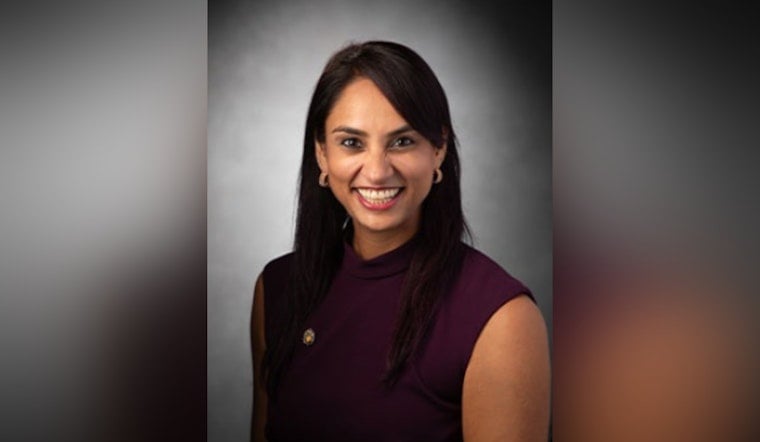
A San Antonio watchdog group has accused District 1 Councilwoman Sukh Kaur of orchestrating an illegal secret quorum through a chain of emails about a proposed water rate hike that could cost residential customers an additional $200 a year. The Bexar County District Attorney's office says the complaint, filed in June, does not yet provide enough of a factual basis to support criminal charges without further investigation.
According to the San Antonio Current, the watchdog group InfuseSA accused Kaur of violating the Texas Open Meetings Act after she and five other council members sent San Antonio Water System a list of conditions in exchange for supporting its rate increase. Kaur reportedly emailed SAWS CEO Robert Puente and board member Jelynne LeBlanc Jamison about fellow council members' concerns, and copied Jalen McKee-Rodriguez, Ric Galvan, Edward Mungia, Marina Alderete Gavito and Marc Whyte on the communication. Kaur also arranged a June 17 lunch with Puente at Down on Grayson in the Pearl area, the outlet reported, though Councilwoman Misty Spears was reportedly not included on the email chain.
What Texas Law Says About Walking Quorums
Texas law prohibits government bodies from deliberating secretly in ways that could influence public business or from voting out of public view, and it defines substantive deliberations outside a posted meeting as an illegal walking quorum. Under Texas Government Code § 551.143, a violation is a misdemeanor punishable by a fine between $100 and $500, jail confinement between one and six months, or both, according to Texas statute. Kaur and the alleged co-conspirators could face those same fines and up to six months in county jail if found guilty, the Current reported.
The current version of the statute isn't the original one. The Texas Court of Criminal Appeals struck down a prior version of § 551.143 as unconstitutionally vague in *State v. Doyal* in February 2019, which pushed the Legislature to pass Senate Bill 1640 later that year establishing specific intent requirements, according to Lloyd Gosselink Rochelle & Townsend. That history matters here: proving a member knowingly participated in a quorum-level deliberation is a much higher bar than simply showing an email chain existed.
Council Members Respond to the Allegations
District 3 Councilwoman Adriana Rocha Garcia expressed concern that Kaur may have violated the Texas Open Meetings Act and described her communications as a walking quorum, per the Current's report. Mayor Gina Ortiz Jones and Councilwoman Phyllis Viagran both said they were unaware of Kaur's document during the June 18 public meeting. Rocha Garcia served on the San Antonio City Council Ethics Review Board for nearly three years, giving her account added scrutiny in the dispute.
Former District 6 Councilman Greg Brockhouse said he believes Kaur organized a walking quorum in violation of Texas state law, though he also doubted she would face legal repercussions. University of Texas at San Antonio political science professor Jon Taylor said he was alarmed after reviewing documents obtained by InfuseSA and warned that a supposed pattern of city council behavior could lead to an investigation. Taylor also cautioned that proving and prosecuting an alleged walking quorum are different matters, and noted the Texas Attorney General's office might become involved if the alleged pattern of secret deliberations continues.
Joseph Brantley filed a formal complaint against Kaur with the Bexar County District Attorney's office on June 24, specifically requesting that prosecutors review whether the communications satisfied Texas Government Code § 551.143. The DA's office said in an emailed statement that the complaint did not provide a sufficiently reliable basis to support criminal charges, adding that criminal allegations requiring factual development are generally investigated before prosecutorial review.
The Rate Fight Behind the Legal Dispute
The email chain in question centered on SAWS's push for a rate increase to fund repairs to its infrastructure and pipes. The utility's Board of Trustees voted 7-0 on May 19 to submit a rate proposal seeking a cumulative 32.8% to 33% increase over four years to fund a $3.2 billion capital infrastructure plan, according to the San Antonio Express-News. City staff countered on June 10 with a recommendation to cap the increase between 26% and 30% through 2029 while requiring SAWS to trim operational expenses.
Facing pressure from Kaur's group and unresolved questions, the San Antonio City Council voted 6-5 on June 18 to postpone its decision on the rate hike until October, with Ric Galvan voting in favor of allowing SAWS to proceed with the increase and Misty Spears among those voting to delay. SAWS officials warned the delay could force $600 million in capital project cuts or require even higher future rate requests. A major driver behind the utility's spending plan is a 10-year settlement with federal environmental regulators requiring $1.1 billion in sewer system replacements, prompted in part by an April collapse that spilled 100,000 gallons of wastewater into Rosillo Creek, as Hoodline has previously reported.
Under SAWS's updated rate structure, low-income residents enrolled in the Uplift Program would see no bill increase at all, and the utility expanded eligibility from 125% to 150% of the federal poverty line, covering households earning up to $49,500 annually. Council's scrutiny of SAWS has intensified in recent months; in August, council members called for a data center construction moratorium after utility reporting showed two local data center campuses consumed 463 million gallons of water in 2023 and 2024 while residents faced Stage 3 drought restrictions.
The TOMA dispute also lands amid broader friction on the council. Kaur was at the center of a February clash that led five council members to seek a special meeting to consider censuring Mayor Ortiz Jones, a fracture Hoodline covered in its report on the council's internal censure push. With the rate vote now pushed to October, both the legal questions around Kaur's emails and the financial questions around San Antonio's water bills remain unresolved.





