

























































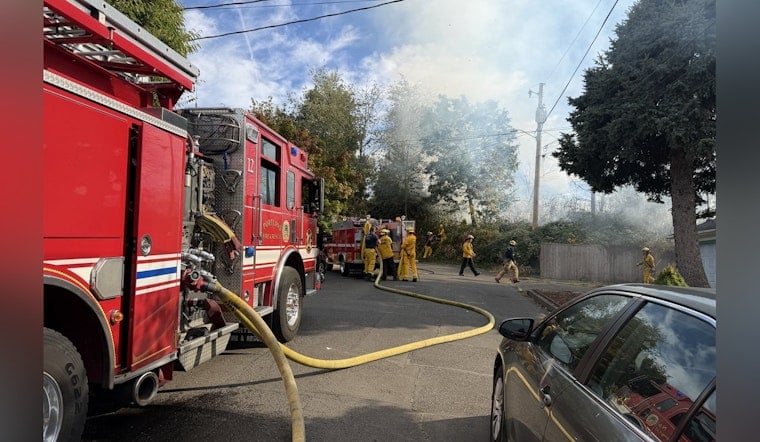
A vegetation fire broke out alongside westbound Interstate 84 in Portland on Wednesday night, growing serious enough that fire officials called for a second alarm to bring in reinforcements. Heavy brush burned close to the freeway lanes on the north side of westbound I-84 near NE 72nd Avenue, according to local community and traffic reports circulating as the fire developed.
Portland Fire & Rescue confirmed it was on scene of the vegetation fire and had requested a second alarm, according to a post from Portland Fire & Rescue. Under the department's operational procedures, upgrading an incident to a second alarm roughly doubles the initial response, sending approximately four additional engines, two ladder trucks, and battalion chiefs to secure water supply and protect nearby exposures, according to Portland Fire & Rescue's incident alert system. The scale of that response reflects just how quickly the flames were spreading through the dry roadside vegetation.
Dangerous Weather Set the Stage
The fire ignited during a stretch of extreme fire weather across the region. The National Weather Service issued Red Flag Warnings across Oregon that day, citing gusty winds, daytime temperatures in the 90s, and relative humidity dropping to as low as 8 to 15 percent — conditions that let roadside ignitions spread rapidly. Those same days brought wildfire smoke drifting into the Portland metro area, dropping air quality to moderate levels and creating persistent haze while highs neared 95 degrees, according to KGW-TV.
The bone-dry conditions are part of a historically destructive year for Oregon wildfires. By the day of the I-84 fire, the state had already recorded 1,667 wildfires that had burned more than 2.53 million acres, making 2026 one of the most severe fire seasons in Oregon history, per statewide records cited on Wikipedia. That statewide fire pressure has already reshaped travel across the state — severe wildfire activity forced the Oregon Department of Transportation to close an 80-mile stretch of I-84 between Baker City and Ontario in late July, as Hoodline reported in its piece on the eastern Oregon I-84 shutdown.
A Recurring Hazard on This Stretch of Freeway
Wednesday's blaze is not the first time this stretch of highway has caught fire this month. On August 6, Portland Fire & Rescue responded to another multi-spot brush fire along I-84 near NE 53rd and Irving Street, where torched pine trees threatened nearby apartment buildings before firefighters stopped the spread, according to a report from a local news account posted to Facebook. And in August 2025, an RV fire along westbound I-84 in Northeast Portland ignited surrounding brush and completely shut down westbound travel for nearly two hours during the evening commute, KGW-TV reported at the time.
Oregon Department of Transportation safety advisories note that dry roadside grass along highway shoulders during late summer creates extreme ignition hazards, often sparked by vehicle carbon emissions, hot catalytic converters, or dragging tow chains. That vulnerability has turned I-84 into one of the state's most fire-prone transportation corridors, with roadside ignitions capable of triggering major disruptions on what is normally a primary east-west artery.
Firefighters Stretched Thin Statewide
The second-alarm call also comes as Portland Fire & Rescue juggles heavy demands beyond city limits. The department deployed 24 personnel across Oregon during mid-2026 to assist with statewide wildfire suppression, even as it continued managing urban and highway fire calls within Portland, according to information shared in a video posted by Governor Tina Kotek's office. That dual burden — fighting fires in the city while lending crews to the broader statewide effort — has tested the agency's staffing during what has already been a demanding summer, including a recent incident in which downed power lines forced SE Portland crews into a risky apartment fire attack.
As of the latest reporting, the specific cause of Wednesday's fire along westbound I-84 had not been determined, and it remains unclear whether the blaze forced significant lane closures or delays during the evening commute. It is also not yet known how local fire stations balanced staffing for this call alongside the department's ongoing statewide wildfire deployments. Those questions remain open as Portland Fire & Rescue continues to respond to a summer marked by repeated roadside ignitions along one of the city's busiest freeway corridors.





