

























































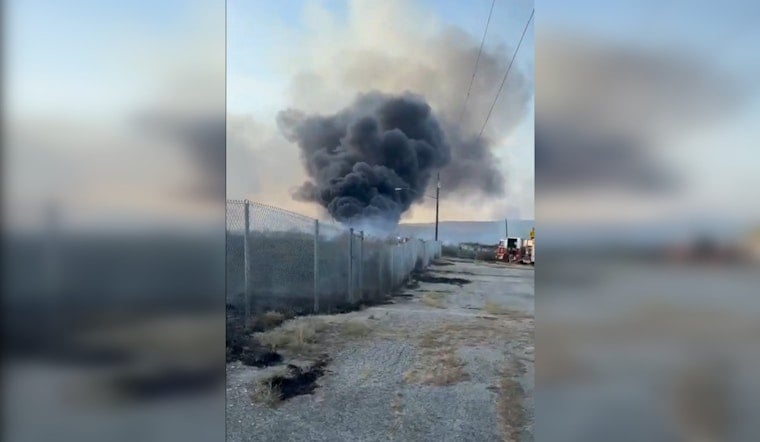
The Austin Fire Department battled a second-alarm fire Sunday evening at the Austin Country Flea Market in the 9500 block of East US Highway 290, with flames spreading into nearby grass as crews worked to contain the blaze. The first alarm came in at 5:22 p.m., and the fire was upgraded to a second alarm by 6:04 p.m. as an associated grass fire ignited off the main structure.
According to the Austin Fire Department, the second-alarm response brought additional resources to the scene as the fire grew. Fire technical documentation from Fire Alarm Houston explains that escalating a call to a second alarm generally doubles the dispatched emergency resources, adding engine companies, ladder trucks, command personnel, and specialized equipment to control heavy fire volume — a signal of just how serious the blaze had become by the time additional units rolled in.
AFD is on scene of a second alarm at the Flea Market at 9500 E US 290. First alarm came in at 17:22, was upgraded to second fire at 18:04 There is an associated grass fire that started off of the main fire.  pic.twitter.com/zByicwLMzF
— Austin Fire Dept (@austinfiredept) August 24, 2026
Local station KVUE confirmed the fire's location at the Austin Country Flea Market itself, tying the seed dispatch address to the well-known East Austin institution. The flames broke out on a Sunday afternoon, close to the market's typical weekend closing time — according to market directory information published by Spyglass Realty, the venue regularly operates Saturdays and Sundays from 10 a.m. to 6 p.m.
A Beloved Vendor Hub With a History of Fire
The Austin Country Flea Market is recognized as one of the oldest and largest weekend flea markets in Central Texas, hosting more than 300 vendor spaces across covered and paved outdoor aisles, according to KWTX News 10. It has served as a major weekend hub for small independent vendors and shoppers for decades, making Sunday's fire a significant blow to the local vendor community.
This isn't the first time the market has faced a major fire. Back in August 2009, a three-alarm fire destroyed roughly 200 of its vendor booths and forced mass evacuations, KVUE reported at the time. During that earlier incident, firefighters faced water supply challenges because nearby fire hydrants were located more than 600 feet from the vendor stalls — a detail that raises questions about whether similar hurdles complicated Sunday's response, though that has not been confirmed for this fire.
Community members posting on Reddit Sunday noted that many vendors at the market store their inventory overnight in locked booths on site, leaving them vulnerable to total merchandise loss whenever a structural fire breaks out. Because the booths function as semi-permanent storage for weekend sellers, a fire like Sunday's can translate into significant financial hardship for the small business owners who depend on the market for their livelihood.
Drought and Heat Set the Stage
Sunday's blaze landed in the middle of a punishing stretch of Central Texas weather. The Lower Colorado River Authority reported on August 18 that a stagnant upper-level heat dome had kept the region locked in triple-digit temperatures, between 100 and 103 degrees Fahrenheit, with no meaningful rain for weeks, drying out soil and ground brush across the area.
A Texas Weather Roundup report from Texas Storm Chasers, published August 20, found that Texas drought conditions had expanded by 8% in a single week, pushing fire danger to “High” across Central Texas. Those conditions help explain how a structure fire could so quickly touch off a secondary grass fire once flames spread beyond the market's main building.
The dry spell had already prompted Travis County officials to act. The Travis County Commissioners Court issued a countywide burn ban effective August 11, prohibiting all outdoor burning due to the elevated fire danger — a measure typically enacted when vegetation moisture drops low enough to favor rapid wildfire spread.
The pattern fits a broader summer trend across the region. earlier Hoodline reporting detailed how dry conditions have repeatedly sparked vegetation and grass fires around Travis County this summer, straining local fire crews already stretched thin by the heat.
Several key questions remain unanswered. The specific cause of the ignition has not been disclosed, and the full extent of structural and inventory damage was still unclear as of Sunday night. It also remains unknown whether water supply or hydrant access posed the same hurdles seen during the market's 2009 fire, or whether any vendors or late-day visitors were injured during evacuation.





