

























































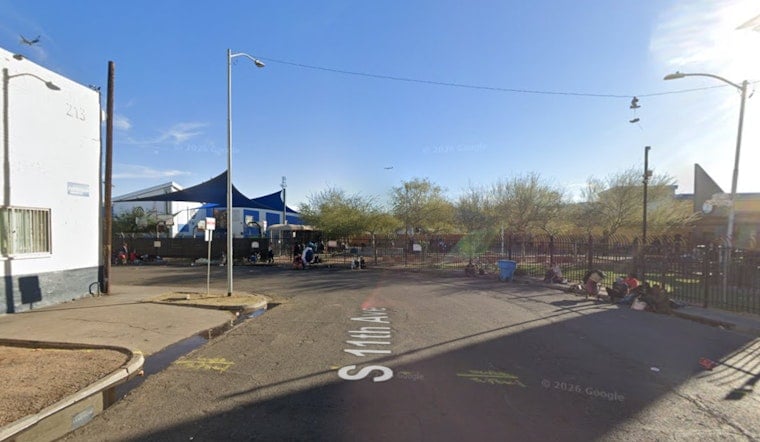
A woman known only as Anna lay on a Phoenix sidewalk near 11th Avenue and Jackson Street on August 1 as the temperature hit 116 degrees, and the scene meant to save her turned into a shoving match. An EMT and three security guards responded from the nearby Key Campus, but a heat gun later registered 140 degrees on the blanket beneath her body, and the confrontation that followed left two homeless advocates pushed onto umbrellas that broke beneath them.
The clash unfolded at what locals still call the Andre House curve, according to Phoenix New Times, which reported that advocates Sophia Elicia and Jessica Spencer were on scene trying to help Anna, who was experiencing possible heat stroke and possible overdose. Elicia held Anna up while firefighters placed ice bags on her body, the outlet reported, and Spencer called 911 during the emergency. The EMT on scene, contracted through a different vendor than the security guards, reportedly attempted to cool Anna without a working thermometer.
Elicia later said the EMT and security guards should have called 911 immediately rather than delaying, per the same account. Instead, Lionheart Security guards — employed to keep emergency scenes clear for first responders — pushed Elicia and Spencer, breaking the umbrellas they were carrying, the outlet reported. The two advocates said they spent about 15 minutes at the scene before firefighters arrived, and they left the area only after firefighters ensured Anna was safe. Firefighters ultimately took Anna to the hospital.
Advocate and Company Give Conflicting Accounts
Elizabeth Venable, another advocate quoted in the report, described the guards' shoving of Elicia and Spencer as assault and said Elicia was right to call 911. Venable also said contractors on the sidewalks around Key Campus often lack proper training. Lionheart Security, for its part, found that its guards acted within protocol, according to the same reporting — a direct conflict in accounts that the dossier does not resolve.
Keys to Change CEO Amy Schwabenlender said the incident occurred off Keys to Change property, drawing a boundary between the nonprofit's 13-acre campus and the public sidewalk where the confrontation took place. Keys to Change, which operates the city-provided Key Campus under contract with Phoenix, itself contracts with Lionheart Security for services on campus grounds. Andre House, an independent nonprofit service provider near the same corner, was not reported to be involved in the altercation itself.
A Sidewalk Shaped by Sweeps and Court Orders
The confrontation happened just two days after Phoenix Police executed a surprise sweep of remaining encampments in the same stretch, arresting seven people on felony charges and citing 18 others for trespassing and camping, according to Phoenix New Times' separate coverage of that operation. The city set up barricades closing the road through the following weekend. Phoenix's Office of Homeless Solutions said it contacted 33 people after the sweep and placed 15 of them into services.
The sweep traces back to a September 2023 ruling by Maricopa County Superior Court Judge Scott Blaney, who found the city maintained a public nuisance by allowing the encampment known as the Zone to flourish and ordered Phoenix to permanently abate street camping there by that November, as Courthouse News reported at the time. The lawsuit had been brought by local business owners citing safety and biohazard concerns. Since the 2023 disbandment, Phoenix has maintained a smaller version of the Zone with fewer people and tents, though tents have crept back into the corridor as shop owners sounded alarms this spring.
Heat Deaths Climbing Across the County
The confrontation over Anna's care landed squarely inside a worsening public health emergency. Maricopa County had confirmed 40 heat-related deaths by late July of this year — more than double the 18 confirmed at the same point in 2025 — while investigating nearly 400 additional suspected heat fatalities, according to Patch. Outdoor exposures accounted for 77% of confirmed 2026 heat deaths through July.
The county's Department of Public Health had recorded 430 heat-related deaths in 2025, a 30% drop from 608 the previous year and down from a record 645 in 2023, with unhoused individuals accounting for 49% of fatalities and 65% involving substance use. Officials attributed that decline to expanded overnight cooling centers and emergency outreach. But this summer marks the final year of federal American Rescue Plan Act funding that has sustained Valley-wide heat relief transportation and cooling center operations, according to the Los Angeles Times, leaving those programs facing a funding cliff just as fatalities climb.
Guard Training and Broader Scrutiny
Unarmed private security guards in Arizona, like those employed by Lionheart, are required under Arizona Revised Statutes Title 32, Chapter 26 to complete an eight-hour basic training curriculum covering use of force, legal limits and ethics before being assigned to a post, per rules enforced by the Arizona Department of Public Safety. Guard registrations must be renewed every two years through state compliance reviews.
Maricopa County counted nearly 10,000 homeless people this year, a population that advocates like Elicia — who runs the Instagram account @unshelteredphx — and Venable say remains acutely vulnerable to sidewalk heat exposure even as the county's overall death toll has trended downward. The scrutiny echoes a February wrongful-death lawsuit against Abrazo Health, which alleged a confused patient was discharged into an Uber to a downtown shelter during extreme heat and died on a nearby sidewalk with a 107°F core body temperature, as Hoodline previously reported. Phoenix officials moved this month to extend the nearby Safe Outdoor Space at 15th Avenue and Jackson Street for three more years, a structured camping lot built to house up to 300 people after the Zone's original clearout.





