

























































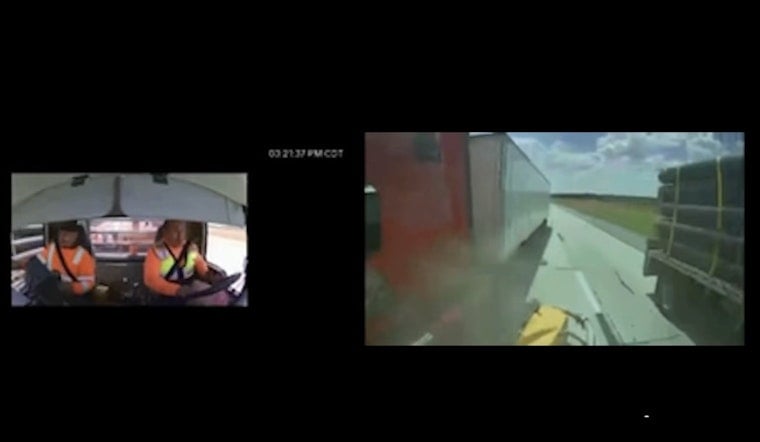
A semi-truck slammed into the back of an attenuator truck shielding a highway work crew in Cotton County, Oklahoma, striking the crash cushion at roughly 50 mph while the convoy crawled along at just 10 mph. One person riding inside the attenuator truck was taken to a nearby hospital, while the semi driver walked away uninjured.
The Oklahoma Highway Patrol released dash cam footage of the collision, according to KOKH, showing the moment a trooper working behind the attenuator truck noticed the semi approaching without appearing to slow down. The trooper quickly changed lanes and ended up alongside the highway, avoiding the impact, per OHP. The attenuator truck had its emergency lights activated at the time of the crash, the agency said.
The semi driver later told OHP he did not realize how slowly the construction crew was traveling before the collision, per the outlet's report. That gap in perception—a driver closing in at highway speed on a convoy moving at a crawl—sits at the center of why work zone crashes involving large trucks remain so dangerous nationwide.
Why the Attenuator Truck Took the Hit
Attenuator trucks, also called crash trucks or TMAs, are deployed specifically to serve as sacrificial buffers ahead of maintenance crews and troopers, absorbing impact energy that would otherwise reach workers or officers on foot. Federal Motor Carrier Safety Administration guidance issued in 2015 even excludes carriers from safety-score penalties when their attenuator trucks are struck as intended, since the vehicles are engineered to be hit, according to the Federal Motor Carrier Safety Administration.
That design appears to have worked as intended in Cotton County. A five-year study by the Texas A&M Transportation Institute examined 181 lane closures using truck-mounted attenuators and found the crash cushions absorbed 62 vehicle impacts with zero worker injuries and only two minor driver injuries, an outcome credited with roughly $51 million in estimated safety savings, per SPA Safety Systems. The crushable honeycomb cartridges inside these trucks collapse on impact specifically to reduce the forces transmitted to an intruding vehicle.
A Familiar Pattern on Divided Highways
Federal Highway Administration data shows nearly 30 percent of all work zone crashes nationwide involve large commercial trucks, with about 60 percent of fatal truck-involved work zone crashes happening on divided highways and almost 90 percent occurring on straight stretches of road, according to Cunningham & Mears. Large trucks need longer stopping distances and have limited room to maneuver once a construction zone narrows the lanes ahead of them, which mirrors the scenario OHP described in Cotton County.
Cotton County sits in rural southwestern Oklahoma, population 5,527 as of the 2020 census, and is crossed by Interstate 44's H.E. Bailey Turnpike along with U.S. Route 70 and U.S. Route 277, according to Wikipedia. Those routes link Lawton and Oklahoma City traffic to the Texas border, funneling a steady stream of commercial trucking through the same corridors where maintenance crews regularly set up mobile operations.
Oklahoma's Move Over Law and the Stakes for Workers
Oklahoma law requires drivers approaching stationary emergency or maintenance vehicles with flashing lights to change lanes or slow down. Known as Bernardo's Law, the statute carries fines starting at $1,000 for a first offense and climbing to $10,000 if an emergency worker is killed, per Cunningham & Mears. The law was renamed in 2021 in honor of tow truck driver Bernardo Martinez, who was killed by a distracted driver.
State figures compiled by research organization TRIP show Oklahoma recorded 141 work zone fatalities between 2020 and 2025, with motor vehicle occupants accounting for 131 of those deaths compared to 10 non-occupant worker fatalities. Separate research from Oklahoma State University's School of Civil and Environmental Engineering found more than 7,100 traffic collisions occurred in Oklahoma highway work zones between 2017 and 2022, causing 91 deaths and over 1,200 injuries, according to Oklahoma State University.
Narrow shoulders compound the risk for crews working these corridors. Oklahoma Department of Transportation records show nearly 5,300 miles of two-lane state highways, or 56 percent of the state's two-lane network, have deficient shoulders offering limited pull-off space, according to the Southwest Ledger. Studies from the AAA Foundation for Traffic Safety found nearly 2,000 people were killed nationwide between 2017 and 2021 while outside a vehicle on a roadway or shoulder, with close to 75 percent of those deaths occurring on high-speed corridors like the ones Cotton County crews were working.
Oklahoma has also moved to address the problem at the driver-education level. In Fiscal Year 2024, the state became the first in the nation to require a work zone and first-responder safety training course for teenage drivers before they can obtain an intermediate license, according to the National Highway Traffic Safety Administration. The Cotton County crash follows a string of recent Oklahoma work zone and roadside incidents, including a predawn Creek County shoulder crash in July that killed a 63-year-old man and invoked the same Move Over statute.


