

























































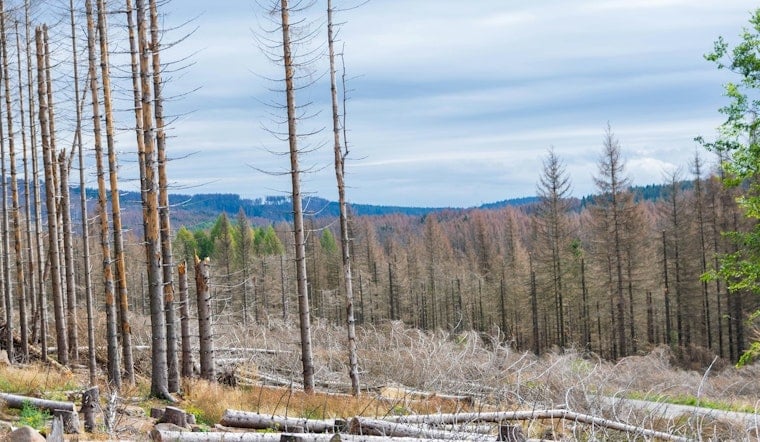
Four years after flames tore through a Sierra National Forest hillside near Mariposa County, the ponderosa pines that once stood there still haven't come back. Instead, researchers surveying the 100-foot plot burned by the 2022 Oak Fire found spiky shrubs and poison oak taking over ground that used to be dense conifer canopy, and they found no ponderosa seedlings at all.
That finding comes from ecologist Winslow Hansen, who directs the Western Fire and Forest Resilience Collaborative, as reported by The New York Times. Hansen described the change bluntly, saying it represents a permanent shift from one ecosystem type to a fundamentally different one, not a temporary setback the forest will eventually recover from. The Oak Fire, which local accounts tied to Mariposa County's history of destructive wildfire, ultimately burned 19,244 acres and destroyed 193 structures, according to a previous Hoodline report on a nearby blaze.
A Regional Pattern Beyond One Hillside
The Oak Fire site is not an isolated case. The Times piece notes that wildfires across the region have already transformed roughly 1,700 acres of ponderosa pine forest into shrubland, and recent studies cited in the same reporting project that Western conifer forests could become as much as 40 percent shrubland by 2100. Ponderosa pine forests across the Southwest are described as particularly at risk of failing to regenerate after fire.
Part of the explanation is speed. A study published in Science Advances that examined roughly 33,000 daily fire-spread events across nearly 3,500 Western wildfires between 2012 and 2023 found that faster-moving fires create larger patches of near-total tree mortality, according to Colorado State University's Warner College of Natural Resources. When fires move fast, they leave fewer surviving edge trees to reseed the interior of the burn scar, and much of the resulting scar ends up far beyond the distance tree seeds can naturally travel. That same study, led by researcher Jonathan Coop, examined almost 3,500 wildfires from 2012 to 2023, per the Times report.
The Times also reported that a second research site, burned by the 2013 Rim Fire, which was California's largest recorded fire at the time, showed markedly different soil conditions than the Oak Fire site. Soil from the Rim Fire location contained roughly four times as much bacteria, six and a half times as much fungus, and one and a half times as much organic matter as soil from the Oak Fire site, along with higher levels of nitrogen and phosphorus. Researcher Johan Eckdahl is working to explain that gap: he has identified around 60,000 different bacteria and fungi so far and plans to swab DNA from nearly 500 soil samples and analyze roughly 260 pounds of dirt collected from summer field sites, hoping to build what the Times described as a microbiological atlas of forest health across the West.
Why Burned Soil Resists New Pines
Underlying that soil difference is a biological mechanism documented separately from the Times reporting. Research on post-fire soil microbiology published in 2022 and 2024 shows that high-severity wildfires destroy ectomycorrhizal fungal networks that conifer seedlings depend on for nutrient uptake, according to research summarized by the National Institutes of Health's PMC archive. That destruction shifts the soil microbiome toward a different type of fungi that favors shrub species over trees, helping explain why burned Sierra ground so often greens up in brush rather than pine.
Climate itself compounds the problem. A 2019 study in the Proceedings of the National Academy of Sciences examining more than 10,000 post-fire plots across the West found that seedling recruitment for ponderosa pine and Douglas fir plummets once annual summer heat and soil moisture cross critical thresholds, as reported by Deccan Chronicle. Adult trees can often tolerate warmer conditions that young seedlings simply cannot survive. Hansen told the Times that ponderosa seeds have adapted over time to fire, but that today's fires are now too hot for them, and Sierra Nevada conifers broadly are not well suited to the current warming climate. Even so, scientists remain uncertain about which pine forests will ultimately survive and which will not, and Sierra Nevada forest regeneration overall has stopped because of more intense fires paired with a warmer, drier climate, per the Times.
A University of California, Berkeley study published in 2022 found that wildfires, severe drought, and bark beetle infestations together destroyed 30 percent of conifer forests in the southern Sierra Nevada between 2011 and 2020, according to Earth.com. That same research found 85 percent of what had been high-density mature forest in the southern Sierra converted to low-density or non-forest vegetation over that decade. Separately, research presented by the Cary Institute of Ecosystem Studies in December 2025 estimated that nearly 38 million hectares across the Western United States remain in a fire deficit from 150 years of fire suppression, even as climate change drives an unsustainable fire surplus in lower-elevation shrublands, according to SciTechDaily.
Water Supplies and Carbon Storage at Stake
The stakes extend well past the trees themselves. Some Western states get as much as 75 percent of their water from snowmelt, and forest loss is expected to cause faster winter and spring snowmelt, per the Times report. U.S. Geological Survey hydrologic data explains why: post-fire loss of forest canopy alters snowpack shading, which accelerates melt timing and shifts when water reaches downstream reservoirs and farms that depend on that gradual release. Conifer forest loss also reduces the landscape's capacity to store carbon dioxide, according to the Times, adding a climate feedback on top of the water supply concern. Western wildfires themselves are simply getting bigger and hotter, the newspaper reported, and survey crews are currently mapping fire severity at more than 100 sites across California, Colorado and New Mexico as part of that broader research effort, which involves 40 researchers under the Western Fire and Forest Resilience Collaborative.
Planting Trees Built for a Hotter Future
Federal policy has started shifting in response. The U.S. Forest Service established formal frameworks in 2023 and 2024 for what it calls Forestry Assisted Migration, allowing land managers to relocate seeds and seedlings from lower elevations or warmer southern regions to burn scars at higher elevations, according to research published in Frontiers in Forests and Global Change. That approach reflects a break from traditional local-seed planting rules that assumed a stable climate no longer holds true. The 2021 Bipartisan Infrastructure Law's REPLANT Act removed statutory funding limits on the Forest Service's Reforestation Trust Fund, aiming to scale the agency's annual replanting target from 60,000 acres to 400,000 acres nationwide, per American Forests' account of the legislation.
Assisted migration experiments are already underway in California and Washington state, the Times reported. In western Montana, conservationists working with The Nature Conservancy and researcher Kimberley Davis planted western larch seedlings sourced from an elevation of 3,400 feet into burned sites between 4,600 and 6,200 feet, testing whether trees from warmer ground can take root higher up. Those lower-elevation seedlings grew better than seedlings sourced from higher elevations, the Times reported. Western larch can eventually reach 200 feet tall. Davis told the Times that keeping as many live trees as possible on the landscape when it burns is really important, since surviving trees are what allow natural reseeding to happen at all.
Forests do retain some innate resilience under normal circumstances, per the Times report, but the compounding pressures of faster fires, drier soil, and disrupted fungal networks are testing the limits of that resilience across the region. Separately, the Cary Institute in August 2026 received a $2.7 million grant from Lyda Hill Philanthropies to expand fire modeling into Western shrublands and grasslands, noting that 90 percent of the 20 fastest-moving U.S. wildfires between 2001 and 2020 occurred in those non-forest ecosystems, according to a Cary Institute press release. For Mariposa County and other Sierra foothill communities that have already lived through fires like the Oak Fire, the open question is whether replanting efforts can outpace a landscape that increasingly regrows as brush rather than forest.




