

























































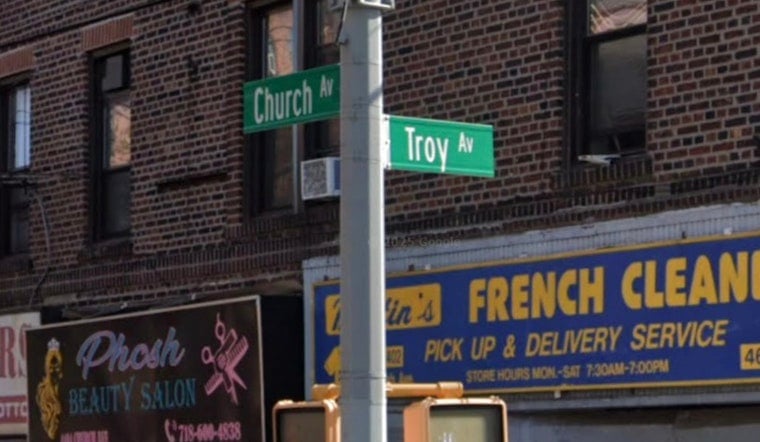
Six people were injured in a crash at the corner of Troy and Church Avenues in East Flatbush, according to firefighters on the scene Sunday. The cause of the crash has not been determined, and the extent of the victims' injuries has not been released.
The collision was first reported by News 12 Brooklyn, which cited firefighters describing the scene at the intersection. No further details about the vehicles involved or how the crash unfolded have been made public as of Monday.
The intersection sits along a stretch of Church Avenue that the city has flagged for years as uniquely hazardous. Church Avenue is designated a Vision Zero Priority Corridor by the New York City Department of Transportation because of its long history of traffic injuries and collisions, a status tied to the heavy commercial traffic and frequent double-parking that create high-conflict conditions along the avenue, according to reporting from the Brooklyn Eagle.
A Neighborhood With an Outsized Crash Rate
The crash lands in a neighborhood that already ranks among the city's most dangerous for drivers, cyclists, and pedestrians alike. A June 2026 study by the Center for an Urban Future found that East Flatbush records a serious crash rate of 67.0 per 10,000 residents, well above the citywide average of 47.0 per 10,000. That same research noted that eight of the ten highest-risk neighborhoods in New York City are lower-income communities of color.
Brooklyn as a whole led all five boroughs in crash volume, recording 22,890 motor vehicle collisions and 49 traffic fatalities in 2023, per an analysis of city transportation data conducted by law firm AEE Law. The borough routinely accounts for roughly a quarter of all motor vehicle crashes citywide, per that same analysis.
Police Presence Hasn't Solved the Problem, Advocates Say
The 67th Precinct, which covers East Flatbush, is far from an inactive command when it comes to traffic enforcement. Officers there performed 40,376 vehicle stops during 2024, according to an analysis of NYPD data published by the Brooklyn Eagle, one of the highest totals among Brooklyn precincts that year. The precinct also received the NYPD Chief of Transportation's Vision Zero award in 2023 after recording zero traffic-related fatalities that year, one of only seven citywide commands honored.
Yet a 2026 report by the Center for an Urban Future found that outer-borough neighborhoods including East Flatbush, East New York, and Canarsie have received significantly fewer neighborhood slow zones and protected bike lanes than Manhattan or North Brooklyn, despite their higher crash rates, as reported by News 12 Connecticut. Transportation officials have pledged to use future City Streets Plans to automatically direct funding toward high-risk areas, the outlet noted.
A History of Pushing for Change on This Corridor
This is not the first time Church Avenue's dangers have drawn public attention. In 2019, safe street advocates and local residents held rallies along the avenue demanding rapid traffic safety upgrades following repeated pedestrian and cyclist collisions, urging the city to accelerate roadway redesigns, according to the Brooklyn Eagle. The city did respond with some physical changes nearby, adding concrete curb extensions on Linden Boulevard at Troy Avenue and East 48th Street to shorten pedestrian crossings and calm turning vehicles, per the NYC Department of Transportation.
More recently, the city and the MTA opened public outreach in 2026 for a broader street safety and rapid transit redesign spanning Church Avenue, Flatbush Avenue, and Utica Avenue in Central Brooklyn, according to the NYC Department of Transportation. Church Avenue carries heavy bus ridership and high traffic volume through East Flatbush, making it a focal point of that planning effort.
No further information about Sunday's crash, including how many vehicles were involved or whether any charges are anticipated, has been released. Hoodline previously reported on the disparities in street safety investment facing neighborhoods like East Flatbush in its coverage of the Center for an Urban Future findings earlier this summer.





