

























































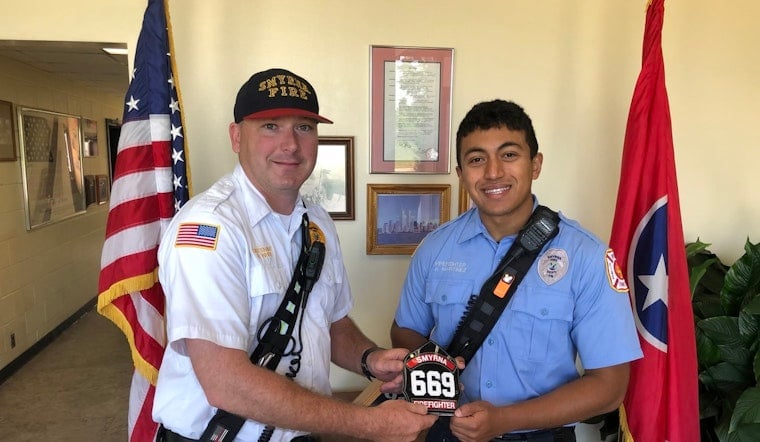
A 911 call dispatched as a seizure turned out to be something far more dire when Smyrna Fire Department Firefighter Alfred Martinez and Engineer Christopher Surber arrived and found the patient had no pulse. What followed was a rapid sequence of CPR, ventilations and a defibrillator shock that brought the person back to life, and by the time they reached the hospital, the patient was conscious and talking.
The department honored Martinez and Surber for their handling of the emergency, according to Smyrna, TN Fire Department. The two recognized that the patient was in cardiac arrest rather than experiencing a seizure, began high-quality CPR and ventilations, applied an AED, and worked alongside Rutherford County EMS to deliver a lifesaving shock. The patient regained a pulse, started breathing independently, and was talking upon arrival at the hospital, the department said.
Why a Cardiac Arrest Call Can Look Like a Seizure
The initial seizure dispatch is not unusual in cases like this one. Clinical research compiled by the National Center for Biotechnology Information shows that 10% to 15% of out-of-hospital cardiac arrest patients display brief seizure-like muscle twitches during initial collapse, caused by sudden cerebral oxygen deprivation. That convulsive activity often leads 911 dispatchers to initially categorize the event as a seizure, which is why the crew's quick reassessment of the patient's pulse once on scene proved so critical.
Updated 2025 guidelines from the American Heart Association state that immediate high-quality bystander or first-responder CPR combined with early AED defibrillation can double or triple a cardiac arrest victim's chance of survival, and that every minute defibrillation is delayed reduces survival probability by roughly 10%. National data from the Cardiac Arrest Registry to Enhance Survival, cited by the American Red Cross, shows overall survival to hospital discharge for out-of-hospital cardiac arrest treated by EMS in the United States remains at approximately 10.5%. Against that backdrop, a patient who regained a pulse, resumed breathing on their own, and was talking by the time they reached the hospital represents an unusually strong outcome.
A Department Built for Rapid Response
Smyrna Fire Department employs 108 trained firefighters operating from multiple stations and maintains an ISO Class 3 public safety rating, according to the Town of Smyrna, TN. Its firefighters frequently act as advanced or basic life support first responders ahead of ambulance arrival, a structural arrangement that reflects interlocal cooperation agreements across Rutherford County municipalities designed to ensure the closest trained unit reaches high-acuity calls immediately, per the City of Murfreesboro.
That framework matters because Rutherford County EMS is stretched thin. The agency responds to between 100 and 130 emergency calls daily across a 619-square-mile coverage area, relying on just 17 to 18 active emergency vehicles to serve a population of roughly 370,000 residents, per WGNS Radio's reporting. With that volume of calls, a fire crew capable of starting CPR and applying an AED within minutes of arrival can determine whether a patient survives long enough for an ambulance to take over.
This is not the first time Smyrna Fire and Rutherford County EMS crews have coordinated on a life-or-death call. The two agencies were jointly recognized with state life-saving awards in May 2026 for a successful joint resuscitation of an infant in cardiac arrest, according to WGNS Radio, underscoring an established pattern of seamless handoffs between the two agencies during medical emergencies.
Growth Is Straining the System
The county broke ground in July 2026 on northern Rutherford County's first new emergency medical station in more than two decades, located at 267 Weakley Lane in Smyrna. The project is meant to shorten response times amid rising 911 call volumes driven by rapid residential and industrial growth in the northern part of the county. It's the kind of infrastructure investment local officials say is necessary as Smyrna keeps expanding faster than emergency services can easily keep pace.
Smyrna Fire Chief Brian Goss was named 2026 Tennessee Fire Chief of the Year in August, a recognition that reflects the operational standard of the department whose crew performed the resuscitation. Goss also serves as International Director on the Southeastern Association of Fire Chiefs board. Rutherford County also operates a Text-to-911 dispatch system that lets residents text emergency details when verbal communication is impossible or unsafe, a service Hoodline previously reported routes real-time location data directly to responding fire and EMS units.





