

























































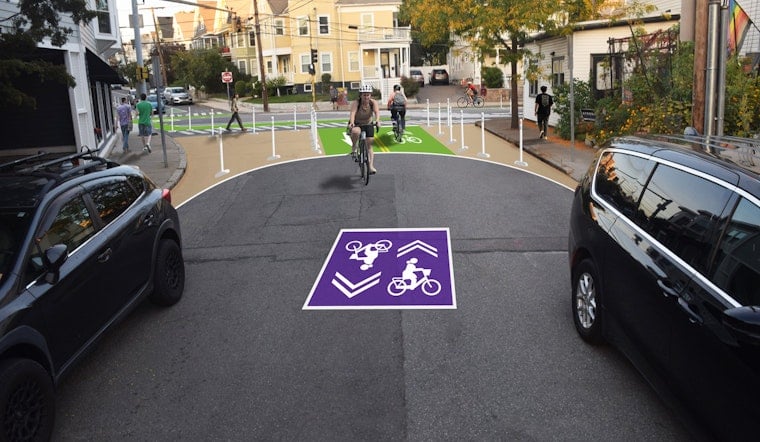
Construction crews rolled into the Elm and Beacon streets corridor this week, kicking off a major street safety project that will reshape how cars, bikes, and pedestrians share the roads between Somerville and Cambridge. The Elm-Beacon Connector project, first announced in April 2026, includes new bike lanes, a signage overhaul, and changes to traffic signal timing designed to calm one of the area's most crash-prone stretches.
James Rojas of WBZ NewsRadio reported that the project also involves the removal of flashing crosswalk signs and the addition of new stop signs along Elm and Beech streets. Residents who spoke with the station described longstanding safety concerns about the corridor. “The area has trucks, people on bikes, and people trying to cross,” said a resident named John. Another resident, Angie, put it more bluntly: the area “is not exactly safe in the long run.”
The concerns track with the data behind the project. Somerville's Bicycle Network Plan, which drew on five years of crash data from 2017 to 2021, found that Elm Street and Somerville Avenue ranked among the city's highest-risk bicycle corridors, averaging 19 and 22 bike-related crashes per mile respectively, according to the City of Somerville. Both streets ranked in the top tier of municipal roads for overall traffic incidents and cyclist collisions, the plan noted.
A Legal Mandate Behind the Construction
The Elm-Beacon Connector is the first major street safety redesign built under Somerville's Safe Streets Ordinance, which the city announced in July 2026 mandates quick-build safety redesigns along high-priority transit corridors. Somerville officials are aiming to finish the quick-build phase — using non-structural materials like painted pavement markings, flex posts, and signal timing changes rather than years of structural reconstruction — by Thanksgiving, per Cambridge Day.
Protected bike lanes are planned for three separate segments: Elm Street from Russell Street to Somerville Avenue, Beacon Street from Somerville Avenue to Oxford Street, and Somerville Avenue from the Cambridge city line to Elm Street. The city says the connected network is meant to link the commercial hubs of Davis Square and Porter Square.
Mossland Street Dead-End Could Push Traffic Elsewhere
One of the more consequential changes involves Mossland Street, which will be converted into a dead-end for motor vehicles at Elm Street to create a two-way “Neighborway” for cyclists. Traffic modeling cited by the Cambridge & Somerville Independent projects that roughly 160 additional vehicles per hour could be diverted onto Somerville Avenue as a result, though fire trucks and other emergency vehicles will retain two-way access through the barrier.
Beyond the new stop signs, the project will modify traffic signal timing at three major intersections — Beacon Street at Somerville Avenue, Somerville Avenue at Elm Street, and Elm Street at Cedar Street — and install centerline hardening along Elm and Beacon streets to stop drivers from cutting through crosswalks, according to city officials.
Parking Losses and Cambridge's Beech Street Redesign
The project isn't without tradeoffs for nearby residents. Cambridge officials said an estimated six residential permit parking spots near the Beech Street bend will be removed as part of the redesign. To offset losses on Elm and Beech streets more broadly, Somerville is adding replacement parking on Russell Street and Cutter Avenue along with new loading zones and a designated pickup and drop-off area near the Kennedy School, addressing parent drop-off congestion that came up during community engagement sessions.
On the Cambridge side, the Beech Street component will convert the intersection at Elm Street into a T-shaped layout and shrink the pedestrian crossing distance from roughly 130 feet down to 60 feet, according to the City of Cambridge. The redesign will also close the intersection's southeast corner to motor traffic, opening space for a future public plaza. Cambridge expects to begin its installation toward the end of Somerville's construction phase, in late summer or fall, and estimates its portion will take three to four weeks to complete.
Part of a Broader Vision Zero Push
City officials frame the corridor overhaul as part of Somerville's Vision Zero initiative, a policy aimed at eliminating traffic deaths and severe injuries. Mayor Jake Wilson noted in July that the initiative has helped the city maintain a multi-year period without a traffic fatality. For residents like John and Angie, who have watched trucks, cyclists, and pedestrians compete for space on Elm Street for years, the construction now underway is the first tangible sign that city hall is responding to those long-simmering concerns.





