

























































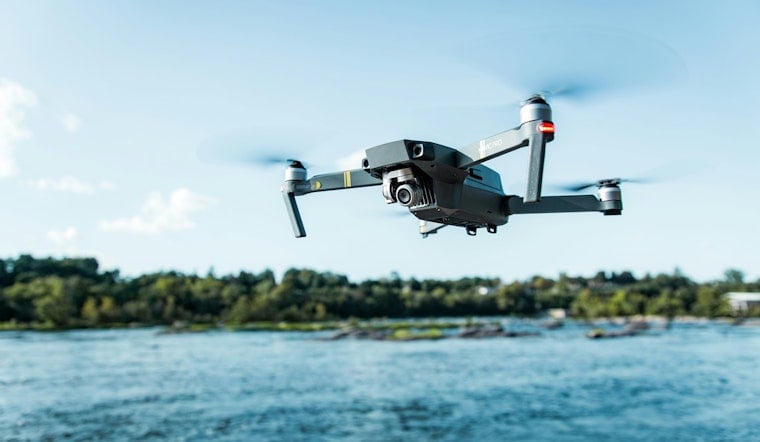
St. Louis County Police plan to launch a drone program in October, starting with three unmanned aircraft that can reach the scene of an emergency in as little as 90 seconds. The department eventually intends to expand the fleet to six drones stationed throughout the county, following the model of the BRINC Responder drone, a US-built aircraft capable of live video streaming, thermal imaging, and even delivering lifesaving medication for overdoses.
The rollout comes after the St. Louis County Board of Police Commissioners approved a memorandum of understanding for the drone initiative during an August 11 meeting that also covered board appointments and federal grant approvals, according to Hoodline. The department's first drone will be stationed on property belonging to the North County Fire and Rescue Protection District, as reported by St. Louis Post-Dispatch reporter Kelsey Landis. A second drone will be housed at the department's North County Police Precinct, and a third will go up at the Affton Southwest Precinct, per the same report.
Police say the drones will be used to follow car and foot chases and to relay early information to officers before they arrive on scene. The Regional Information and Intelligence Center will decide when to launch and operate the aircraft, according to the Post-Dispatch. Capt. Shanna Ostendorf, chief of intelligence operations for the St. Louis County Police Department, said the drones will hover above a scene and that most people probably will not know they are there — though she added that the drones will not hover above somebody's house.
What the BRINC Responder Can Actually Do
The drone model St. Louis County plans to use initially, the BRINC Responder, can be launched from a spot as small as a convenience store parking lot and can zoom in on a scene from hundreds of feet away, per the Post-Dispatch's reporting. Manufacturer specifications reviewed by BRINC Drones list up to 42 minutes of flight time, a 40x zoom camera, thermal imaging, a 98 dB loudspeaker, emergency lights and sirens, 4G LTE teleoperation, and a mechanical release system that can drop supplies like Narcan or EpiPens. BRINC, a Seattle-based aerospace company, is also building out a system designed to give first responders more information before they even arrive at a scene, according to the Post-Dispatch.
The program carries no cost in its first year but is projected to cost $67,000 in its second year, per the newspaper's report. St. Louis County police did not immediately detail how the aircraft's two-way communication features will be used beyond monitoring and responding to emergencies.
A Regional Push Toward Automated Response
St. Louis County's launch fits into a broader eastern Missouri trend. Neighboring St. Charles County formed a multi-agency Regional Drone Unit across six police departments in February 2024 and, in May 2026, announced plans to use drones to respond to 911 calls directly, according to the St. Charles County Police Department. Inside St. Louis County itself, the Webster Groves Police Department operationalized an FAA-certified drone unit in January with four certified officers and two thermal-imaging drones for tactical overwatch, a program Hoodline previously covered. Kirkwood police also flew a loudspeaker-equipped drone over the city's Freedom Festival in July to monitor crowds and deter illegal fireworks.
Nationally, the shift toward these so-called Drone as First Responder programs accelerated after the Federal Aviation Administration reworked its regulatory waiver process in May 2025, approving more than 400 Beyond Visual Line of Sight waivers within two months, according to the Electronic Frontier Foundation. Industry data reported by Motorola Solutions puts the number of police drone programs nationwide at roughly 6,000 by 2026, a fourfold increase driven largely by the move to automated DFR models. Federal supply-chain rules that took effect at the end of 2025 also restricted market access for the foreign manufacturer DJI without security audits, a shift that accelerated adoption of domestic makers like BRINC, per the same EFF reporting.
Privacy Questions Remain Unresolved by State Law
Missouri law does not require police to obtain a warrant before flying a drone. Legislation known as the Preserving Freedom from Unwarranted Surveillance Act has repeatedly failed to pass the Missouri General Assembly since 2013, according to the Unmanned Safety Institute. Separately, Missouri Revised Statutes Section 577.800 explicitly exempts law enforcement officers, firefighters, and emergency medical personnel from state criminal penalties for flying unmanned aircraft within 400 feet over open-air facilities and critical infrastructure while performing official duties.
Maya Stanley, a senior policy analyst with the American Civil Liberties Union, said drones could have chilling effects on First Amendment rights. St. Louis already has at least one neighborhood using drones to patrol streets at night, according to the Post-Dispatch's reporting, underscoring how aerial surveillance has already crept into everyday life in the region well ahead of any statewide guardrails. With state lawmakers unwilling to mandate warrants, oversight of how St. Louis County's drones are used — and where they are permitted to hover — will rest largely with the Board of Police Commissioners and the Regional Information and Intelligence Center rather than any statutory requirement.



