

























































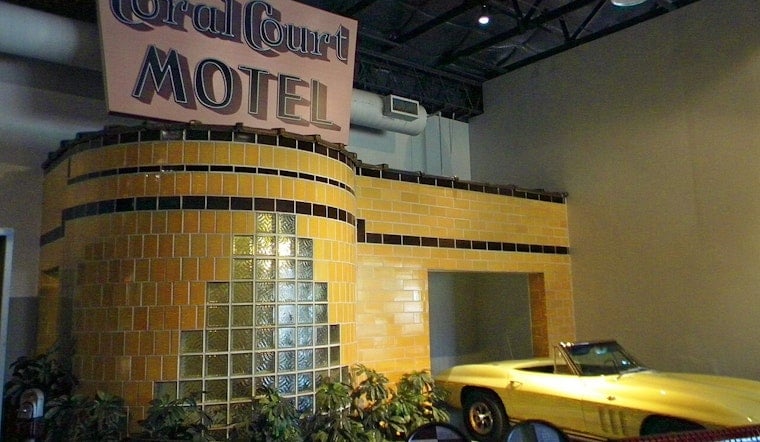
While most Route 66 centennial celebrations this year lean into neon signs and roadside nostalgia, a new exhibition opening August 22 at the National Building Arts Center in Sauget, Illinois, is taking a harder look at what the highway actually did to St. Louis. Called “City 66: The Other Road,” the show reframes Route 66 not as an open-road fantasy but as an urban corridor that reshaped city streets, displaced neighborhoods, and left a complicated legacy still debated today.
The exhibition includes historically relevant architectural artifacts, some of which have never been publicly displayed before, according to St. Louis Magazine. Among the featured pieces is a salvaged fragment of the Coral Court Motel, the Streamline Moderne icon built on Watson Road in Marlborough in 1941 that earned a spot on the National Register of Historic Places in 1989 before it was demolished in 1995 to make way for a residential development, per Wikipedia. The show also includes an entrance salvaged from a downtown office building, another physical reminder of the urban fabric that Route 66-era development tore through.
The exhibition is curated by Michael Allen, a former Washington University professor who also served as the National Building Arts Center's first director, the magazine's report notes. Allen examines both the positive and negative effects Route 66 had on St. Louis, aiming to understand the highway's power to produce change in both directions.
How Route 66 Reshaped the City Grid
Route 66 passed directly through downtown St. Louis, helping draw traffic into the urban core during its peak decades. City leaders had begun considering the highway a potential benefit as far back as 1921, and federal Route 66 designations later jumpstarted their plans for roads connecting downtown to the growing suburbs, per the St. Louis Magazine account. The highway itself became fused with existing city streets and neighborhoods rather than existing as a separate corridor.
At its peak, the route crossed the Mississippi River via the Chain of Rocks and McKinley bridges and connected to Chouteau Avenue, Tucker Boulevard, Chippewa Street, Manchester Road, and Gravois, according to the Missouri Department of Transportation. City planners eventually expanded Gravois into a six-lane, highway-like road, and it now carries a reputation as the deadliest road in St. Louis, per the same St. Louis Magazine reporting. The highway changed the face of old urban neighborhoods, and Route 66's legacy remains hotly debated today.
A Highway Made Obsolete by Interstates
Route 66's dominance did not last. Interstate highway construction eventually diverted traffic away from downtown St. Louis, and the interstate system ultimately made Route 66 itself obsolete, the magazine's account states. That shift mirrors the broader national arc of the highway, which was officially established in November 1926 as a 2,448-mile corridor including roughly 317 miles through Missouri, according to Route 66 Missouri centennial materials. Route 66 affected the development of St. Louis throughout the entire 20th century, well beyond its years as a functioning federal highway.
Free Opening Symposium Features Multiple Scholars
The exhibition opens August 22 with a free symposium featuring guest speakers examining underreported aspects of the highway's history. Scheduled speakers include Mike Jackson on Route 66 terra cotta materials, Anne Walker on Metro East Black-owned businesses and Green Book listings, and Michael R. Allen on urban automobility, according to the National Building Arts Center. An opening reception follows at 2 p.m. that same day at the center's Sauget location, and the exhibition itself runs through October 17.
The National Building Arts Center sits on a 15-acre former steel casting foundry and stewards more than 150,000 architectural artifacts, making it the largest collection of building arts materials in the United States, according to Atlas Obscura. Late founder Larry Giles acquired the former Sterling Steel Casting Company facility in 2005 to house the salvaged urban fragments he had begun collecting back in 1982, formally donating his collection in 2002. Giles spent decades rescuing St. Louis architectural history from demolition sites before his collection became the institutional backbone of the center.
New Leadership and a Citywide Art Partnership
The exhibition arrives as the institution itself is in transition. In January, the center appointed former Washington University landscape architecture professor Eric Ellingsen as its first full-time Executive Director, succeeding interim director Mike Jackson, per the center's own announcement. The National Building Arts Center is also serving as an official anchor site for Counterpublic 2026: Coyote Time, a major St. Louis public art triennial running from September 10 through December 13, according to the Biennial Foundation.
Public programming tied to the exhibition extends beyond the gallery walls. A guided “City 66: The Other Road Bus Tour” is scheduled for October 3, giving visitors a chance to see the city streets and river crossings discussed in the show firsthand, according to an Eventbrite listing. The center previously partnered with the Pulitzer Arts Foundation on the 2023–2024 exhibition “Urban Archaeology: Lost Buildings of St. Louis,” also curated by Allen, which explored similar themes of urban transformation through salvaged architectural fragments, per ArchDaily.
The new show adds a more critical thread to a centennial year that has largely celebrated Route 66's neon and chrome, a trend Hoodline covered in its earlier centennial coverage. Where that celebratory framing focused on roadside diners and retro signage, “City 66: The Other Road” asks St. Louis visitors to reckon with the neighborhoods, streets, and buildings the highway left behind.




